

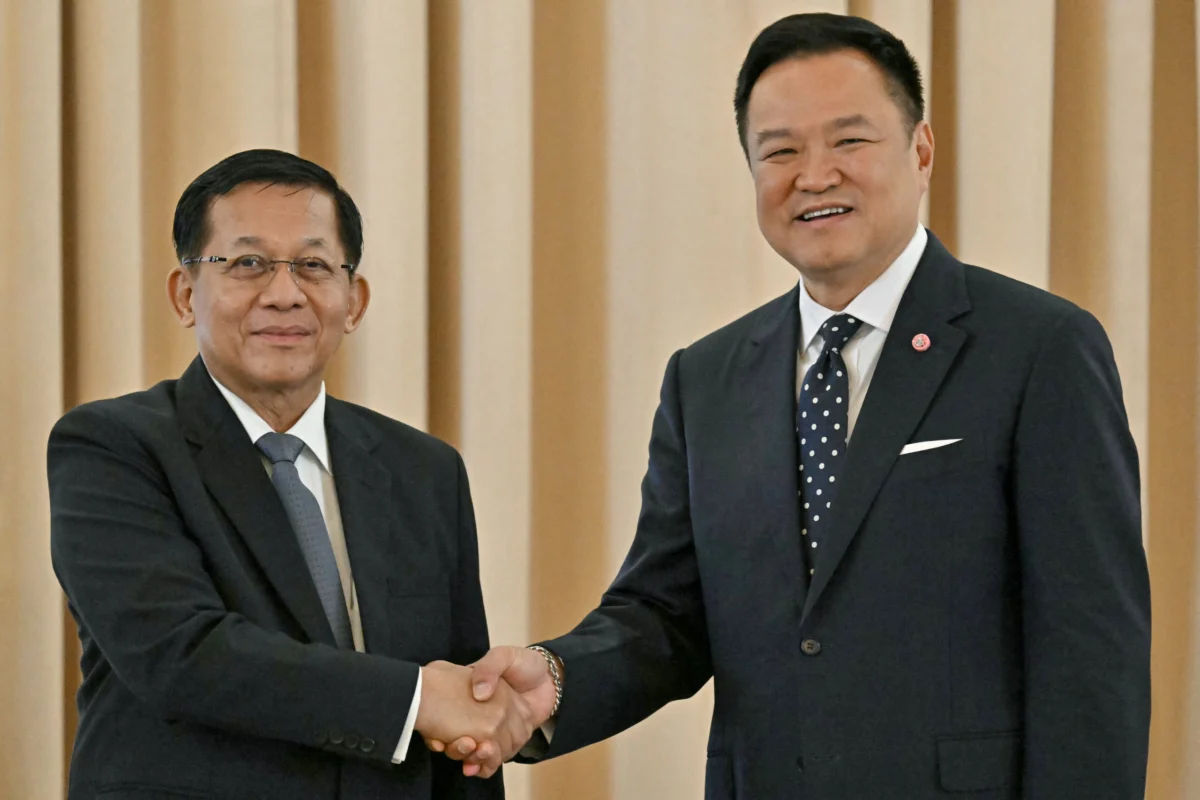
The head of Myanmar’s military-backed government, Senior General Min Aung Hlaing, embarked on his first official visit to Thailand since seizing power in a coup in 2021, meeting with Thai Prime Minister Anutin Charnvirakul in Bangkok. The high-profile visit, which took place on Thursday, comes more than five years after the military takeover plunged Myanmar into a devastating civil war and aimed to bolster the junta’s international standing and secure economic lifelines amidst widespread condemnation and sanctions. Min Aung Hlaing emphasized his administration’s commitment to resolving the protracted conflict and restoring peace to the resource-rich nation, asserting that Myanmar was "now reestablished on the path to democracy and is moving toward a better future." He further stated, "As the new government, we have now begun working on national stability, peace, and national reconciliation."
A Bid for Legitimacy Amidst Unrest
The visit represents a significant diplomatic outreach by the State Administration Council (SAC), the governing body formed by the military junta, which has faced severe international isolation since the February 1, 2021, coup. The coup ousted the democratically elected government of Aung San Suu Kyi’s National League for Democracy (NLD) and triggered a nationwide armed resistance movement. According to the Armed Conflict Location & Event Data (ACLED) project, the ensuing civil war has claimed over 100,000 lives, a figure that continues to climb as clashes intensify across multiple fronts. Beyond the tragic death toll, the conflict has displaced more than 2.5 million people internally and forced hundreds of thousands more to seek refuge in neighboring countries, exacerbating an already dire humanitarian crisis. The United Nations Office for the Coordination of Humanitarian Affairs (OCHA) estimates that nearly 18 million people, or one-third of Myanmar’s population, are in need of humanitarian assistance.
Min Aung Hlaing’s strategic visit to Thailand, a key regional player and significant investor in Myanmar, signals a concerted effort by the junta to break free from its pariah status. It also underscores an attempt to garner a semblance of legitimacy, particularly following a widely criticized election earlier this year. In April, Min Aung Hlaing was sworn in as president after an election that UN experts and numerous international observers unequivocally dismissed as a "sham," designed solely to entrench military rule. Western governments, including the United States, the United Kingdom, and the European Union, have consistently condemned the coup and the subsequent human rights violations, implementing targeted sanctions against Min Aung Hlaing, his associates, and military-affiliated entities. These sanctions aim to cripple the junta’s financial resources and restrict its ability to acquire arms, but their effectiveness in altering the military’s behavior remains a subject of ongoing debate.
Thailand’s "Calibrated Re-engagement" and Economic Imperatives
Thailand, sharing a 2,400km (1,500-mile) border with Myanmar, finds itself in a delicate geopolitical position. As one of Myanmar’s top foreign investors, with substantial stakes in energy, infrastructure, and trade, Bangkok has advocated for a "calibrated re-engagement approach" with its troubled neighbor. This policy reflects Thailand’s complex interests, which include maintaining border stability, managing refugee flows, safeguarding economic investments, and addressing transnational issues such as drug trafficking and illegal migration. The Thai government, under Prime Minister Anutin Charnvirakul, has expressed a desire to facilitate dialogue and humanitarian assistance, positioning itself as a potential bridge between the isolated junta and the broader international community, or at least its regional counterparts.
Following their meeting, both leaders addressed the Thailand-Myanmar Business Forum, highlighting the economic dimension of the visit. Prime Minister Anutin affirmed that Thailand and Myanmar were poised to "step into the new chapter of economic cooperation that is built upon mutual trust and benefit for the people of the two countries." Min Aung Hlaing, in turn, extended an invitation to attendees, assuring them they could "invest with confidence" in Myanmar’s diverse sectors, including energy, agriculture, manufacturing, healthcare, and technology. This appeal for foreign investment comes at a time when Myanmar’s economy has been severely battered by the civil war, international sanctions, and mismanagement, experiencing significant contractions and a sharp decline in foreign direct investment since the coup. The junta is desperate for economic lifelines to fund its military operations and maintain a semblance of state functionality.
Timeline of Turmoil: From Coup to Civil War
The current crisis in Myanmar has its roots in the military’s long-standing dominance over civilian politics and its refusal to accept democratic outcomes.
- November 2020: The NLD, led by Aung San Suu Kyi, secures a landslide victory in general elections, a result the military disputes, alleging widespread fraud without providing credible evidence.
- February 1, 2021: The military, under Min Aung Hlaing, stages a coup, detaining Aung San Suu Kyi, President Win Myint, and other senior NLD figures. The military declares a state of emergency and establishes the State Administration Council (SAC).
- February-March 2021: Mass protests erupt across Myanmar, met with brutal force by the military, leading to hundreds of civilian deaths and thousands of arrests. This crackdown fuels the formation of local People’s Defense Forces (PDFs).
- April 2021: ASEAN convenes an emergency summit in Jakarta, where Min Aung Hlaing agrees to a Five-Point Consensus (FPC) to resolve the crisis, including an immediate cessation of violence, dialogue among all parties, appointment of an ASEAN special envoy, humanitarian assistance, and a visit by the special envoy to Myanmar.
- Mid-2021 onwards: The SAC largely fails to implement the FPC. Violence escalates as PDFs, often aligning with ethnic armed organizations (EAOs), launch widespread resistance against the junta. The National Unity Government (NUG), formed by ousted lawmakers and anti-junta activists, declares a "defensive war."
- Late 2021: ASEAN, frustrated by the SAC’s non-compliance, takes the unprecedented step of barring Min Aung Hlaing from its summits.
- 2022-2025: The civil war intensifies, marked by widespread human rights abuses, including aerial bombardments, arson attacks on villages, and targeted killings. The conflict spreads to nearly all of Myanmar’s states and regions.
- October 2023: A coalition of EAOs, known as the Three Brotherhood Alliance, launches "Operation 1027" in northern Shan State, marking a significant offensive that captures numerous military outposts and towns, shifting the momentum of the conflict.
- April 2026: Min Aung Hlaing is sworn in as "president" following an internationally condemned election, further solidifying the military’s nominal control despite ongoing widespread resistance.
- This week (Thursday): Min Aung Hlaing visits Thailand, seeking to mend diplomatic ties and attract investment.
Outcry and Condemnation: The Opposition’s Perspective
The visit has predictably drawn sharp criticism from activist groups and opposition movements. Justice For Myanmar, a prominent advocacy group, vehemently condemned the trip, asserting that it lends "false legitimacy" to Min Aung Hlaing and the ruling generals. The group highlighted the junta’s ongoing atrocities and called on Thailand and other international actors to cease any engagement that could be perceived as normalizing military rule. Outside the United Nations regional headquarters in Bangkok, about a dozen demonstrators gathered to protest the visit, holding placards denouncing Min Aung Hlaing as a "criminal" and asserting that he was unwelcome in Thailand. These protests underscore the deep-seated anger and rejection of the junta’s authority, both domestically and among the Myanmar diaspora.
The National Unity Government (NUG), which considers itself the legitimate representative of the Myanmar people, has consistently called on international governments to refrain from engaging with the SAC, arguing that such interactions undermine democratic efforts and prolong the conflict. While the NUG did not issue an immediate official statement regarding the Bangkok visit, its consistent stance implies a strong condemnation of any moves that might grant the junta international recognition.
The Plight of Aung San Suu Kyi and Human Rights Concerns
Amidst these diplomatic maneuvers, the fate of Aung San Suu Kyi remains a poignant symbol of Myanmar’s democratic reversal. Overthrown in 2021 and subjected to a series of politically motivated trials, she remains under house arrest, serving a lengthy prison sentence. Her limited contact with the outside world has been a constant source of concern for her supporters and international human rights organizations. On Monday, she was reportedly allowed to meet a representative of the International Committee of the Red Cross (ICRC), a development cautiously welcomed by her son, Kim Aris. However, Aris cautioned that he had not yet received independent confirmation of his mother’s condition or wellbeing, reflecting the opacity surrounding her detention. Critics quickly characterized this rare meeting as a calculated "government stunt" aimed at rehabilitating the junta’s severely tarnished image, particularly in the context of the current diplomatic push. The military has consistently denied access to Suu Kyi for independent observers and diplomats, raising concerns about her health and treatment.
Broader Implications for Regional Stability and Humanitarian Crisis
The visit of Min Aung Hlaing to Thailand carries significant implications for regional stability and the ongoing humanitarian crisis. For Thailand, balancing its economic interests with the moral imperative to address human rights abuses and the regional security risks posed by the civil war is a formidable challenge. A deeper engagement with the SAC, while potentially offering some economic benefits and a channel for communication on border issues, risks alienating the international community and human rights advocates, potentially undermining Thailand’s own standing.
For ASEAN, the visit highlights the enduring divisions within the bloc regarding its approach to Myanmar. While some member states advocate for continued isolation and pressure on the junta, others, like Thailand, favor engagement, albeit "calibrated." This divergence has severely hampered ASEAN’s ability to act cohesively and effectively implement its own Five-Point Consensus, raising questions about the organization’s capacity to address internal crises among its members. The failure of the FPC to yield any meaningful progress has left ASEAN’s credibility wounded and its commitment to democratic values under scrutiny.
Ultimately, Min Aung Hlaing’s visit to Bangkok is a strategic move to project an image of control and legitimacy, both domestically and internationally. It seeks to secure crucial economic partnerships and potentially pave the way for a return to regional diplomatic forums. However, with the civil war showing no signs of abating, the humanitarian catastrophe deepening, and international condemnation remaining firm, the junta’s path to genuine recognition and lasting peace remains fraught with immense challenges. The visit, while offering a temporary diplomatic spotlight, does little to address the fundamental grievances that continue to fuel the armed resistance and the profound suffering of the Myanmar people. The international community, meanwhile, continues to grapple with the complex dilemma of how to effectively respond to a crisis that threatens to destabilize not just Myanmar, but the entire Southeast Asian region.
