

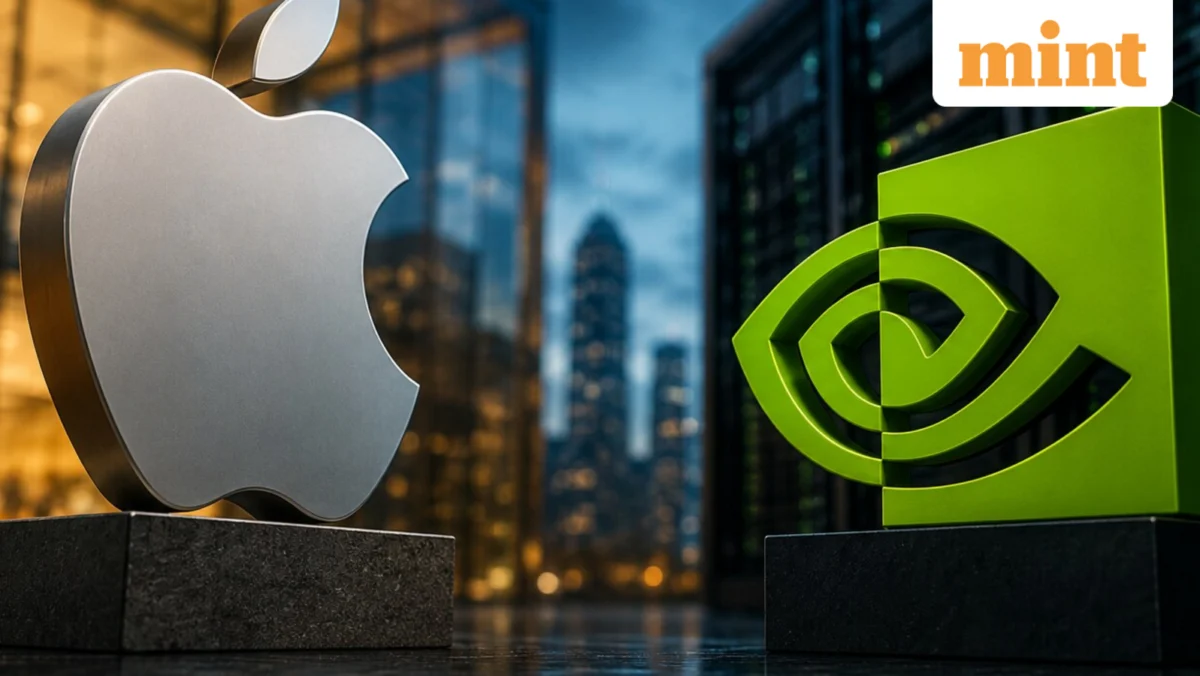
The global financial landscape is currently witnessing a historic tug-of-war for the title of the world’s most valuable company, a battle primarily fought between the legacy consumer tech giant Apple Inc. and the semiconductor powerhouse Nvidia Corporation. Following a series of volatile trading sessions and pivotal earnings reports, the two titans have repeatedly swapped positions in market capitalization, highlighting a fundamental divide in how the technology sector approaches the generative artificial intelligence (AI) revolution. While Apple has opted for a conservative, cash-flow-heavy strategy centered on "renting" AI infrastructure, Nvidia has positioned itself as the indispensable architect of the AI era, reaping massive rewards while tethering its fate to the continued capital expenditure of Big Tech’s hyperscalers.
The competition for the top spot has become a proxy for investor sentiment regarding the AI boom. Apple’s recent earnings reignited its momentum, briefly allowing it to reclaim the crown before Nvidia’s relentless growth trajectory pushed it back to the forefront. This rotational leadership underscores a critical question for the markets: is it more advantageous to own the platform that delivers AI to the masses, or the company that builds the engines making that delivery possible?
The Strategic Divergence: Building Infrastructure vs. Delivering Experiences
The core of the Apple-Nvidia rivalry lies in their vastly different business models and their subsequent approaches to AI integration. Apple, led by CEO Tim Cook, has historically prioritized ecosystem stability and high-margin hardware sales. Its entry into the AI space, branded as "Apple Intelligence," focuses on the "edge"—integrating AI features directly into the iPhones, Macs, and iPads used by billions. However, unlike its peers, Apple is not investing hundreds of billions of dollars into building its own massive data centers or training foundational large language models (LLMs) from scratch.
In contrast, Nvidia has become the "arms dealer" of the AI gold rush. Under CEO Jensen Huang, the company has transformed from a graphics card manufacturer into the world’s most critical provider of AI hardware and software. Nvidia’s H100, H200, and the upcoming Blackwell GPU architectures are the gold standard for training and deploying AI models. This dominance has granted Nvidia unprecedented pricing power and revenue growth, but it also makes the company uniquely sensitive to the spending cycles of a handful of major clients, including Microsoft, Alphabet, Meta, and Amazon.
Apple’s "Rent, Don’t Build" Gamble
Apple’s approach to AI has been described by industry analysts as a "renting" strategy. While hyperscalers like Microsoft and Google are projected to spend upwards of $100 billion each on AI-related capital expenditure (capex) this year, Apple’s projected capex remains relatively modest at approximately $11 billion. In the June quarter alone, Apple’s capex stood at $3.4 billion, a fraction of what is being spent by companies building the infrastructure for the next generation of computing.
Sandeep Nambiar, Co-Founder and CEO of OneCap, notes that this strategy is a double-edged sword. By renting AI capacity—such as utilizing third-party cloud providers and partnering with entities like OpenAI for ChatGPT integration—Apple preserves its legendary cash flow. This allows the company to continue its massive share buyback programs and dividend payments, which provide a safety net for investors during periods of market volatility.
However, Nambiar warns of a long-term risk: "If AI becomes the layer people actually live inside, then renting it means renting your future." By not owning the underlying infrastructure, Apple risks losing a degree of control over the core technology that will define the next decade of consumer electronics. Despite this, the strategy aligns with Apple’s historical preference for perfecting user experience over being first to market with raw technology.
Nvidia’s Growth and the Dependency on Hyperscaler Capex
Nvidia’s valuation is built on the premise of exponential growth. Its revenue has seen triple-digit percentage increases as the world’s largest tech companies race to secure its chips. However, this growth is heavily dependent on the willingness of "Big Tech" to continue writing massive checks for data center expansions.
The risk for Nvidia is twofold. First, there is the question of whether the return on investment (ROI) for AI spending will materialize quickly enough for its customers to justify continued high-level spending. Second, Nvidia’s hardware, while dominant, is subject to a replacement cycle that investors may be underestimating.
"The part people underrate is that GPUs get consumed; they aren’t owned forever," Nambiar asserts. He points out that two-thirds of Microsoft’s capex in the last quarter was allocated to short-lived assets like CPUs and GPUs. This suggests that Nvidia’s current valuation assumes a perpetual replacement cycle where companies must constantly upgrade to the latest chips to remain competitive. If that cycle slows down or if competitors begin to gain ground with in-house chip designs (like Google’s TPUs or Amazon’s Trainium), Nvidia’s growth could face a significant correction.

A Chronology of the Valuation Race
The battle for the $3 trillion and $3.5 trillion milestones has been a defining feature of the 2024-2025 market cycle.
- Early 2024: Microsoft held a steady lead as the most valuable company, buoyed by its early partnership with OpenAI and aggressive integration of Copilot across its software suite.
- June 2024: Nvidia’s stock surged following a 10-for-1 stock split and a blowout earnings report, briefly making it the most valuable company in the world.
- August 2024: Apple regained the top spot following its Worldwide Developers Conference (WWDC) and a strong earnings report that reassured investors about the "Apple Intelligence" rollout and a potential iPhone upgrade super-cycle.
- Late 2024/Early 2025: The rankings have remained rotational, with the gap between the two companies often narrowing to within 2-3%.
Expert analysis suggests that with valuations hovering near the $5 trillion mark, the rankings can be shifted by a single earnings report or a minor change in macroeconomic conditions. The sheer scale of these companies means that a 2% move in stock price represents roughly $70 billion to $100 billion in market value.
Investor Sentiment: Stability vs. High-Octane Growth
Ross Maxwell, Global Strategy Operations Lead at VTMarkets, observes that the two companies offer distinct profiles for different types of investors. Apple represents the "flight to quality" and stability. Its disciplined approach to capital allocation and its massive, loyal user base provide a level of predictability that is rare in the tech sector.
"Investors often rotate towards businesses with more predictable earnings and lower capital requirements," Maxwell says. "Apple’s disciplined approach could therefore appeal to investors seeking stability, even if Nvidia continues to deliver stronger long-term growth."
Nvidia, on the other hand, is the choice for those betting on a fundamental shift in the global economy toward accelerated computing. Its margins are extraordinarily high, and its moat—protected by the CUDA software platform—is currently unrivaled. However, its high valuation multiples leave little room for error. Any hint of a slowdown in AI demand or a delay in its product roadmap (as seen with minor concerns regarding the Blackwell chip rollout) can lead to sharp pullbacks.
Broader Impact and Market Implications
The divergence between Apple and Nvidia reflects a broader split in the tech industry. We are seeing a move toward "Sovereign AI," where nations and large enterprises seek to own their computing power, benefiting Nvidia. Simultaneously, we are seeing the rise of "Edge AI," where privacy-conscious processing happens on the device, benefiting Apple’s vertically integrated hardware and software stack.
If the market enters a phase where investors demand immediate returns from AI spending, companies with balanced strategies—like Apple—may see sustained favor. Conversely, if AI continues to evolve at a breakneck pace, requiring ever-more powerful clusters, Nvidia’s dominance will likely remain unchallenged.
Furthermore, the concentration of market value in these two firms (along with Microsoft) has significant implications for index-tracking funds and the broader S&P 500. The performance of these two stocks alone can dictate the direction of the entire market, creating a "top-heavy" environment where the health of the AI sector becomes synonymous with the health of the global economy.
Conclusion: The Edge of Innovation
Ultimately, neither Apple nor Nvidia has a definitive "edge" that renders the other obsolete; rather, they are the two indispensable poles of the modern technology ecosystem. Apple provides the interface through which the world will experience AI, while Nvidia provides the intelligence that powers those experiences.
As the race toward a $5 trillion valuation continues, the market will likely continue its rotational pattern. Apple’s strength lies in its ability to generate dependable cash flows while letting others take the high-risk, high-reward gambles on infrastructure. Nvidia’s strength lies in its role as the engine of the most significant technological shift since the dawn of the internet. For the global investor, the choice between the two is less about which company is "better" and more about an individual’s tolerance for risk versus their desire for a share in the explosive growth of the AI frontier.
