

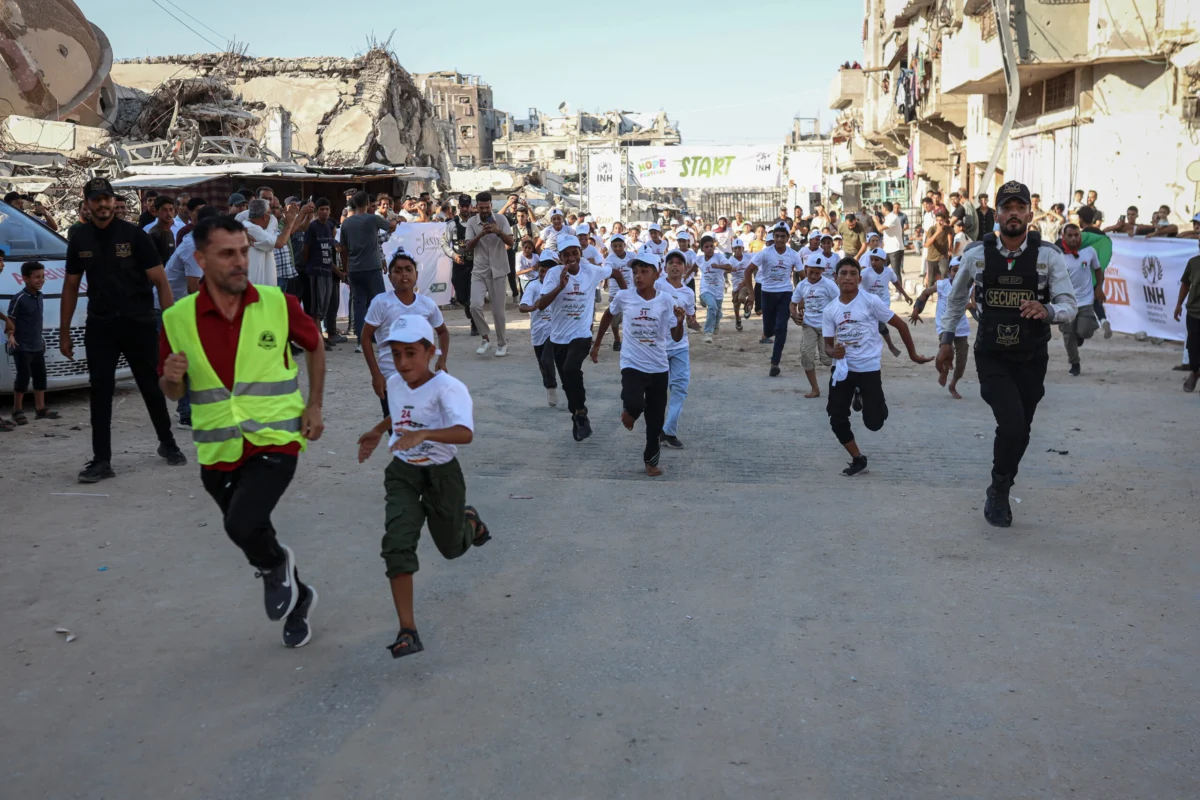
The sound of a starting whistle momentarily eclipsed the low hum of surveillance drones and the distant rumble of machinery in Khan Younis on Friday, as dozens of Palestinian children surged forward in a race that was less about athletic prowess and more about survival, visibility, and the reclamation of a stolen childhood. Organized against a backdrop of pulverized concrete and twisted rebar, the event sought to cast a spotlight on the staggering number of children orphaned during the ongoing military operations in the Gaza Strip. For a few brief minutes, the focus shifted from the debris of the southern Gaza city to the resilience of its youngest inhabitants, many of whom have spent the last two years navigating a landscape defined by loss and displacement.
The "orphan marathon," as it was dubbed by organizers, was not a traditional race but a communal demonstration of solidarity. Among the participants were boys and girls who have lost one or both parents since October 2023. They ran through makeshift tracks, cheered on by a community that has seen its social fabric stretched to the breaking point. The event was facilitated by International Networking for Humanitarian (INH) Indonesia, an organization attempting to bridge the gap between the overwhelming needs of Gaza’s orphaned population and the dwindling resources available on the ground.
The Human Toll: The Story of Saif Hijazi
While many children found a brief reprieve in the physical act of running, the reality of the conflict remained anchored in the presence of 13-year-old Saif Hijazi. Unlike his peers, Saif watched the start of the race from a wheelchair. His story serves as a dual testament to the violence that has defined Gaza for nearly two years: he is both an orphan and a victim of direct physical trauma.

Saif’s father, Rami Hijazi, was killed in January 2024 when an Israeli airstrike struck the family’s home in northern Gaza. Exactly one year later, in January 2025, Saif’s own life was irrevocably altered. While seeking shelter in a tent following multiple displacements, he was caught in the radius of an artillery shell. The blast left him paralyzed and suffering from kidney failure. "I miss my father every day," Saif said, his voice quiet but steady. "He used to take care of everything for us. Since I was injured, I can’t walk or move on my own anymore. I just want my life to get better."
Saif’s mother, Warda Hijazi, 33, now serves as the sole provider and caregiver for her three children, including 9-year-old Sarah and 10-year-old Ammar. The family’s journey from northern Gaza to their current temporary shelter in al-Zawaida, central Gaza, mirrors the experience of hundreds of thousands of others. For Warda, the burden is not merely financial but deeply psychological. She described a "daily battle" to provide food and medicine while attempting to fill the emotional void left by her husband’s death.
A Generation in Crisis: Data and Statistical Context
The scale of the crisis facing children in Gaza is unprecedented in modern conflict. According to the latest figures from health officials in the territory, the death toll from Israeli attacks since October 2023 has exceeded 73,000 people. Within this demographic catastrophe, children have emerged as the most vulnerable group.
Data provided by the United Nations Children’s Fund (UNICEF) indicates that more than 58,000 children in Gaza have lost one or both parents. Furthermore, UNICEF estimates that approximately 17,000 children are currently "unaccompanied or separated," a designation that refers to those living without any adult kin to provide care. This has led to the emergence of the acronym "WCNSF"—Wounded Child, No Surviving Family—a term that humanitarian workers say has become a grim staple of medical charts in Gaza’s remaining hospitals.

The broader implications for the youth population are equally dire. UNICEF reports that more than one million children in the Gaza Strip now require urgent protection and psychosocial support. The collapse of the education system, with more than 80 percent of school buildings damaged or destroyed, has left a generation without the stability of a classroom, further exacerbating the long-term developmental risks associated with prolonged exposure to high-intensity conflict.
Humanitarian Logistics and Community Response
The marathon in Khan Younis was designed to do more than provide a day of recreation. According to Mohammed Yassin, the project coordinator for INH Indonesia, the primary goal was to remind the international community that the needs of orphans extend far beyond basic caloric intake.
"Orphans are always among the most affected groups in wars," Yassin stated during the event. "No matter how much effort we make as an organization, we cannot reach all of them. Through these activities, we try to remind the world and encourage people to support them and provide sponsorship that can help them in their daily lives."
Yassin highlighted a critical shift in the socio-economic reality of Gaza. In previous escalations, extended family networks—uncles, aunts, and grandparents—often absorbed orphaned children into their households. However, the current conflict has seen the "provider system" collapse entirely. "Families that still have a provider are already struggling to secure the minimum necessities because of the loss of purchasing power and the challenging daily conditions," Yassin explained. "But when a family loses its main provider, the suffering becomes much greater in securing basic needs such as water and food."

The Burden of the Sole Caregiver
The testimony of Samah Abu Amra, a 43-year-old widow and mother of five, underscores the exhaustion of those left to pick up the pieces. Her husband was killed in an Israeli attack while walking in Khan Younis during the first year of the war. Since then, she has been responsible for five children ranging in age from seven to 19.
"Life is extremely difficult, and the situation is beyond what anyone can bear," Abu Amra said. She noted that the support systems available in previous years have largely evaporated. "An orphan needs to be seen and heard. Their needs must be met. They need someone who asks about them and cares for them, not just temporary assistance."
For mothers like Samah and Warda, the challenge is multifaceted:
- Economic Scarcity: The lack of formal employment and the astronomical rise in the cost of basic goods (flour, clean water, fuel) makes maintaining a household nearly impossible without aid.
- Medical Vulnerability: Children like Saif require specialized care and equipment that are virtually non-existent in a territory where the healthcare infrastructure has been decimated.
- Emotional Trauma: The "invisible wounds" of war—nightmares, regression, and severe depression—require long-term therapy that local NGOs are struggling to provide at scale.
Broader Impact and Implications for the Future
The marathon concluded with a ceremony where 100 orphaned children were symbolically honored. Saif Hijazi was the first to be called to receive a medal, a gesture intended to recognize his endurance and the specific hardships he has faced as a paralyzed orphan.

The long-term implications of this "orphan crisis" are profound. Sociologists and humanitarian experts warn that without a massive, sustained intervention, the Gaza Strip faces the prospect of a "lost generation." The combination of physical disability, lack of education, and the loss of parental guidance creates a vacuum that could lead to long-term social instability.
Furthermore, the psychological impact of being an "unaccompanied" child in a war zone is often permanent. The lack of "safe spaces" means that children are in a constant state of hyper-vigilance. Events like the Khan Younis marathon are seen by local psychologists as essential "psychological first aid," providing a rare moment where children can engage in age-appropriate activities and feel a sense of communal belonging.
Conclusion: A Call for Sustained Support
As the sun began to set over the ruins of Khan Younis, the children dispersed back to their tents and damaged homes, medals clinking against their chests. For the organizers at INH Indonesia and the families involved, the event was a success in terms of visibility, but the underlying reality remains unchanged.
"My son needs to feel that he is still part of this world, that people see him and care about him," Warda Hijazi said as she prepared to navigate Saif’s wheelchair back through the uneven, debris-strewn streets.

The international community faces an escalating challenge in Gaza. While immediate ceasefire negotiations often dominate the headlines, the demographic shift toward a population with tens of thousands of orphans suggests that the humanitarian requirements for the region will last for decades. For now, the children of Gaza continue to run—sometimes literally, as they did on Friday, and more often figuratively, as they race to survive a conflict that has already claimed their past and threatens their future.
