

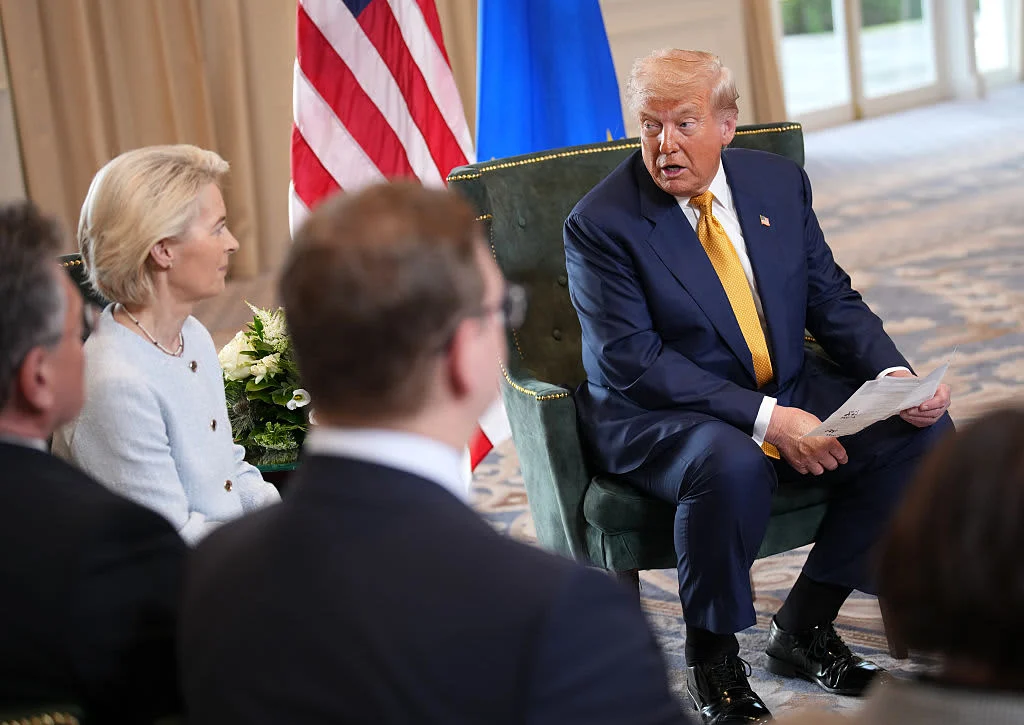
President Donald Trump announced on Friday that his administration will initiate a formal trade investigation into the European Union, a move intended to counter what he described as the systematic targeting of American technology companies by foreign regulators. The investigation, to be conducted under Section 301 of the Trade Act of 1974, is expected to result in the cancellation of several high-profile fines levied against U.S. firms and the imposition of "substantial" new tariffs on goods imported from the 27-member bloc.
The announcement followed a series of aggressive regulatory actions by the European Commission against American "gatekeeper" firms, most recently a $1 billion (€890 million) penalty imposed on Google for alleged noncompliance with the Digital Markets Act (DMA). In a statement released via Truth Social, the President accused the European Union of exploiting American corporations to bolster its own coffers, asserting that the bloc has been "’ROBBING’ American Companies and, in turn, the American Taxpayer."
The Catalyst: Google and the Digital Markets Act
The immediate trigger for the administration’s decision was the European Commission’s Wednesday announcement regarding Google. The commission alleged that the search giant had failed to comply with the DMA, specifically regarding how it displays search results. Regulators claimed Google continued to give preferential treatment to its own services, such as Google Shopping and Google Flights, over those of competitors, despite previous warnings and legal mandates.
The $1 billion fine is part of a broader trend of European regulatory scrutiny. In his statement, President Trump cited previous actions taken against other industry leaders, including Apple, Meta, and Amazon. He claimed these penalties were often issued "without explanation," though the European Commission has maintained that its actions are rooted in maintaining fair competition and protecting consumer choice within the European Single Market.
"The European Union is at it again and, as usual, taking direct aim at GREAT American Companies!" Trump wrote. He emphasized that the era of the United States serving as a "PIGGYBANK" for Europe has ended, signaling a return to the highly protectionist trade policies that defined his first term.
Legal Framework: Understanding Section 301
The administration’s primary tool for this retaliation is Section 301 of the Trade Act of 1974. This specific provision of U.S. law grants the President broad authority to investigate and respond to foreign government actions that are deemed "unjustifiable," "unreasonable," or "discriminatory," and that burden or restrict United States commerce.
Historically, Section 301 was a cornerstone of the Trump administration’s trade strategy between 2017 and 2021, most notably used to launch the multi-year trade conflict with China over intellectual property theft and forced technology transfers. By invoking this authority against the European Union, the administration is bypassing traditional World Trade Organization (WTO) dispute resolution mechanisms in favor of unilateral executive action.
Legal experts note that a Section 301 investigation typically involves a public comment period and a formal finding by the Office of the United States Trade Representative (USTR). If the USTR finds that U.S. commerce is indeed being unfairly burdened, the President has the authority to impose duties, fees, or restrictions on the importation of goods and services from the offending country or bloc.
A Growing Pattern of Trade Hostilities
The move against the EU does not exist in a vacuum. Just hours prior to the announcement of the tech-related probe, the Trump administration moved to impose new duties ranging from 10% to 12.5% on a wide array of goods from over 80 countries, including several EU member states. These tariffs were purportedly linked to concerns over forced labor practices in global supply chains.
This rapid succession of trade barriers has already sparked legal pushback within the United States. On Friday afternoon, a lawsuit was filed in the U.S. Court of International Trade by the Liberty Justice Center on behalf of Burlap and Barrel and other small businesses. The plaintiffs argue that the federal government is misusing Section 301 to circumvent judicial rulings. Specifically, the suit alleges the administration is attempting to reinstate the 2025 "liberation day" tariffs, which were struck down by the Supreme Court earlier this year on the grounds that the executive branch had exceeded its constitutional authority.
The Liberty Justice Center argues that the administration’s reliance on Section 301 is an attempt to achieve through trade law what it could not achieve through standard legislative or executive channels. "The European Union will pay a very big price for this illegal and highly unethical conduct," Trump warned, dismissing the legal challenges as he doubled down on his tariff-first approach.

Historical Context of EU-US Regulatory Friction
The tension between Washington and Brussels over the technology sector has been simmering for over a decade. The European Union has positioned itself as the world’s leading "tech cop," implementing landmark regulations such as the General Data Protection Regulation (GDPR) and, more recently, the Digital Markets Act (DMA) and the Digital Services Act (DSA).
The DMA, which came into full effect earlier this year, identifies major tech firms as "gatekeepers"—entities that provide a core platform service that acts as an important gateway for business users to reach customers. Under the DMA, companies like Alphabet (Google), Amazon, Apple, ByteDance (TikTok), Meta, and Microsoft are subject to strict "dos and don’ts." For instance, they are prohibited from ranking their own products more favorably than those of third parties on their platforms and are required to allow users to easily uninstall pre-installed software.
The U.S. government, across multiple administrations, has often viewed these regulations as disguised protectionism designed to hamper American innovation while European tech firms struggle to compete on a global scale. However, the Trump administration’s response marks a significant escalation from diplomatic complaints to direct economic warfare.
Economic Implications and Market Reaction
The potential for a renewed trade war between the United States and the European Union has sent ripples through global markets. The EU is the United States’ largest trading partner in terms of combined goods and services. In 2023, the total trade between the two entities exceeded $1.3 trillion.
Economists warn that "substantial" tariffs on EU goods could lead to:
- Increased Consumer Prices: Tariffs on European automobiles, machinery, chemicals, and luxury goods (such as wine and cheese) would likely be passed on to American consumers.
- Retaliatory Measures: The European Union has historically responded to U.S. tariffs with its own "rebalancing" duties. During the previous administration’s steel and aluminum tariff disputes, the EU targeted iconic American products such as Harley-Davidson motorcycles, Kentucky bourbon, and Levi’s jeans.
- Supply Chain Disruption: Many U.S. manufacturers rely on high-tech components and specialized machinery produced in Germany, France, and Italy. New trade barriers could stall production and increase costs for domestic industries.
Conversely, supporters of the administration’s move argue that a firm stance is necessary to protect the American tax base. When the EU fines U.S. companies billions of dollars, those funds are paid into the EU’s general budget. Trump and his allies contend that this effectively allows Europe to fund its social programs using capital that would otherwise be reinvested in the U.S. economy or paid to the U.S. Treasury in corporate taxes.
Timeline of Recent Events
The current escalation follows a dense timeline of regulatory and political maneuvers:
- March 2024: The EU Digital Markets Act (DMA) enters full enforcement, targeting six major "gatekeepers."
- May 2024: The U.S. Supreme Court strikes down the administration’s "liberation day" tariff plan, citing executive overreach.
- June 2024: The European Commission opens multiple non-compliance investigations into Apple, Google, and Meta.
- July 23, 2024: The EU announces a $1 billion fine against Google for search priority violations.
- July 24, 2024 (Morning): The Trump administration imposes 10%–12.5% tariffs on 80+ countries over forced labor allegations.
- July 24, 2024 (Afternoon): President Trump announces the Section 301 probe into the EU via Truth Social.
- July 24, 2024 (Evening): Liberty Justice Center files a lawsuit in the U.S. Court of International Trade.
Statements from Stakeholders
While the European Commission has yet to issue a formal response to the threat of a Section 301 probe, a spokesperson for the Commission previously stated that its regulations are "objective, non-discriminatory, and aimed at ensuring a contestable and fair digital sector."
Industry groups in the United States have expressed mixed reactions. Organizations representing the technology sector, such as the Computer & Communications Industry Association (CCIA), have long complained about "disproportionate" EU regulations. However, many of these same groups are wary of a full-scale trade war that could lead to retaliatory digital taxes or further regulatory crackdowns in Europe.
"The penalties will be entirely reversed and, we anticipate, a substantial TARIFF to be placed on them at the earliest possible moment," Trump concluded in his announcement. He ended the post with a cryptic "Stay tuned!", suggesting that further trade actions against other international bodies or nations may be forthcoming.
As the USTR prepares to launch the investigation, the global business community remains on high alert. The outcome of this probe will not only redefine the relationship between the world’s two largest democratic economies but will also determine the future of global technology regulation and the limits of executive power in international trade.
