

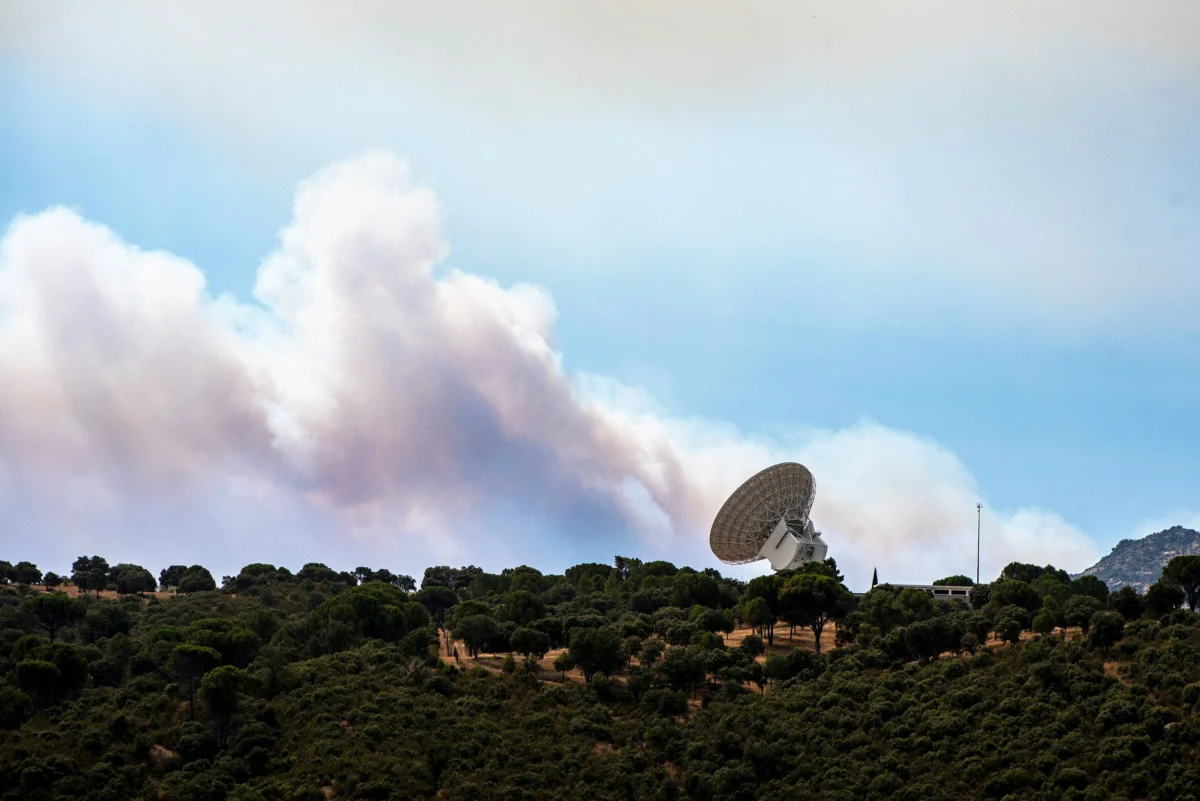
The intensifying global climate crisis has extended its reach beyond terrestrial concerns, directly threatening the infrastructure required for interstellar exploration and deep-space communication. On Friday, a series of aggressive wildfires in central Spain encroached upon the Madrid Deep Space Communications Complex, one of only three facilities in the world that the National Aeronautics and Space Administration (NASA) utilizes to maintain contact with its most distant and critical spacecraft. The facility, located in Robledo de Chavela, serves as a vital umbilical cord for missions including the Voyager 1 probe—the most distant human-made object in existence—the James Webb Space Telescope (JWST), and the Artemis lunar program. As record-breaking heatwaves continue to bake the European continent, the incident underscores the vulnerability of high-tech scientific infrastructure to the escalating frequency of extreme weather events.
The Vital Link to the Stars: Understanding the Deep Space Network
To understand the gravity of the threat to the Madrid complex, one must recognize its role within the broader Deep Space Network (DSN). Established in 1963, the DSN is the largest and most sensitive scientific telecommunications system in the world. It consists of three ground stations spaced approximately 120 degrees apart in longitude: Goldstone, California; Canberra, Australia; and Madrid, Spain. This strategic placement ensures that as the Earth rotates, at least one station is always in view of a given spacecraft, providing constant 24-hour coverage.
The Madrid facility is not merely a collection of satellite dishes; it is a sophisticated array of massive radio antennas, including a 70-meter (230-foot) diameter antenna capable of tracking whispers of data from the edge of the solar system. These instruments are responsible for transmitting commands to spacecraft and receiving telemetry and scientific data. Without the Madrid station, NASA would face significant "blind spots" in its communication schedule, potentially delaying critical commands or losing precious data from missions like the James Webb Space Telescope, which orbits nearly a million miles from Earth, or the Voyager 1 and 2 probes, which have crossed the heliopause into interstellar space.
Chronology of the Crisis: From Heatwave to Wildfire
The emergency in Spain began to escalate mid-week as a relentless heatwave, fueled by a "heat dome" trapped over Western Europe, sent temperatures soaring well above 40 degrees Celsius (104 degrees Fahrenheit). On Friday, the situation turned critical when multiple wildfires ignited near the capital, Madrid. Driven by shifting winds and exceptionally dry vegetation, the flames moved rapidly toward the municipality of Robledo de Chavela, where the NASA facility is situated.
Spain’s regional government declared a wildfire emergency as the blazes spiraled out of control. Evacuation orders were issued for approximately 60,000 residents across the affected areas. Dramatic footage and photographs from the scene showed the iconic white radio telescopes of the NASA complex silhouetted against a backdrop of thick, orange smoke and encroaching flames. By Friday afternoon, the fire had reached the perimeter of the observatory complex.
NASA officials moved quickly to ensure the safety of their personnel. A spokesperson confirmed to news outlets that all staff members at the Robledo de Chavela site were successfully evacuated before the fire reached the facility. As the flames swept through the complex, the agency was forced to shut down local operations and rely on its built-in redundancies to maintain mission continuity.
Operational Resilience and the Goldstone Transition
Despite the physical threat to the Madrid station, NASA’s Deep Space Network is designed with high levels of resilience. As the fire approached, the agency initiated a "seamless transition" of mission support to the Goldstone Deep Space Communications Complex in California’s Mojave Desert. This shift allowed mission controllers to maintain uninterrupted contact with active spacecraft, ensuring that the fire in Spain did not result in a loss of signal for the various probes currently exploring the cosmos.
However, the transition to a two-station configuration places additional strain on the remaining sites. With the Madrid station offline, the scheduling of "antenna time" becomes significantly more complex. Missions like the James Webb Space Telescope require high-bandwidth downlinks to transmit the massive amounts of data generated by its infrared sensors. Similarly, the Artemis missions, which represent the vanguard of humanity’s return to the Moon, require constant and reliable communication for navigation and safety.
By Saturday, NASA officials reported that the fire had passed through the observatory complex. While the immediate danger from the flames had subsided, the status of the sensitive electronic and mechanical components remained unknown. A site assessment was planned to begin as soon as safety conditions allowed, with engineers looking for signs of heat damage to the antenna structures, smoke interference with delicate receivers, and damage to the power and fiber-optic infrastructure that connects the site to the global network.
The Technical Vulnerability of Deep Space Infrastructure
While the primary concern during a wildfire is the destruction of structures by flame, the Madrid Deep Space Communications Complex faces more nuanced technical risks. The radio telescopes used in deep space communication are marvels of precision engineering. Even if the antennas themselves do not burn, the intense heat from a nearby wildfire can cause thermal expansion in the metal structures, potentially misaligning the dishes and reducing their sensitivity.
Furthermore, smoke and ash pose a significant threat to the facility’s cooling systems and sensitive electronics. The receivers on these antennas are often cryogenically cooled to near absolute zero to minimize thermal noise, allowing them to pick up incredibly faint signals from billions of miles away. Ash infiltration into these systems or the coating of the dish surfaces with soot can degrade performance. The assessment teams will need to meticulously clean and recalibrate the instruments before the Madrid site can return to full operational status.
A Continent Ablaze: The Broader European Emergency
The crisis at the NASA facility is a microcosm of a much larger disaster unfolding across Southern Europe. In addition to the 60,000 people displaced in Spain, neighboring France is battling equally ferocious blazes. In the Gironde region, near Bordeaux, more than 30,000 people have been forced to flee. Tourists at popular beach resorts reported skies turning a bruised orange, with ash falling like snow into the Atlantic Ocean.
French Interior Minister Laurent Nunez described the fires as "extremely difficult to bring under control," noting that shifting winds had turned a manageable blaze into a "large, self-sustaining fire." In total, an estimated 200,000 people have been evacuated across Spain and France this week. The human and economic toll is staggering, with thousands of hectares of forest, including the historic vineyards of Bordeaux, under threat.
Meteorologists attribute the severity of these fires to a combination of long-term climate change and immediate weather patterns. The Mediterranean region is warming 20% faster than the global average, leading to a process of aridification that turns forests into tinderboxes. The current heatwave has seen temperatures reach 10 degrees Celsius above seasonal norms, a trend that is expected to continue. While a brief period of cooler weather was forecast for the weekend, experts warn that temperatures will climb again by Monday, potentially sparking new outbreaks or reigniting existing ones.
Climate Change as a Threat Multiplier for Space Exploration
The encroachment of wildfires on a NASA facility highlights a growing reality: the infrastructure of the future is being threatened by the environmental consequences of the past. Climate change acts as a "threat multiplier," taking existing risks—such as the seasonal wildfire risk in Spain—and amplifying them to a level that can overwhelm even the most sophisticated safeguards.
For NASA and other space agencies, this event serves as a wake-up call regarding the geographic distribution and protection of ground-based assets. As the planet warms, the locations chosen decades ago for their clear skies and remote terrain—such as the arid regions of Spain, California, and Australia—are increasingly becoming the front lines of the climate crisis. The Deep Space Network is essential for the future of the Artemis program, the search for life on Mars, and the monitoring of the Sun’s activity. Ensuring the resilience of these stations against fire, flood, and extreme heat is now as critical to space exploration as the engineering of the rockets themselves.
As of Sunday, the global scientific community remains on standby for the results of the damage assessment in Madrid. The "seamless transition" to Goldstone has proven the DSN’s operational robustness, but the long-term sustainability of such facilities in a warming world remains a pressing question for policymakers and scientists alike. The fires in Spain have demonstrated that in the 21st century, the path to the stars must first navigate the increasingly volatile climate of Earth.
