

The landscape of modern video gaming is currently undergoing a seismic shift toward a digital-only future, as evidenced by Sony’s recent indications that it may cease disc production for PlayStation consoles by 2028. This move has reignited a passionate debate regarding the preservation of physical media and the concept of true game ownership. In response to this increasingly ephemeral digital market, a growing sector of the gaming industry is looking backward, developing sophisticated hardware to keep legacy media alive. Romania-based hardware developer Epilogue has positioned itself at the forefront of this movement with the release of the SN Operator, a specialized peripheral designed to bridge the gap between 1990s Super Nintendo (SNES) cartridges and modern computing environments.
The SN Operator serves as a successor to the company’s well-received GB Operator, which provided similar functionality for the Game Boy family of handhelds. By providing a dedicated hardware interface for original cartridges, Epilogue offers an alternative to both the legal gray area of internet-sourced ROMs and the high cost of field-programmable gate array (FPGA) consoles. The device allows users to play their original physical library on a PC while utilizing the benefits of modern software emulation, creating a hybrid experience that emphasizes archival integrity and user accessibility.
Hardware Specifications and Industrial Design
The SN Operator is a notable departure from the compact form factor of its predecessor. Measuring 185 × 70 × 37 millimeters and weighing approximately 230 grams, the device is built to accommodate the substantial physical footprint of Super Nintendo and Super Famicom cartridges. Constructed from a transparent perspex material, the unit allows users to view the internal circuitry, a design choice that echoes the aesthetic of 1990s "clear tech" while maintaining a modern, minimalist profile.
.jpg)
A key hardware improvement in this iteration is the inclusion of spring-loaded guard flaps within the cartridge slot. This design, pioneered by Nintendo in the early 1990s, serves the dual purpose of stabilizing the cartridge and protecting the internal 62-pin connector from dust and environmental debris. To ensure stability during gameplay, the device features a high-friction rubber base, preventing the unit from sliding when larger, heavier cartridges are inserted. Connectivity and power are handled via a single 1-meter braided USB-C to USB-C cable, ensuring compatibility with modern laptops and desktop configurations without the need for external power bricks.
The Playback Software Ecosystem and Emulation Architecture
The core of the Epilogue experience is the proprietary "Playback" software. This application acts as the interface between the hardware reader and the computer’s operating system, supporting Windows, macOS, Linux, and Raspberry Pi distributions. Upon inserting a cartridge, the software identifies the game, verifies its authenticity, and launches it within a specialized emulation environment.
By default, the SN Operator utilizes the BSNES emulator core, which is widely regarded within the retro gaming community for its high level of accuracy and cycle-accurate performance. For users who require different performance profiles or specific compatibility, the software also includes five versions of Snes9X and allows for the manual addition of external cores. This flexibility is essential for a library as diverse as the SNES, which often utilized specialized enhancement chips—such as the Super FX or SA-1—embedded directly within the cartridges.
The software suite also integrates "Retro Achievements," a community-driven platform that adds modern trophy-style goals to classic titles. This feature, combined with a robust set of visual filters, allows players to customize their experience. Options range from "pixel-perfect" digital clarity to sophisticated CRT (Cathode Ray Tube) shaders that simulate the scanlines and phosphor glow of 20th-century television sets.
.jpg)
Overcoming Historical Region Restrictions
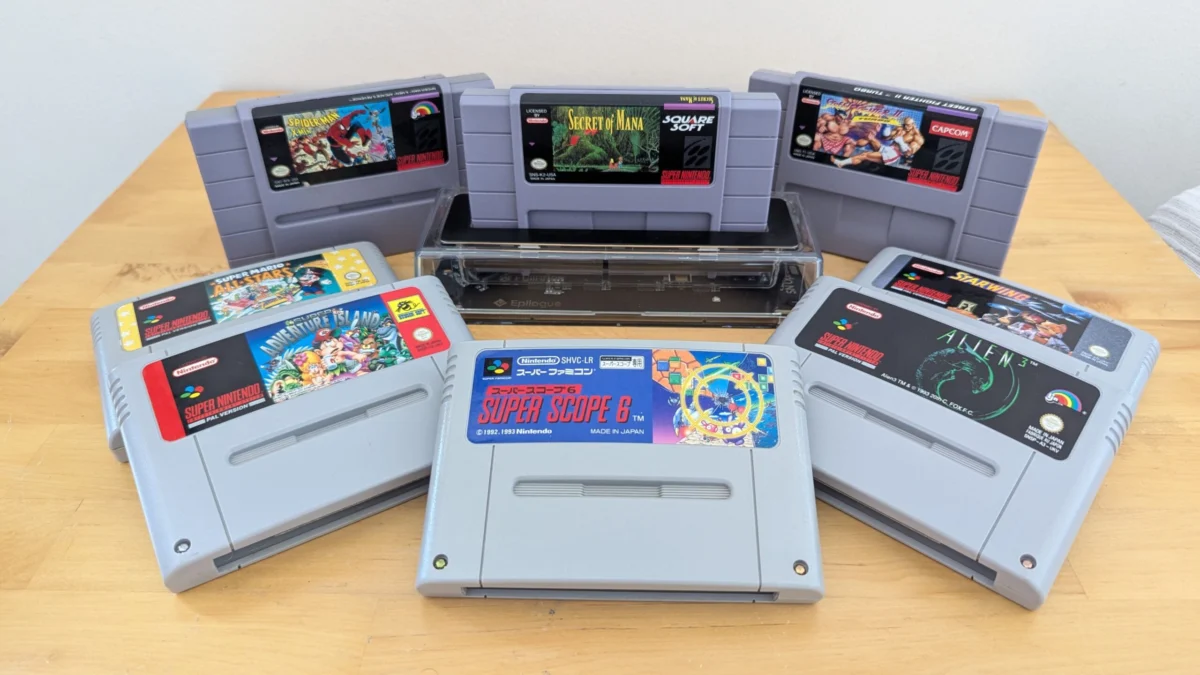
One of the most significant technical hurdles for SNES collectors has historically been regional lockout. During the 16-bit era, Nintendo employed both physical and electronic barriers to prevent games from being played outside their intended markets. North American cartridges featured a rectangular, "boxy" design that would not fit into the curved slots of Japanese Super Famicom or European PAL SNES consoles. Furthermore, internal lockout chips would prevent the software from booting if the regions did not match.
The SN Operator effectively dismantles these barriers. The hardware slot is designed to be universal, accepting any physical cartridge shape from the SNES era. On the software side, the Playback interface ignores lockout chips, allowing for a truly region-free experience. This is particularly beneficial for European and Australian players who grew up with the PAL standard. Historically, PAL games were often optimized for a 50Hz refresh rate, resulting in a 17.5% reduction in gameplay speed compared to the 60Hz NTSC standard used in Japan and North America. The SN Operator allows these games to be played at their intended speeds on modern displays, removing the "sluggish" feel associated with many classic PAL conversions.
Archival Tools and Save Data Management
Beyond gameplay, the SN Operator functions as a sophisticated archival tool. The device allows users to create digital backups of their physical cartridges in a matter of seconds. While the Playback software requires the physical cartridge to be present to initiate gameplay—a measure designed to ensure the device remains a tool for owners rather than a piracy engine—the ability to dump ROMs and save data is invaluable for long-term preservation.
A critical concern for retro gamers is the longevity of internal cartridge batteries. Most SNES games utilized a CR2032 lithium battery to maintain save files; as these batteries die, decades of progress can be lost. The SN Operator addresses this by allowing users to transfer save data back and forth between the physical cartridge and the computer. Furthermore, the device introduces "virtual save states," a feature not possible on original hardware. This allows players to save their progress at any exact moment, bypassing the often-punishing save-point systems of 1990s JRPGs like Secret of Mana or Final Fantasy VI.
.jpg)
Peripheral Emulation: The Mouse and Super Scope
The SNES was notable for its experimental peripherals, most notably the SNES Mouse and the Super Scope light gun. Modern displays, particularly OLED and LCD panels, are fundamentally incompatible with original light gun technology, which relied on the timing of a CRT’s electron beam.
Epilogue has addressed this by mapping these peripheral functions to modern hardware. In games like Mario Paint or Populous II, the software allows a standard PC mouse to replicate the functions of the original SNES Mouse. For light gun titles such as Yoshi’s Safari or Super Scope 6, the PC mouse acts as a cursor for the Super Scope. While this significantly lowers the difficulty of these games due to the high precision of modern optical sensors, it provides a functional way to experience niche titles that would otherwise require a vintage television to play.
Market Context and Economic Barriers
While the SN Operator is competitively priced at $60, the broader context of the retro gaming market presents a significant barrier to entry. The "treasure hunt" for original cartridges has become increasingly expensive. For example, a loose English-language cartridge of the acclaimed RPG Chrono Trigger can command prices exceeding $200 on the secondary market.
The SN Operator’s region-free capabilities offer a partial solution to this economic hurdle. Japanese Super Famicom versions of popular titles are often available for a fraction of the cost of their Western counterparts. However, this highlights a current limitation in the Epilogue software: the lack of support for translation packs. Currently, players importing a Japanese RPG must be fluent in the language, as there is no native way to apply English fan-translation patches to the physical cartridge during playback. Epilogue has confirmed that translation support and online multiplayer are currently in development for future software updates.
.jpg)
Timeline of Epilogue Product Development
To understand the SN Operator’s place in the market, it is helpful to view the chronology of Epilogue’s hardware releases and the context of the SNES lifespan:
- 1990–1992: Original SNES/Super Famicom launches globally.
- 2021: Epilogue releases the GB Operator, establishing the "plug-and-play" cartridge reader niche.
- 2023–2024: Prices for original SNES hardware and software hit record highs on the collectors’ market.
- 2024: Epilogue announces the SN Operator to meet the demand for 16-bit console alternatives.
- 2026: Official release of the SN Operator and updated Playback software suite.
Broader Impact and Implications for Gaming History
The release of the SN Operator arrives at a pivotal moment for the video game industry. As major manufacturers push for a transition to subscription-based models and digital storefronts, the risk of "digital rot"—where games become unplayable due to server shutdowns or licensing expirations—has never been higher.
The SN Operator represents a decentralized approach to preservation. By empowering individual users to maintain their own libraries and back up their own data, Epilogue is contributing to a more resilient gaming ecosystem. While it lacks the "zero-latency" purity of expensive FPGA solutions like the Analogue Super Nt, its $60 price point and ease of use make it an essential tool for the average enthusiast. If the developer successfully implements translation support and improves the full-screen scaling issues currently present in the software, the SN Operator will likely become the gold standard for accessible, legal, and high-fidelity retro gaming in the modern era.
