

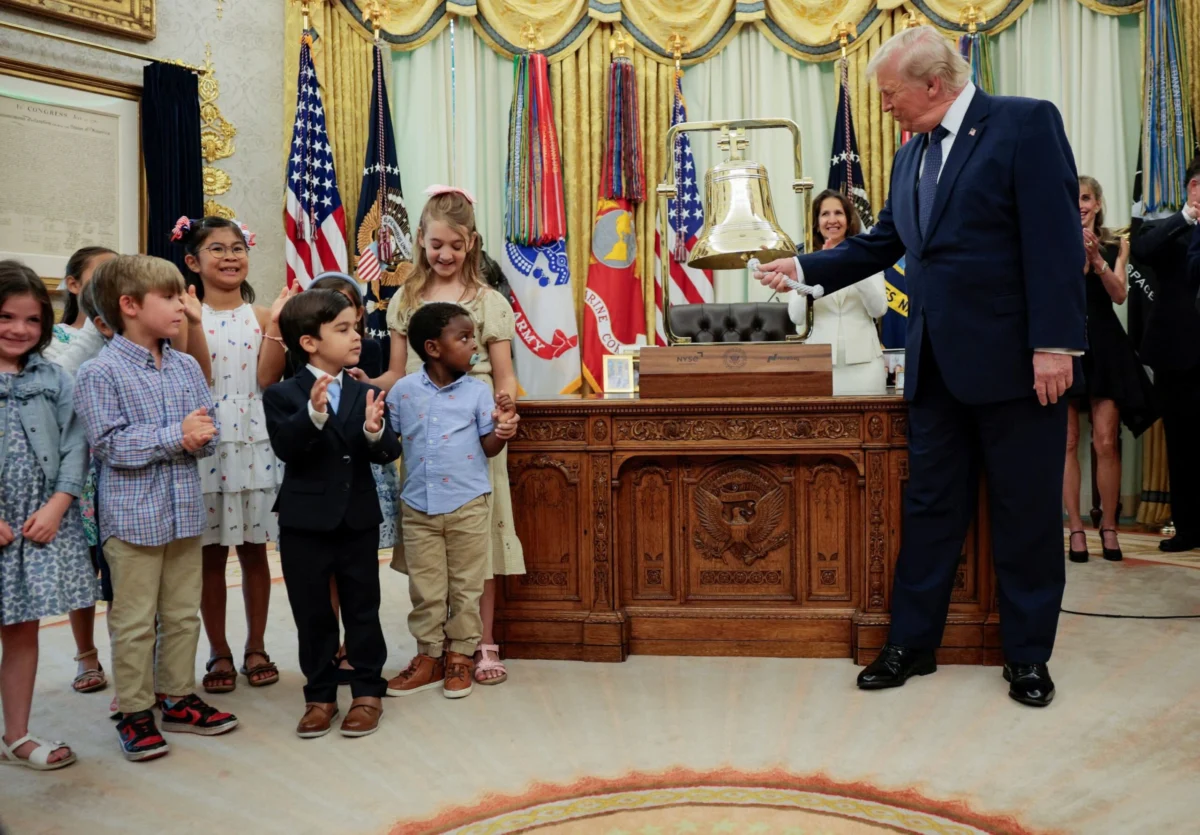
Global financial markets entered a pivotal Tuesday as major indices reacted to a series of geopolitical developments, corporate restructurings, and a historic symbolic gesture from the White House. Following a day of gains for major U.S. benchmarks, stock futures remained mixed in early trading. The session marks a historic milestone for the aerospace industry as SpaceX officially joins the Nasdaq-100, a move that reflects the private sector’s growing dominance in space exploration and telecommunications. Concurrently, the intersection of politics and finance reached a new peak with the launch of the "Trump Accounts" initiative, signaled by an unprecedented opening bell ceremony held within the Oval Office.
SpaceX Joins the Nasdaq-100: A New Era for Tech Indices
On Tuesday, July 7, 2026, SpaceX officially commenced its first day as a constituent of the Nasdaq-100 index. The inclusion of Elon Musk’s aerospace giant represents one of the most significant shifts in the index’s composition in recent years. Traditionally dominated by software, internet, and biotechnology firms, the Nasdaq-100 now includes a primary player in the burgeoning space economy.
Analysts suggest that SpaceX’s entry will necessitate significant rebalancing from institutional investors and exchange-traded funds (ETFs) that track the index, such as the Invesco QQQ Trust. The company’s valuation, which has soared on the back of successful Starship launches and the global expansion of the Starlink satellite internet constellation, places it among the most influential entities in the tech-heavy benchmark. The inclusion is viewed by many as a validation of the commercial space sector’s maturity, moving from a venture-capital-heavy speculative industry to a cornerstone of the public equity market ecosystem.
The Trump Accounts and the Oval Office Opening Bell
In a move that blended presidential theater with economic policy, President Donald Trump rang the opening bell for the New York Stock Exchange and Nasdaq from the Oval Office on Monday. The event served as the official launch for "Trump Accounts," a new series of retail investment vehicles designed to encourage domestic equity participation among the American public.
The collaboration between the White House and the major exchanges is the first of its kind, highlighting the administration’s focus on the stock market as a primary barometer of national success. The Trump Accounts are reportedly structured to provide tax-advantaged status for investments in domestic manufacturing, energy, and technology sectors. During the ceremony, the President emphasized a "market-first" approach to the economy, suggesting that these accounts would "democratize wealth" by providing direct incentives for middle-class Americans to invest in the U.S. corporate landscape.
While the markets reacted positively to the symbolic support, some governance experts have raised questions regarding the unprecedented level of coordination between the executive branch and private market operators. However, for investors, the immediate impact was a surge in retail trading activity as details of the accounts were disseminated through major financial institutions.
Geopolitical Tensions and the Hesai Technology Controversy
Despite the celebratory atmosphere at the White House, underlying tensions regarding U.S.-China relations continue to complicate the technology sector. Hesai Technology, a Shanghai-based manufacturer of lidar (light detection and ranging) sensors, remains at the center of a national security debate. Although the U.S. Department of Defense has designated Hesai as a "Chinese military entity," the company has successfully expanded its footprint within the United States.
Lidar technology is critical for the development of autonomous vehicles and robotics, providing the "eyes" that allow machines to map and navigate their environments. The Department of Defense’s concerns center on the potential for these sensors to be used for data collection or compromised via malware, posing a threat to U.S. infrastructure.
However, Hesai’s integration into the U.S. tech ecosystem is deep. The company currently maintains a partnership with Nvidia, the world’s leading artificial intelligence chipmaker. Nvidia utilizes Hesai’s sensors within its autonomous driving development platforms, creating a complex dilemma for regulators. Hesai CEO David Li has consistently denied any links to the Chinese military, asserting that the company’s products are designed for civilian use and adhere to rigorous security standards.
The situation underscores the "de-risking" challenge facing the U.S. government: balancing national security imperatives against the reality that many domestic AI and automotive leaders rely on global supply chains that include Chinese-made components.
The 2026 World Cup: U.S. Elimination and FIFA Controversy
The domestic mood was dampened on Monday evening as the United States Men’s National Team was eliminated from the 2026 World Cup following a 4-1 loss to Belgium in the Round of 32. The defeat makes the U.S. the last of the three co-host nations—alongside Canada and Mexico—to exit the tournament.
The match was preceded by significant controversy involving American striker Folarin Balogun. Balogun had received a red card and an ejection in the previous match against Bosnia and Herzegovina, which typically carries an automatic one-game suspension. However, FIFA leadership intervened, allowing Balogun to play against Belgium. This decision sparked a formal protest from the Belgian Soccer Association, which was ultimately overruled.
The controversy extended to the political sphere when it was revealed that President Trump had placed a phone call to FIFA President Gianni Infantino regarding the suspension. Addressing the media on Monday, the President defended the call, stating that he viewed the initial red card as an error. "I didn’t think it was a foul," the President remarked, though he clarified that he did not explicitly direct Infantino on how to rule. The U.S. exit from the tournament marks a disappointing end to a campaign that had seen record-breaking domestic viewership and significant commercial investment.
Microsoft Restructuring: Job Cuts in the AI Transition
In the corporate sector, Microsoft announced a significant reduction in its workforce, cutting 4,800 positions as it reallocates resources toward artificial intelligence. The layoffs represent approximately 2.1% of the company’s total headcount and are part of a broader trend of "efficiency-seeking" within the Big Tech sector.
The Xbox gaming division was the most heavily impacted, losing 3,200 employees—roughly 20% of its total staff. In addition to the layoffs, Microsoft confirmed plans to spin out four of its internal gaming studios into independent entities. This move suggests a shift in Microsoft’s gaming strategy, moving away from a centralized first-party developer model toward a more diversified publishing and platform-based approach.
Industry analysts suggest that Microsoft’s decision is driven by the immense capital requirements of the AI era. As the company invests billions into data centers and specialized hardware to support its Azure AI services and Copilot integrations, legacy divisions—particularly those with lower margins like hardware-intensive gaming—are facing increased scrutiny. Microsoft shares fell 1% following the announcement, as investors weighed the short-term costs of severance and restructuring against the long-term benefits of an AI-centric business model.
Cryptocurrency Markets and the "Big Crypto" Pivot
The digital asset market saw a notable rebound on Monday, driven by supportive comments from the White House. Bitcoin prices climbed after President Trump expressed a newfound enthusiasm for the cryptocurrency sector. During a briefing, when asked if Bitcoin or other digital assets could eventually be integrated into the newly launched Trump Accounts, the President responded, "I’ve become a big crypto guy."
The statement marks a significant departure from previous years and suggests a potential shift in the regulatory environment for digital assets. Proponents of cryptocurrency viewed the comment as a signal that the administration may move toward a more permissive framework, potentially including the classification of certain tokens as legitimate components of retirement or national savings accounts.
The "Daily Dividend" for investors remains the volatility inherent in these shifts. While Bitcoin’s rebound provided relief to holders, the broader market remains sensitive to interest rate projections and the Federal Reserve’s ongoing battle with inflation.
Broader Implications and Market Outlook
As the trading day progresses, the convergence of these events points to a market in transition. The inclusion of SpaceX in the Nasdaq-100 signals the arrival of the "New Industrial" era, where aerospace and high-tech manufacturing carry the weight once held by traditional internet stocks.
Meanwhile, the Microsoft layoffs serve as a stark reminder that even the most successful companies are not immune to the pressures of technological displacement. The shift toward AI is creating a bifurcated labor market within the tech industry, where specialized AI engineers are in high demand while roles in traditional software development and gaming face consolidation.
Geopolitically, the Hesai Technology case will serve as a bellwether for how the U.S. handles "dual-use" technologies originating from China. If the government moves to further restrict Hesai, it could trigger retaliatory measures or disrupt the development timelines of U.S. autonomous vehicle programs.
Investors will continue to monitor the performance of the Nasdaq-100 following the SpaceX debut and look for further details regarding the implementation of the Trump Accounts. With the 2026 World Cup moving into its later stages without the host nations, the economic impact on domestic tourism and hospitality will also be closely watched by analysts.
