

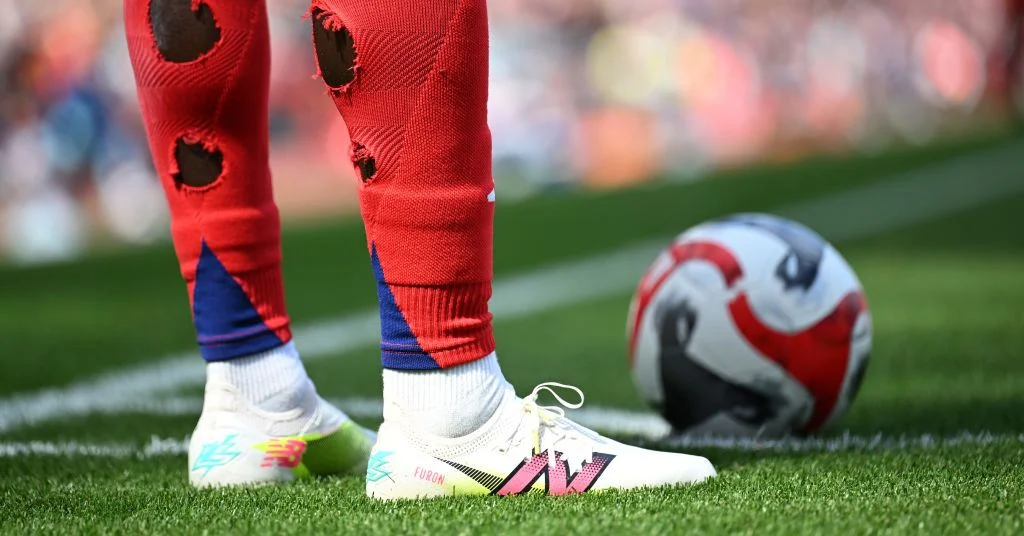
The sight of elite athletes competing on the world’s most prestigious stages with visibly tattered equipment has become an increasingly common anomaly in modern professional soccer. During the recent cycles of international competition, including the European Championships and the preparations for the 2026 World Cup, spectators have frequently observed star players taking the pitch with various circular or diamond-shaped perforations cut into the calf sections of their official team socks. While social media platforms often erupt with speculation regarding secret aerodynamic advantages or new wearable technologies, the reality of the practice is rooted in a complex intersection of biomechanics, material science, and sports psychology. Despite the prevalence of this DIY modification among the world’s highest-paid athletes, a significant gap remains between the players’ perceived benefits and the empirical evidence provided by sports medicine.
The Engineering of the Modern Soccer Sock
To understand why a player would choose to mutilate a piece of high-tech equipment, one must first examine the design intent of the modern soccer sock. For decades, the primary functions of the sock were rudimentary: to keep the shin guards in place and to provide a layer of protection between the skin and the boot. However, in the last twenty years, kit manufacturers like Nike, Adidas, and Puma have transformed the humble sock into a sophisticated piece of performance apparel.
Contemporary professional-grade socks are engineered using a blend of synthetic fibers, typically a combination of polyester, nylon, and a high percentage of elastane (spandex). These materials are chosen for their moisture-wicking properties and their ability to provide graduated compression. This compression is intended to serve several purposes: it stabilizes the lower leg muscles, reduces muscle oscillation (vibration) during impact, and promotes venous return—the process of blood flowing back to the heart. Furthermore, many modern socks feature specialized zones with varying degrees of tension to support the arch of the foot and the Achilles tendon, while integrated "grip" technologies on the sole prevent the foot from sliding inside the cleat.
The Biomechanical Conflict: Muscle Expansion vs. Fabric Tension
The conflict leading to the "holey sock" trend arises from the physiological changes that occur in an athlete’s leg during high-intensity exertion. The calf is composed primarily of two muscles: the gastrocnemius and the soleus. During a ninety-minute match, a soccer player may perform hundreds of sprints and rapid changes of direction. Each time a player pushes off the ground, these muscles contract with immense force.
Physiologically, when a muscle works at high intensity, blood flow to the area increases significantly to deliver oxygen and nutrients. This surge in blood volume, combined with the natural contraction of the muscle fibers, causes the calf to expand in circumference. For players with particularly hypertrophied (large) calf muscles, the standard-issue socks provided by kit manufacturers can begin to feel restrictive.
Athletes frequently report a sensation of "strangulation" or "tightness" as the match progresses and their muscles swell. This is not merely a matter of comfort; some players have complained of a tingling sensation or numbness, symptoms often associated with localized pressure on the nerves or a slight restriction in peripheral blood flow. In the mind of the athlete, cutting holes in the fabric serves as a "pressure valve," allowing the muscle to expand freely without the counter-pressure of the synthetic fibers.
A Chronology of the Trend: From Anomaly to Mainstream
The practice of modifying socks did not emerge overnight; it has evolved over the last decade from a niche habit into a widespread phenomenon.
2012–2014: The Early Adopters
Early instances of modified socks were seen in the English Premier League. Players like Kyle Walker were among the first to be photographed with small slits in their socks. At the time, it was viewed as a quirk of individual players rather than a tactical or physiological trend.
2018 World Cup: Global Visibility
The trend gained significant traction during the 2018 World Cup in Russia. England’s Danny Rose and Kyle Walker were frequently seen with multiple large holes in their socks. This prompted the first wave of mainstream media inquiries into the practice, with commentators questioning whether it violated FIFA’s strict kit regulations.
2020–2024: The Era of the Superstars
By the time of the 2020 European Championships (played in 2021) and the 2022 World Cup in Qatar, the practice had been adopted by some of the game’s biggest stars, including Jude Bellingham and Bukayo Saka. Bellingham, in particular, has become synonymous with the look, often sporting large, symmetrical holes that reveal the underlying skin or white "grip socks" worn underneath the team-colored sleeves.
Scientific Skepticism: Does It Actually Work?
While the anecdotal evidence from players is overwhelming, the scientific community remains largely unconvinced of any physiological performance benefit derived from cutting holes in socks. In fact, much of the existing research on sports compression suggests that the players might be counteracting the very benefits their equipment is designed to provide.
Sports medicine specialists point out that compression garments are specifically engineered to manage muscle inflammation and reduce the buildup of lactic acid. By maintaining a consistent level of pressure, these garments help prevent the "heavy leg" feeling that often sets in during the latter stages of a game. When a player cuts holes in the sock, they break the integrity of the compression gradient. This can lead to uneven pressure distribution, which theoretically could increase the risk of localized swelling or even minor muscle strains in the areas where the fabric is still tight.
Furthermore, there is no clinical evidence to suggest that the "tension" released by cutting a sock has any impact on the prevention of cramps. Cramping in elite athletes is typically the result of electrolyte imbalances, dehydration, or neuromuscular fatigue—factors that are unaffected by the external pressure of a nylon-blend fabric.
The Psychological Edge and the Placebo Effect
If the science does not support the physical benefits, why does the practice continue to spread? The answer likely lies in the realm of sports psychology. In high-stakes environments where the difference between winning and losing is measured in milliseconds, the "feeling" of being unrestricted can be as important as any objective physical advantage.
Sports psychologists often discuss the "placebo effect" in the context of athletic rituals. If a player believes that tight socks are hindering their ability to sprint, that belief itself can become a mental block. By cutting the socks, the player removes that perceived hindrance, leading to a boost in confidence and a sense of "lightness." This psychological comfort allows the athlete to focus entirely on the game rather than on a minor physical annoyance.
Moreover, soccer is a sport steeped in superstition and ritual. When younger players see established stars like Jude Bellingham performing at a world-class level with holes in their socks, they may mimic the behavior in hopes of achieving similar success, regardless of the physiological logic behind it.
Regulatory Responses and Equipment Standards
The trend has placed governing bodies like FIFA and UEFA in a difficult position regarding kit regulations. According to Law 4 of the IFAB (International Football Association Board) Laws of the Game, "Players must not wear equipment or any other item that is dangerous." The rules also state that "the two socks must be the same color as the main color of the shirt or shorts."
Historically, officials have been strict about "uniformity." For instance, if a player wears athletic tape over their socks, the tape must be the same color as the sock. However, the rules do not explicitly forbid small tears or modifications to the fabric, provided the shin guards remain fully covered and the modifications do not pose a safety risk to other players. To date, no major governing body has issued a fine or a ban for "holey socks," though some referees have requested players to tidy up excessively ragged modifications to maintain a professional appearance on broadcast.
Implications for the Future of Athletic Apparel
The persistence of this trend suggests a potential disconnect between how kit manufacturers design equipment and how athletes actually experience it. The move toward "one-size-fits-most" compression socks may not be suitable for the extreme muscularity of professional soccer players’ lower legs.
In response, we are beginning to see a shift in the industry. Some manufacturers are experimenting with "variable-knit" technology, which allows for higher elasticity in the calf area while maintaining high compression in the ankle and arch. Additionally, many professional players have moved away from traditional full-length socks entirely, opting to wear "sleeves" (socks without feet) combined with specialized "grip socks." This allows them to customize the tension and fit of their footwear and legwear separately.
As we approach the 2026 World Cup, the "holey sock" phenomenon serves as a reminder that in the world of elite sports, the athlete’s perception of comfort and freedom will always trump the intended engineering of their equipment. Whether it is a legitimate biomechanical necessity or a widespread psychological ritual, the sight of perforated socks is likely to remain a staple of the beautiful game for years to come.
