

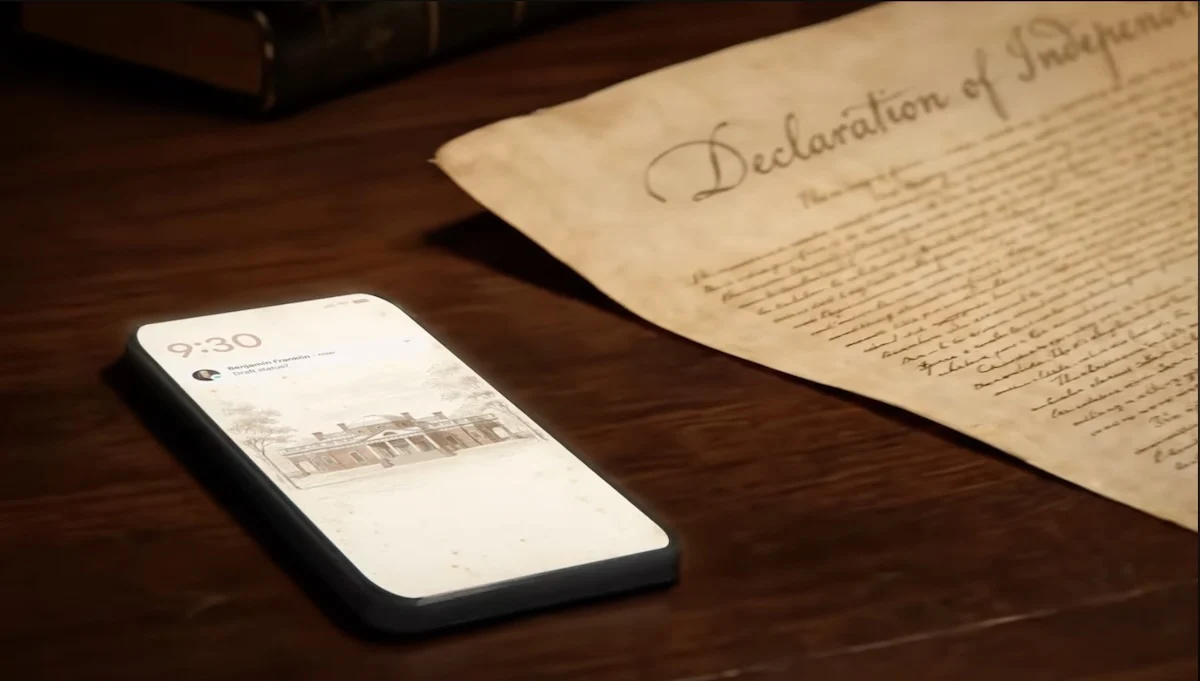
In a high-profile marketing move timed for the United States Semiquincentennial, Google has released a new commercial that explores an alternative history where the Founding Fathers utilized modern digital collaboration tools. The advertisement, titled "Group project, but make it 1776," serves as a centerpiece for Google’s 2026 brand campaign, showcasing the integration of Google Workspace and the Gemini artificial intelligence suite within the context of the nation’s founding. The campaign attempts to bridge the gap between 18th-century revolutionary ideals and 21st-century productivity software, depicting the drafting of the Declaration of Independence as a chaotic yet synchronized cloud-based collaboration.
The commercial opens with Thomas Jefferson working on an early draft of the document. The scene quickly shifts from the traditional image of a solitary writer with a quill to a digital environment where Benjamin Franklin sends a nagging text message to Jefferson’s mobile device. This sets the stage for a series of rapid-fire demonstrations of Google’s ecosystem. The ad features edits being made in real-time via Google Docs, a legislative meeting organized through Google Calendar, and a remote session held on Google Meet. Notably, the ad includes a humorous nod to modern corporate culture, showing a video call where every attendee has their camera turned off, leaving only static avatars to represent the revolutionary figures. The process culminates in the finalization of the document through e-signatures, followed by a celebratory display of digital fireworks.
The Integration of Generative AI in Historical Narrative
A significant portion of the advertisement is dedicated to Google’s generative AI capabilities, reflecting the technological landscape of 2026. Unlike previous marketing efforts that faced criticism for suggesting AI could replace human sentiment, this campaign positions AI as a supportive administrative and creative assistant. The fictionalized Founding Fathers are seen using Google’s "Help me visualize" tool to experiment with different animal designs for the Great Seal of the United States.
Furthermore, Gemini is shown taking automated minutes during the Continental Congress’s virtual meetings, summarizing key points of debate. In a moment intended for comedic effect, the founders consult the Gemini chatbot for advice on a document access request from King George III. Following the AI’s prompt, they move to "decline" the request, reinforcing the theme of independence through a digital interface.
Industry analysts note that this approach represents a strategic pivot for Google. In early 2024, the company faced significant backlash for a Super Bowl advertisement that depicted a father using AI to write a fan letter for his daughter. That ad was criticized for suggesting that AI should mediate personal human connections. In contrast, the 1776 campaign carefully avoids implying that Gemini wrote the actual text of the Declaration. Instead, the AI handles the "busy work"—visualizing concepts, taking notes, and managing permissions—leaving the "self-evident truths" to the human authors.
Historical Context and the Committee of Five
To understand the scale of the parody, it is necessary to contrast the advertisement with the actual historical events of 1776. The drafting of the Declaration of Independence was handled by the "Committee of Five," consisting of Thomas Jefferson, Benjamin Franklin, John Adams, Roger Sherman, and Robert R. Livingston. Historically, the process was one of physical movement and manual labor. Jefferson wrote the first draft over the course of roughly 17 days in a rented house in Philadelphia.
The draft then underwent a rigorous review process by Adams and Franklin before being submitted to the full Congress. Between June 11 and June 28, 1776, the document was a physical parchment moved from hand to hand. Google’s advertisement reimagines this two-week period as a matter of hours or days, facilitated by instant notifications and concurrent editing. By replacing the "fair copy" parchment with a Google Doc, the ad highlights the evolution of document version control, a far cry from the original "Rough Draught" which contains numerous strike-throughs and marginalia still visible to historians today.
Technical Execution and the "Uncanny" Aesthetic
Observers have pointed out that the visual style of the commercial itself appears to be a product of the very technology it promotes. The footage possesses a distinct "uncanny glow," characterized by hyper-realistic textures and slightly fluid movements often associated with high-end AI-generated video. While Google has not explicitly confirmed the percentage of the ad generated by its Veo or Sora-competitor models, the aesthetic aligns with the 2026 trend of "AI-first" filmmaking in the advertising industry.
This visual choice has sparked a technical debate among creators. Some view the use of AI-generated footage as a meta-commentary on the theme of the ad, while others argue it creates a disconnect from the historical period it seeks to parody. The lighting, which appears perpetually golden and filtered, mimics the "prestige television" look but with a digital precision that suggests algorithmic optimization rather than traditional cinematography.
Market Reception and Social Media Polarization
The public response to the campaign has been sharply divided along platform lines, reflecting broader societal views on the encroachment of AI into historical and cultural spheres. On mainstream platforms such as YouTube and Instagram, the sentiment has been largely positive. Users have praised the "tongue-in-cheek" humor, particularly the joke involving Sam Adams suggesting the group settle their differences over beers—a nod to the brewing legacy that bears his name.
However, the reception on Bluesky and among academic circles has been considerably more critical. Historians and tech skeptics have labeled the commercial as "cringey" and "tone-deaf." A primary point of contention is the trivialization of political organizing. Historian Angus Johnston remarked on the platform that even within the context of a "corny fantasy joke," the ad fails to make a compelling case for AI as a genuine tool for revolutionary collaboration.
"It’s amazing how little of this is actually AI, yet they insist on centering it," Johnston noted, referring to the fact that the core of the ad’s "usefulness" comes from standard cloud editing features that have existed for over a decade. The criticism suggests that by framing the American Revolution as a "group project," Google may be oversimplifying the gravity of the historical event to sell subscription software.
Data and Trends: AI in the 2026 Advertising Landscape
The "Group project, but make it 1776" ad is part of a broader surge in AI-integrated marketing. Data from the first half of 2026 indicates that nearly 65% of Fortune 500 companies have featured generative AI in their primary television campaigns. This is a significant increase from 2024, where the technology was often relegated to experimental or tech-specific spots.
Recent Super Bowl 60 ads from brands like Svedka and Anthropic have also leaned heavily into AI themes, ranging from fully AI-generated visuals to narratives centered on human-AI partnerships. Google’s decision to use the 250th anniversary of the United States as a backdrop is seen as an attempt to "Americanize" and normalize AI, moving it away from the perception of a cold, disruptive force and toward a tool of national heritage and efficiency.
Broader Implications for Digital Labor and History
The commercial raises deeper questions about how society perceives the "work" of creativity and governance. By depicting the Founding Fathers as being bogged down by administrative tasks—scheduling, note-taking, and file permissions—Google reinforces a modern corporate worldview where the primary barrier to genius is "friction."
However, critics argue that the "friction" of the 18th century—the slow letters, the face-to-face debates, and the physical act of writing—was essential to the deliberative process of the time. The implication that the Declaration of Independence was simply a "group project" that needed better software suggests a shift in how we value the process of creation versus the speed of the output.
As the United States continues its year-long Semiquincentennial celebration, the Google Workspace ad stands as a marker of the current era’s technological priorities. It represents a moment where the largest tech entities are no longer just providing tools for the future, but are actively rewriting the visual and conceptual language of the past to fit a digital-first narrative. Whether this "AI evangelism" will result in increased user adoption or continued cultural pushback remains to be seen as the campaign continues to circulate through the 2026 holiday season.
