

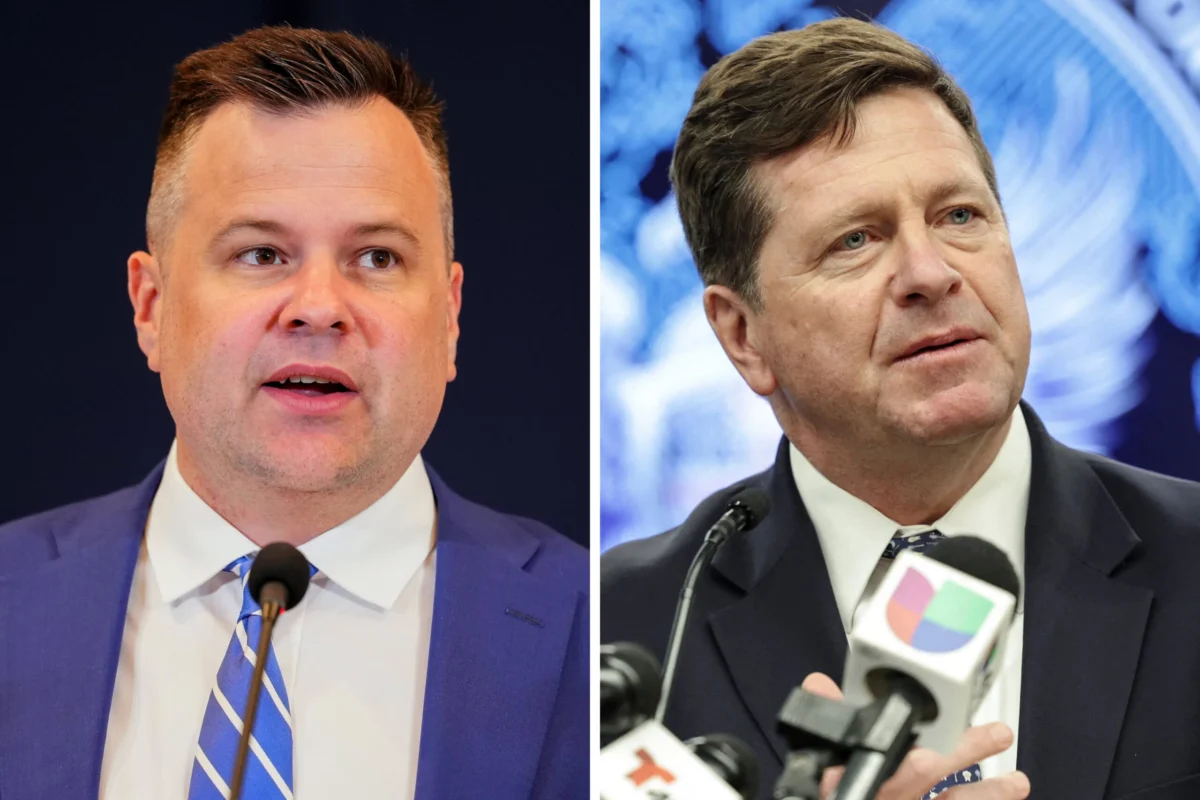
In an abrupt and highly unusual move, President Donald Trump announced Wednesday the cancellation of the confirmation hearing for Jay Clayton, his nominee to become the Director of National Intelligence (DNI). The decision, communicated via a social media post just hours before the scheduled Senate Intelligence Committee session, has cast a shadow over critical national security functions, most notably the reauthorization of Section 702 of the Foreign Intelligence Surveillance Act (FISA), which expired last week. The sudden halt to the confirmation process also highlighted escalating tensions between the White House and Congress, revealing a complex web of presidential demands tied to unrelated legislative priorities and controversial appointments.
The Unforeseen Halt: President Trump’s Direct Intervention
The morning began with anticipation for the confirmation hearing of Jay Clayton, the U.S. Attorney for the Southern District of New York, a widely respected figure in legal and financial circles, for the crucial DNI post. However, this expectation was shattered by an early morning post from President Trump on Truth Social. In a detailed and grievance-laden message, the President declared, "Regarding the approval of our Great Patriot, Jay Clayton, we are cancelling the Senate Hearing RE: DNI today, and will not be going forward until Jamie McDonald is approved to be U.S. Attorney." He further asserted, "In the meantime, Bill Pulte will remain as the Acting Director of National Intelligence."
This directive immediately threw the confirmation process into disarray, prompting the Senate Intelligence Committee to confirm the postponement. Senator Tom Cotton (R-Ark.), the committee’s chair, issued a statement expressing regret but affirming the President’s instruction. "It’s regrettable that the president has directed Jay Clayton not to appear at his confirmation hearing today," Cotton stated via an X post. While praising Clayton as "a patriot and a highly qualified nominee," Cotton noted the hearing’s unfortunate postponement, expressing hope for its resumption "in the near future." The President’s decision, communicated directly through social media rather than traditional White House channels, underscored a pattern of unconventional executive actions that frequently challenge established political norms.
The Director of National Intelligence: A Pivotal Role in National Security
The Director of National Intelligence is one of the most critical national security positions within the U.S. government. Established in the wake of the September 11, 2001, terrorist attacks through the Intelligence Reform and Terrorism Prevention Act of 2004, the DNI serves as the principal advisor to the President on intelligence matters and oversees the vast U.S. Intelligence Community (IC). This community comprises 18 organizations, including agencies like the CIA, NSA, FBI, and components of the military and Treasury departments. The DNI’s role is to integrate foreign, military, and domestic intelligence, ensuring that policymakers receive timely, accurate, and comprehensive information necessary for national security decisions. The DNI also manages the National Intelligence Program budget and establishes intelligence priorities.
Jay Clayton, nominated by President Trump for this demanding role, brings a distinguished background to the table. As the U.S. Attorney for the Southern District of New York, a position he held prior to this nomination, Clayton oversaw some of the nation’s most complex and high-profile legal cases, particularly in areas of financial crime and national security. Before his tenure at SDNY, he served as the Chairman of the Securities and Exchange Commission (SEC) from 2017 to 2020, where he spearheaded initiatives related to capital formation, market modernization, and investor protection. His experience navigating complex regulatory landscapes and managing large organizations, coupled with his legal acumen, made him a seemingly strong candidate for the DNI post, one who was widely expected to garner bipartisan support in the Senate. The abrupt cancellation of his hearing, therefore, came as a surprise to many observers, particularly given his perceived qualifications.
The Controversial Figure: Acting DNI Bill Pulte
A central element of President Trump’s rationale for delaying Clayton’s confirmation revolved around the status of Bill Pulte, the current acting Director of National Intelligence. Pulte, who also serves as the director of the Federal Housing Finance Agency (FHFA), has been a lightning rod for criticism, particularly from Democrats. Critics argue that Pulte lacks any meaningful intelligence experience, a stark contrast to the traditional profiles of DNI nominees who typically possess extensive backgrounds in intelligence, diplomacy, or national security.
Democrats have vociferously opposed Pulte’s continued presence in the DNI role, viewing him as a partisan operative rather than an objective intelligence chief. Accusations have surfaced that Pulte has used his federal position, including his role at the FHFA, to advance political agendas and target perceived enemies of the President. This perception has led to a firm stance from Democrats, who have vowed to block any reauthorization of FISA Section 702 as long as Pulte remains in an acting capacity. Senator Mark Warner (D-Va.), the ranking member of the Intelligence Committee, has been particularly vocal in his criticism, articulating concerns about the politicization of intelligence under Pulte’s leadership. The President’s insistence on Pulte remaining as acting DNI, despite the significant Democratic opposition and the clear impediment it poses to critical legislative processes, underscores a willingness to prioritize political loyalty over the conventional functioning of government.
FISA Section 702: A Lapsed Cornerstone of National Security
Perhaps the most immediate and significant consequence of the stalled DNI confirmation is the imperiled reauthorization of Section 702 of the Foreign Intelligence Surveillance Act. This critical intelligence-gathering authority, which expired just last week, allows the U.S. government to conduct warrantless surveillance of non-U.S. persons located outside the United States for foreign intelligence purposes. While explicitly targeting foreign individuals, Section 702 operations can incidentally collect communications involving U.S. citizens and residents, a point of significant contention and debate among civil liberties advocates and some members of Congress.
Intelligence officials and national security experts widely regard Section 702 as indispensable for protecting the nation from a range of threats, including terrorism, cyberattacks, espionage, and foreign malign influence. It is a cornerstone for agencies like the National Security Agency (NSA) and the Federal Bureau of Investigation (FBI) to gather vital intelligence on foreign adversaries. The lapse in authority means that the intelligence community’s ability to monitor these crucial foreign targets has been severely curtailed, potentially creating dangerous blind spots in national security.
The debate surrounding Section 702 has often pitted national security imperatives against concerns over privacy and civil liberties. Reform advocates have pushed for stricter oversight, particularly regarding "U.S. person queries"—the practice of searching collected data for information pertaining to American citizens. Despite these concerns, there has been a broad, bipartisan consensus on the necessity of reauthorizing the authority, albeit with potential modifications. The current impasse, exacerbated by the DNI confirmation delay and other presidential demands, leaves a critical gap in the nation’s intelligence capabilities at a time of heightened global instability. Without a confirmed DNI to advocate for and oversee intelligence operations, the legislative path for 702 reauthorization becomes even more convoluted.
The SDNY Succession Saga: Jamie McDonald’s Unconfirmed Nomination
Another key condition set by President Trump for proceeding with Clayton’s DNI hearing was the confirmation of Jamie McDonald as the U.S. Attorney for the Southern District of New York. This demand creates a perplexing circular problem: Clayton’s DNI nomination is on hold until his successor at SDNY, McDonald, is confirmed, but according to sources familiar with the nomination process, the White House had not even formally sent McDonald’s nomination to the Senate. This bureaucratic delay means that the first step toward confirming McDonald—the formal submission of his name—had not even occurred, effectively ensuring a prolonged delay in Clayton’s DNI confirmation.
The U.S. Attorney for the Southern District of New York is a highly influential and sensitive position, overseeing a jurisdiction known for prosecuting high-profile financial crimes, terrorism cases, and public corruption. The office has historically been a launching pad for prominent legal careers and is often at the forefront of significant legal battles. The lack of a confirmed U.S. Attorney for SDNY, combined with the acting status of the DNI, highlights a broader issue of unconfirmed leadership in critical federal positions, potentially impacting the continuity and effectiveness of government operations.
The "SAVE America Act": A New Legislative Condition
Adding another layer of complexity to the already convoluted situation, President Trump also explicitly linked the reauthorization of FISA to the passage of a controversial voter-ID bill known as the "SAVE America Act." In his Truth Social post, he declared, "Therefore, to add a slight bit of intrigue but, for the Good of the Nation, and the People of our Country, I will not approve FISA without THE SAVE AMERICA ACT going along with it."

The SAVE America Act is presented by its proponents as a measure to enhance election integrity by requiring stricter voter identification. However, it is vehemently opposed by Democrats, who view such legislation as a thinly veiled attempt at voter suppression, disproportionately affecting minority voters, the elderly, and low-income individuals who may face challenges in obtaining required identification. Attaching a highly contentious piece of electoral legislation to a critical national security authorization like FISA is an unprecedented move, further polarizing an already fractured Congress and making compromise exceedingly difficult. Democrats have unequivocally stated their refusal to support the SAVE America Act, creating a legislative standoff that appears intractable under the current conditions.
Congressional Reactions: Frustration and Alarm
The President’s intervention elicited strong reactions across the political spectrum in Congress, underscoring deep frustration with the White House’s approach to legislative and nomination processes.
Senator Tom Cotton, while deferring to the President’s directive, could not hide his disappointment. His statement, emphasizing Clayton’s qualifications and patriotism, subtly conveyed the Senate Intelligence Committee’s readiness and preference to proceed.
Senator Mark Warner, the top Democrat on the Intelligence Committee, minced no words, calling Trump’s about-face an "extraordinary display of dysfunction." In a statement, Warner asserted, "The president’s latest intervention only underscores a simple reality: the biggest obstacle to resolving these issues has not been Senate Democrats or Senate Republicans. It has been the chaos and confusion coming from the White House itself." Later, in a press conference, Warner even questioned the definitive status of Clayton’s nomination, pondering aloud, "I wonder whether Jay Clayton knows whether he has been postponed or withdrawn," highlighting the lack of clear communication and the resulting uncertainty.
Republicans, some of whom have also expressed private concerns about Bill Pulte’s suitability for the DNI role, are caught in a difficult position. They are eager to confirm Clayton to pave the way for FISA reauthorization but are now directly hampered by their party’s leader. Senate Majority Leader John Thune (R-S.D.) acknowledged the uncertainty, stating the Senate would "have to take it a day at a time ’til we get more clarity on kind of what the White House position is." Even staunch Trump allies expressed exasperation. Senator Kevin Cramer (R-N.D.), a loyal supporter, openly vented his frustration: "Frankly, I was disappointed again that while Sen. Thune has very meticulously and skillfully managed a process that ends up with another Trump victory gets upended by an impulsive post of some sort. It’s frustrating, but it’s also not that abnormal these days." Cramer’s comments reflect a growing sentiment among some Republicans who feel that the President’s unpredictable actions undermine the painstaking work of congressional leaders.
Broader Implications: National Security, Political Gridlock, and Executive Authority
The confluence of these events carries significant implications for national security, political dynamics, and the functioning of executive and legislative branches.
National Security Risks: The prolonged lapse of FISA Section 702 creates undeniable intelligence gaps. Without this authority, the U.S. intelligence community’s ability to track and disrupt foreign adversaries, terrorist plots, and cyber threats is diminished. This could potentially leave the nation vulnerable to attacks or allow foreign intelligence services to operate with greater impunity. The urgency of reauthorization cannot be overstated in a complex global threat landscape.
Deepening Political Gridlock: The President’s decision to link the DNI confirmation, a critical national security appointment, to the confirmation of a U.S. Attorney and the passage of a controversial voter-ID bill represents an unprecedented politicization of essential government functions. This strategy is likely to exacerbate the already deep partisan divisions in Washington, making compromise on any of these issues significantly harder. The demands create a multi-layered legislative and nomination hostage situation, where unrelated priorities are intertwined, stifling progress.
Challenges to Executive-Legislative Relations: The President’s use of social media to announce major policy shifts and impose new legislative conditions bypasses traditional channels of communication and negotiation with Congress. This approach, while a hallmark of the administration, generates friction, confusion, and resentment among lawmakers, including those within his own party. It undermines the Senate’s constitutional role in advice and consent for nominations and complicates legislative efforts.
Uncertainty for Key Leadership Roles: The DNI position is too critical to remain in an acting capacity for an extended period, especially with an individual who lacks intelligence experience and faces strong opposition. An acting DNI typically has limited authority and influence compared to a confirmed official, which could hinder strategic planning and coordination within the IC. Similarly, the delay in confirming a U.S. Attorney for SDNY leaves another vital law enforcement position in limbo.
Erosion of Norms: The current situation further chips away at established norms regarding presidential appointments and legislative processes. Tying unrelated and highly contentious legislation to critical national security authorities sets a dangerous precedent, potentially leading to future impasses where essential government functions are held hostage to political demands.
The Path Forward: A Murky Outlook
The immediate path forward appears shrouded in uncertainty. For Jay Clayton, his nomination for DNI is now in limbo, potentially withdrawn or indefinitely postponed, leaving him in a precarious professional position. For Jamie McDonald, his nomination to SDNY remains unsubmitted, preventing any progress. For Bill Pulte, his controversial tenure as acting DNI is extended, much to the chagrin of Democrats. And for FISA Section 702, its critical reauthorization faces a prolonged and uncertain battle, with national security implications growing by the day.
The ball is now firmly in the White House’s court. Whether President Trump will eventually separate his demands, or if Congress can find a way to navigate this complex political minefield, remains to be seen. What is clear is that the current impasse represents a significant challenge to the effective functioning of the U.S. government, impacting everything from intelligence operations to the very fabric of democratic processes. The situation underscores the deep divisions within American politics and the profound consequences when those divisions spill over into critical national security matters.
