

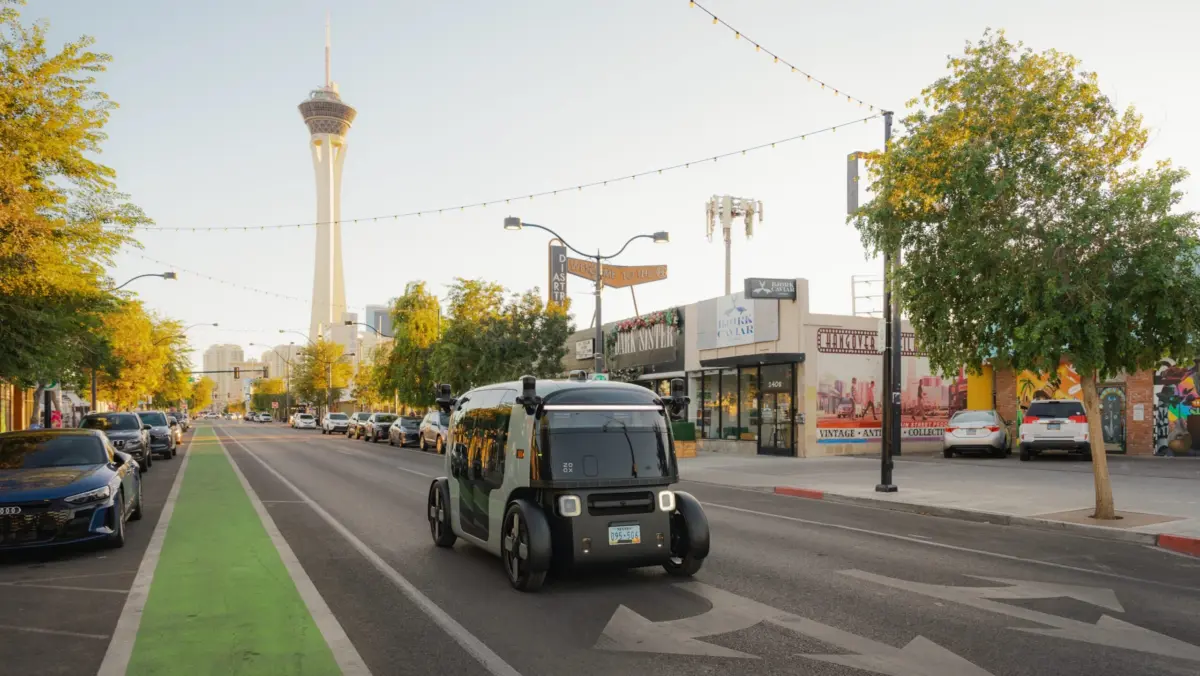
Zoox, the autonomous vehicle subsidiary of Amazon, has announced a significant expansion of its commercial robotaxi operations in Las Vegas, marking a pivotal moment in the company’s efforts to scale its unique, purpose-built transportation solution. Moving beyond its initial pilot zone on the world-famous Las Vegas Strip, the company is now deploying its fleet into the city’s Downtown corridor and the thriving Arts District. This expansion is accompanied by a substantial increase in operational availability, with vehicles now running from 6:00 a.m. to 3:00 a.m. daily, effectively covering the peak transit hours for both commuters and the city’s massive tourism sector.
This strategic growth follows a series of successful high-traffic integrations at major venues, including Harry Reid International Airport, the Sphere, and T-Mobile Arena. The move into Downtown and the Arts District signals Zoox’s transition from a novelty tourist attraction to a legitimate component of the Las Vegas urban transit infrastructure. By connecting the airport directly to major resort venues and local cultural hubs, Zoox is positioning itself as a comprehensive alternative to traditional ride-hailing services and short-range car rentals.
A New Era for the Purpose-Built Robotaxi
Unlike its primary competitors, such as Alphabet’s Waymo or General Motors’ Cruise, which utilize modified production vehicles equipped with sensors, Zoox has championed a "ground-up" philosophy. The expansion in Las Vegas features the latest evolution of the Zoox robotaxi, which introduces a refined, lighter interior designed to maximize passenger comfort.

The vehicle is characterized by its distinct carriage-style seating, where four passengers face each other in a symmetrical cabin. Because the vehicle is bidirectional—meaning it has no defined front or back—it can navigate tight urban spaces and dead-end streets without the need for complex three-point turns. The absence of a steering wheel, pedals, and a traditional driver’s seat allows for a spacious interior that prioritizes the rider experience.
Aicha Evans, CEO of Zoox, emphasized that the goal is to transform ride-hailing from a functional necessity into a "delightful experience." She noted that 2026 has become a definitive year for the autonomous vehicle industry, as technology that once seemed experimental has finally reached commercial maturity.
Strategic Integration: Harry Reid International Airport and Major Venues
One of the most critical aspects of the expansion is the enhanced service at Harry Reid International Airport. Navigating airport logistics is a notorious challenge for autonomous driving systems due to the high density of pedestrians, erratic driving behavior from human motorists, and complex terminal layouts. Zoox has established dedicated pickup and drop-off zones at Terminal 1 departures and the baggage claim areas of both Terminal 1 and Terminal 3.
The timing of this airport expansion is notable within the broader political and social landscape of late 2026. Following a significant shift in the U.S. political climate during the midterm elections, there has been renewed focus on smart city infrastructure and the integration of green technology into public transit hubs. Zoox’s presence at an airport named after the late Senator Harry Reid serves as a symbolic intersection of traditional Nevada political legacy and the state’s future as a tech-forward economy.

Beyond the airport, Zoox has solidified its presence at "partner destinations" such as Resorts World, AREA15, and the Sphere. These locations provide "premier" pickup spots, ensuring that riders do not have to search for their vehicles in crowded, generic rideshare lanes.
User Experience and the "FindMyZoox" Feature
To address the logistical hurdles of identifying an autonomous vehicle in a sea of traffic, Zoox has introduced "FindMyZoox." This feature allows the robotaxi to communicate with the passenger through synchronized light and sound cues. When a rider approaches the designated pickup zone, the vehicle emits a specific light pattern and audio signal, making it easily identifiable even in the neon-heavy environment of the Las Vegas Strip.
The Zoox mobile app, available on both iOS and Android, serves as the central interface for the service. It provides real-time updates, estimated pickup times, and license plate identification. Furthermore, the app includes a "Help" feature that connects riders to a remote support team. While the vehicles operate entirely without a human driver on board, Zoox maintains a "human-in-the-loop" safety architecture where remote technicians can provide high-level guidance or assistance if the vehicle encounters an unprecedented road obstruction.
Chronology of Zoox in Las Vegas
The journey to this expansion has been defined by incremental milestones and rigorous safety testing:

- 2020: Amazon acquires Zoox for an estimated $1.2 billion, providing the capital necessary to pursue a purpose-built vehicle strategy.
- Early 2023: Zoox becomes the first company to operate a purpose-built robotaxi without traditional controls on public roads in California, albeit in a limited employee shuttle capacity.
- September 10, 2025: Zoox officially launches its public service in Las Vegas, focusing initially on the areas surrounding the Strip.
- Early 2026: The company begins testing at Harry Reid International Airport and high-capacity entertainment venues.
- Late 2026: Commercial expansion into Downtown Las Vegas and the Arts District is finalized, alongside the debut of the updated vehicle interior and extended 21-hour daily service.
Market Context and Competitive Landscape
The expansion of Zoox comes at a time of intense competition in the autonomous vehicle (AV) sector. As of late 2026, the industry is dominated by a "Big Three" in the United States: Waymo, Zoox, and a resurgent Cruise.
Waymo remains the incumbent leader in terms of total miles driven and geographic footprint, with established operations in Phoenix, San Francisco, and Los Angeles. However, Zoox’s carriage-style interior offers a unique value proposition for groups and tourists, a demographic that is particularly lucrative in the Las Vegas market.
The economic implications of this expansion are significant. Las Vegas serves as a "living laboratory" for AV companies due to its unique traffic patterns—characterized by high nighttime activity and a constant influx of visitors who are not familiar with the city’s geography. Success in Las Vegas is often seen as a prerequisite for scaling to other high-density tourist destinations like Orlando or New Orleans.
Regulatory and Safety Analysis
Nevada has long been at the forefront of autonomous vehicle regulation, offering a more permissive environment than California or New York. The Nevada Department of Motor Vehicles (DMV) was the first in the nation to establish a licensing framework for autonomous vehicles.

Zoox’s safety strategy relies on a multi-modal sensor suite involving LiDAR, radar, and cameras, providing a 360-degree field of vision with significant redundancy. The "purpose-built" nature of the vehicle also allows for unique safety features, such as specialized airbag systems designed for the inward-facing carriage seating.
Critics of the industry often point to "edge cases"—unpredictable events like extreme weather or erratic pedestrian behavior—as the ultimate hurdle for full autonomy. However, by restricting service to a 6:00 a.m. to 3:00 a.m. window, Zoox is able to avoid the most unpredictable hours of the early morning while still capturing the vast majority of the city’s transit demand.
Broader Impact and Future Outlook
The expansion into the Arts District is perhaps the most telling sign of Zoox’s long-term ambitions. Unlike the Strip, which is almost exclusively tourist-driven, the Arts District is a hub for local businesses, galleries, and residents. By moving into these neighborhoods, Zoox is testing its ability to handle more "organic" urban environments that lack the rigid, predictable flow of the resort corridors.
As 2026 draws to a close, the "Year of the Robotaxi" has proven that autonomous mobility is no longer a futuristic concept, but a present-day utility. For Las Vegas, the arrival of Zoox in Downtown and the Arts District represents a shift toward a more integrated, electric, and driverless future.

Looking ahead, Zoox is expected to leverage the data gathered from this Las Vegas expansion to refine its service for other markets, including San Francisco and Seattle. The company’s focus on the "journey as an experience" suggests that the future of urban transit may lie not just in getting from point A to point B, but in providing a private, social space that operates seamlessly within the fabric of a smart city. With the support of Amazon’s logistics expertise and a growing fleet of custom-designed vehicles, Zoox is well-positioned to remain a leader in the rapidly evolving landscape of global mobility.
