

The global landscape of business education is undergoing a profound transformation as the 17th annual Corporate Knights Better World MBA ranking reveals a decisive move toward accountability and real-world impact. For more than a decade, research has consistently highlighted a growing sense of urgency among the youth, who remain deeply concerned by the climate crisis and the perceived inertia of global governments. In response, the 2026 ranking serves as a critical guide for prospective students seeking programs that do not merely discuss sustainability as a peripheral topic but embed it into the core of corporate decision-making. This year’s results see Maastricht University’s School of Business and Economics in the Netherlands ascending to the top spot, signaling a shift in how academic excellence is defined in the era of the Great Transition.
The 2026 methodology marks a significant departure from previous years, reflecting an evolving educational sector. Corporate Knights has introduced two pivotal changes to its evaluation criteria to ensure that the rankings reflect genuine pedagogical depth rather than superficial "greenwashing." First, the weight of graduate-impact metrics has been doubled. This adjustment prioritizes institutions that can demonstrate a clear pipeline from the classroom to high-impact roles where alumni actively influence clean energy transitions and sustainable corporate strategies. Second, the ranking now awards bonus marks to schools that implement rigorous, standardized testing—such as the Sustainability Knowledge Assessment (TASK) by Sulitest—to verify that students have truly mastered the complexities of sustainable development before graduation.
A New Hierarchy in Business Education
The rise of Maastricht University to the number-one position (up from third in 2025) underscores the effectiveness of a holistic approach to business education. Celebrating its 50th anniversary, the Maastricht MBA program is designed for seasoned professionals, requiring an average of 15 years of business experience. By integrating courses like "Sustainability Science, Policy, and Society" into the very beginning of the curriculum, the school ensures that sustainability is viewed not as a specialized elective but as a foundational lens through which all business functions are viewed.

Following closely in second place is the University of Cape Town (UCT) Graduate School of Business in South Africa. Moving up from seventh place in 2025, UCT’s performance highlights the growing importance of emerging market perspectives in the climate conversation. The school’s leadership emphasizes that sustainability is a strategic imperative rather than a public relations exercise. At UCT, the curriculum forces students to move beyond traditional financial modeling to explore the socio-economic consequences of business decisions on local communities and the planet.
The third spot is shared by the Grossman School of Business at the University of Vermont and the previous year’s leader, Griffith Business School in Australia. While Griffith saw a slight relative decline in the rankings, it remains a global leader in values-led education. The institution has integrated sustainability into its 2025–2030 strategic plan, with an ambitious target to achieve net-zero emissions by 2029. This commitment to internal institutional sustainability mirrors the lessons taught in its classrooms, reinforcing the school’s credibility as a leader in the field.
Addressing the "AI Headwind" and Sustainability Slippage
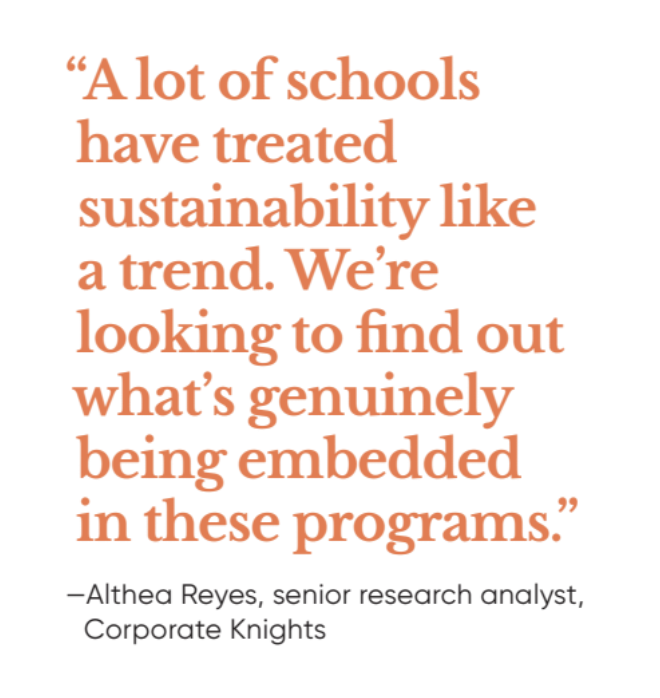
One of the most concerning trends identified by Corporate Knights researchers is a recent "slippage" in the sustainability focus of many MBA programs. Althea Reyes, a senior research analyst at Corporate Knights, noted that the rapid rise of artificial intelligence has, in some instances, diverted academic attention and resources away from the climate crisis. "A lot of schools have treated sustainability like a trend," Reyes observed, emphasizing that the 2026 ranking aims to distinguish between schools that are following the latest headlines and those that are genuinely embedding sustainable principles into their DNA.
The methodology’s focus on core MBA programs—rather than specialized climate degrees—is intentional. The goal is to transform the "standard" business leader. By evaluating how sustainability is integrated into traditional finance, marketing, and operations courses, the ranking challenges the notion that environmental stewardship is a separate department. The inclusion of bonus marks for standardized testing is a direct response to this need for rigor, rewarding schools that move beyond "attendance-based" learning toward "mastery-based" evaluation.
The Canadian Resurgence and Regional Performance
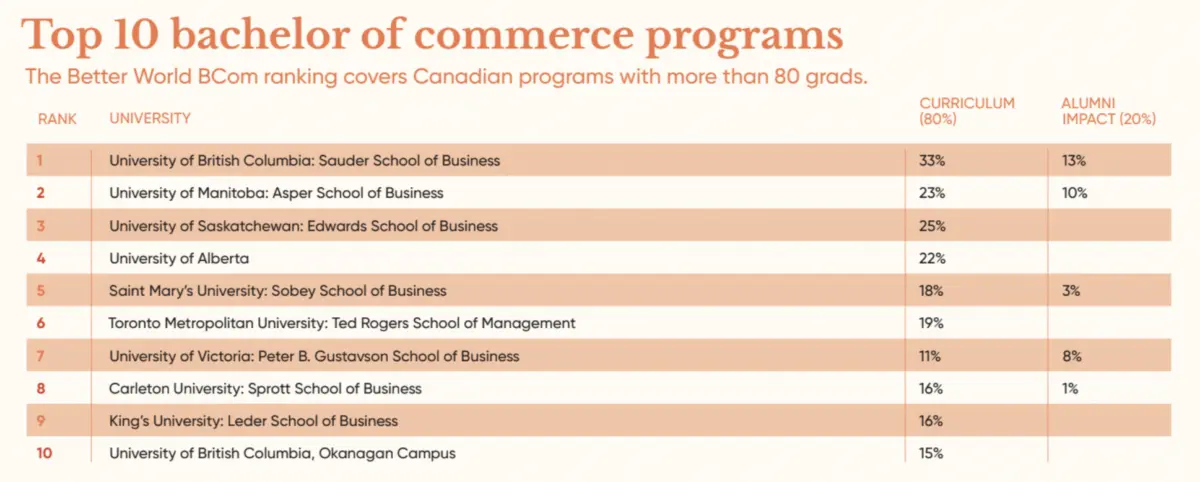
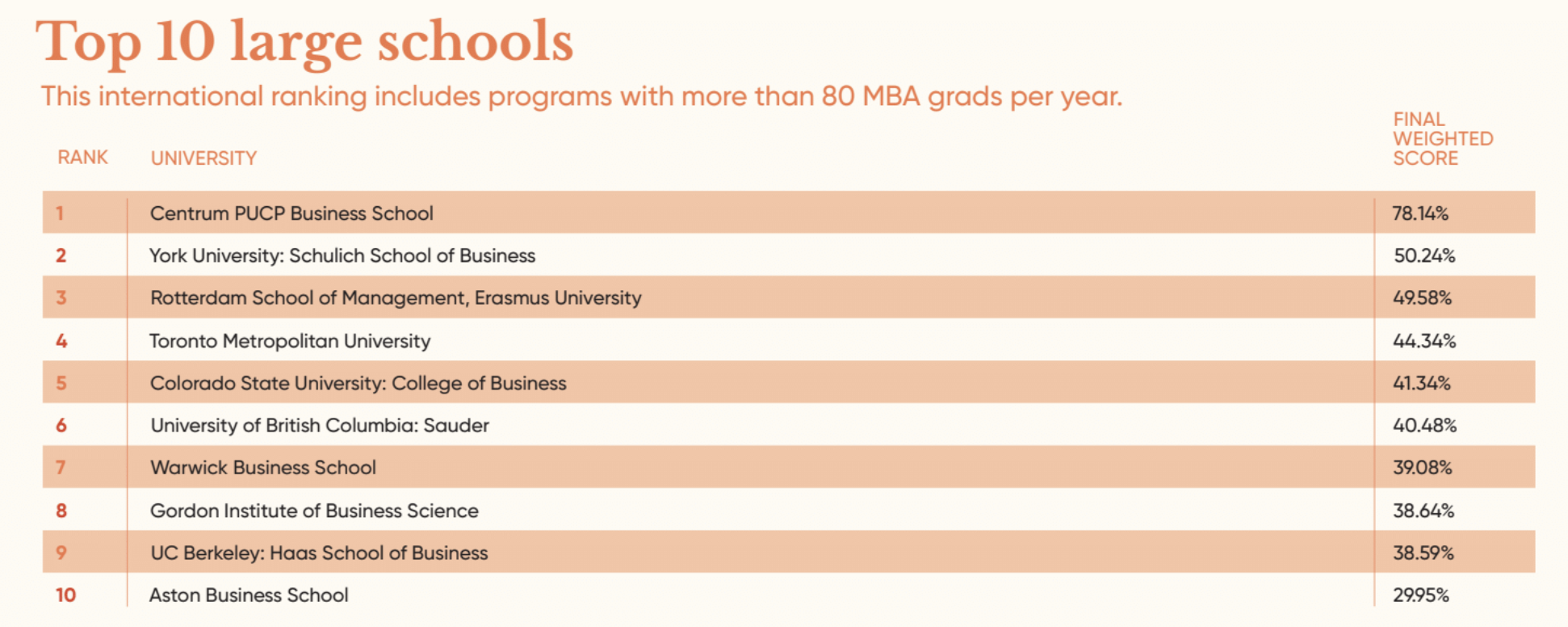
Canada continues to punch above its weight in the realm of sustainable business education. The University of Victoria’s Peter B. Gustavson School of Business climbed to sixth place globally, leading a strong contingent of Canadian institutions. Other notable Canadian performers include York University’s Schulich School of Business (17th), Toronto Metropolitan University (19th), HEC Montréal (20th), the University of British Columbia’s Sauder School of Business (23rd), the University of Guelph (25th), and McGill University’s Desautels Faculty of Management (34th).
The Peter B. Gustavson School of Business stands out for its "Sustainable Innovation" MBA, which targets mid-career professionals. Academic Director Cheryl Mitchell describes her students as "realist idealists"—individuals from diverse sectors, including government, non-profits, and even the traditional energy sector (such as Alberta’s oil patch), who believe that organizations can be repurposed to serve the common good. The program’s unique pedagogical approach involves team-building, play-based learning spaces, and close collaboration with First Nations communities to solve "wicked problems" that lack easy answers.
Measuring Success Through Alumni Impact
The ultimate test of a "Better World MBA" is the career trajectory of its graduates. The 2026 ranking places a 20% weight on alumni impact, looking specifically at graduates who secure roles in impact organizations or sustainability-focused leadership positions within traditional firms. The success stories coming out of top-ranked schools provide a roadmap for the future of the workforce:
- Consulting and Strategy: A University of Victoria graduate transitioned from a provincial Crown corporation to lead the sustainability practice for a major global consulting firm.
- Entrepreneurship and Waste Reduction: Another graduate leveraged their experience working with First Nations groups on food waste to launch a full-time venture dedicated to circular economy solutions.
- Internal Transformation: In the mining sector, a junior employee used his MBA research to lead a fleet transformation project, shifting his employer’s trucking operations toward low-carbon alternatives.
- Financial Services: A student from a multinational financial firm ascended to the role of Director of Sustainability after completing her program, proving that internal advocacy can lead to significant corporate shifts.
The 2026 Corporate Knights Top 40 Better World MBA Ranking
The following table details the top 40 programs, reflecting their performance across curriculum density and alumni impact.
| 2026 rank | 2025 rank | School | Country | Curriculum (80%) | Alumni impact (20%) | Final weighted score |
|---|---|---|---|---|---|---|
| 1 | 3 | Maastricht University: School of Business and Economics* | Netherlands | 94% | 37% | 95.2% |
| 2 | 7 | University of Cape Town Graduate School of Business* | South Africa | 83% | 62% | 89.1% |
| ~3 | 2 | University of Vermont: Grossman School of Business | United States | 84% | 50% | 85.8% |
| ~3 | 1 | Griffith Business School | Australia | 88% | 28% | 84.0% |
| 5 | 5 | American University: Kogod School of Business* | United States | 78% | 62% | 83.6% |
| 6 | 9 | University of Victoria: Peter B. Gustavson School of Business* | Canada | 76% | 62% | 82.6% |
| 7 | 8 | Centrum PUCP Business School* | Peru | 72% | 1% | 78.1% |
| 8 | 4 | Bard College | United States | 65% | 62% | 69.9% |
| 9 | 10 | University of Exeter Business School* | United Kingdom | 55% | 23% | 64.9% |
| 10 | 6 | Duquesne University: Palumbo-Donahue School of Business* | United States | 52% | 70% | 60.5% |
| 11 | 22 | Eada Business School Barcelona* | Spain | 59% | 14% | 59.8% |
| 12 | 21 | ESMT Berlin | Germany | 57% | 27% | 57.6% |
| 13 | 17 | Henley Business School | United Kingdom | 55% | 22% | 54.8% |
| 14 | 39 | Loughborough Business School | United Kingdom | 52% | 19% | 52.0% |
| 15 | 19 | Glasgow Caledonian University: Glasgow School for Business and Society* | United Kingdom | 50% | 18% | 51.5% |
| 16 | New | Manchester Metropolitan University | United Kingdom | 52% | 9% | 50.6% |
| 17 | 12 | York University: Schulich School of Business | Canada | 52% | 11% | 50.2% |
| 18 | 25 | Rotterdam School of Management, Erasmus University | Netherlands | 47% | 39% | 49.6% |
| 19 | 18 | Toronto Metropolitan University | Canada | 43% | 29% | 44.3% |
| 20 | 41 | HEC Montréal* | Canada | 33% | 6% | 41.7% |
| 21 | 24 | Colorado State University: College of Business* | United States | 38% | 29% | 41.3% |
| 22 | 20 | University of Winchester Business School | United Kingdom | 44% | — | 41.1% |
| 23 | 14 | University of British Columbia: Sauder School of Business | Canada | 41% | 16% | 40.5% |
| 24 | 15 | La Trobe Business School | Australia | 36% | 49% | 40.4% |
| 25 | Opted out | University of Guelph: Gordon S. Lang School of Business and Economics | Canada | 37% | 37% | 39.5% |
| 26 | 11 | Warwick Business School | United Kingdom | 40% | 11% | 39.1% |
| 27 | 23 | Gordon Institute of Business Science* | South Africa | 34% | 6% | 38.6% |
| 28 | 13 | UC Berkeley: Haas School of Business | United States | 39% | 15% | 38.6% |
| 29 | 16 | Nottingham University Business School | United Kingdom | 39% | 8% | 37.7% |
| 30 | 59 | Newcastle University Business School | United Kingdom | 40% | 3% | 37.6% |
| 31 | 31 | Frankfurt School of Finance and Management | Germany | 32% | 44% | 36.4% |
| 32 | 29 | TIAS School for Business and Society | Netherlands | 35% | 24% | 36.3% |
| 33 | 42 | University of Bath School of Management | United Kingdom | 38% | 7% | 36.2% |
| 34 | 27 | McGill University: Desautels Faculty of Management | Canada | 36% | 11% | 35.7% |
| 35 | 36 | Keele University: Keele Business School* | United Kingdom | 36% | — | 35.5% |
| 36 | 30 | Solvay Brussels School of Economics & Management | Belgium | 35% | 18% | 35.4% |
| 37 | 28 | Durham University Business School | United Kingdom | 32% | 14% | 32.6% |
| 38 | New | University of Lincoln | United Kingdom | 33% | 5% | 32.0% |
| 39 | 34 | WHU – Otto Beisheim School of Management | Germany | 32% | 12% | 31.6% |
| 40 | No response | Australian Graduate School of Management at UNSW | Australia | 33% | — | 31.3% |
* Schools receiving a bonus for Sustainability Assessment KPI.
Implications for the Future of Management
The findings of the 2026 Better World MBA ranking suggest that the "business as usual" model is being systematically dismantled. As schools increasingly adopt rigorous assessments like TASK by Sulitest, the barrier for entry into the top tier of sustainable education is rising. The heavy concentration of schools from the United Kingdom (12 in the top 40) and Canada (7 in the top 40) indicates that regional policy environments and cultural attitudes toward the climate crisis play a significant role in shaping academic priorities.
Furthermore, the data suggests that the "value" of an MBA is being redefined. While traditional rankings often focus on post-graduation salary increases, the Corporate Knights ranking prioritizes the purpose of the role. For the next generation of business leaders, the measure of success is no longer just the size of the paycheck, but the scale of the positive impact they can have on a planet in crisis. As Althea Reyes concludes, these rankings offer a glimpse into what the companies of the near future will look like—and the specific institutions that will produce the leaders capable of navigating them. Amidst the noise of political debate and economic uncertainty, the evolution of these programs provides a clear signal: the future of business is green, accountable, and driven by impact.
