

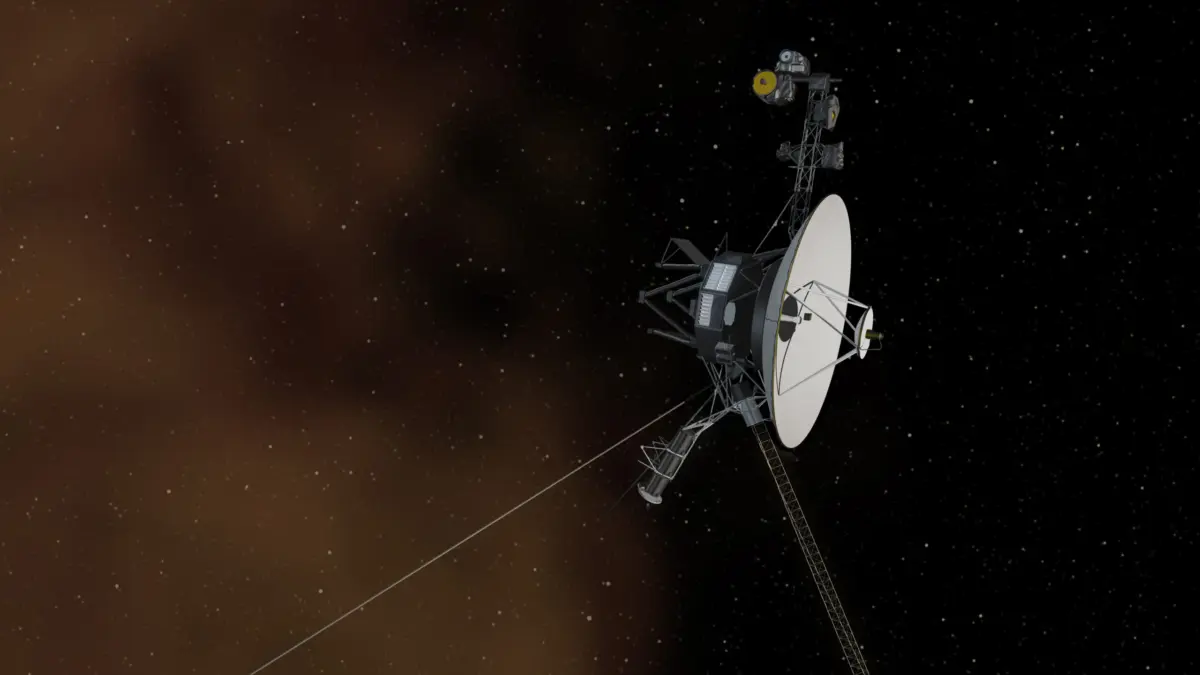
NASA has officially confirmed that the Voyager 1 spacecraft, a robotic explorer launched during the Carter administration, has reached a distance from Earth equivalent to one light-day. This milestone, achieved this Wednesday, marks the first time in human history that a man-made object has traveled 16 billion miles (approximately 25.7 billion kilometers) away from its home planet. To put this distance into perspective, a radio signal traveling at the speed of light now requires a full 24 hours to traverse the vast expanse between the probe and the antennas of the Deep Space Network on Earth. This achievement solidifies Voyager 1’s status as the most distant emissary of humanity, operating in the cold, dark environment of interstellar space.
The journey to this point has spanned more than 47 years. Launched on September 5, 1977, from Cape Canaveral, Florida, Voyager 1 was originally designed for a five-year mission to explore the outer planets of our solar system. However, through a combination of robust engineering, gravitational assists, and meticulous management by NASA’s Jet Propulsion Laboratory (JPL), the probe has far outlived its original life expectancy. It is currently hurtling through the interstellar medium—the region of space between star systems—at a staggering velocity of approximately 38,000 miles per hour (61,000 kilometers per hour).
The Technical Significance of a Light-Day
The concept of a "light-day" is a measurement of distance, not time, representing how far light can travel in a vacuum over the course of 24 hours. Given that the speed of light is approximately 186,282 miles per second, the total distance for a light-day sits at roughly 16.09 billion miles. When Voyager 1 crossed this threshold on Wednesday, it created a unique communication lag: any command sent by NASA engineers now takes 23 hours and 20-some minutes to reach the spacecraft, and another full day for the confirmation signal to return to Earth.
This distance is a testament to the longevity of the spacecraft’s systems. Powered by three radioisotope thermoelectric generators (RTGs), which convert the heat from the natural decay of plutonium-238 into electricity, Voyager 1 continues to operate its core instruments despite the diminishing power supply. NASA engineers have had to become increasingly creative over the decades, shutting down non-essential heaters and scientific instruments to conserve energy for the sensors that measure the interstellar environment.
A Chronology of an Interstellar Odyssey
The path to 16 billion miles began with the "Grand Tour" alignment of the outer planets, a rare celestial occurrence that happens only once every 175 years. This alignment allowed Voyager 1 and its twin, Voyager 2, to use the gravity of one planet to whip themselves toward the next, significantly reducing travel time and fuel requirements.
In 1979, Voyager 1 made its closest approach to Jupiter, discovering active volcanism on the moon Io and intricate structures within the Jovian rings. By 1980, it reached Saturn, providing unprecedented views of the planet’s ring system and its largest moon, Titan. Following the Saturn flyby, Voyager 1 began its trek toward the edge of the solar system, eventually crossing the heliopause—the boundary where the sun’s solar wind is halted by the interstellar medium—in August 2012.
In 1990, at the request of astronomer Carl Sagan, Voyager 1 turned its camera back toward the inner solar system one last time. From a distance of 3.7 billion miles, it captured the "Pale Blue Dot" photograph, showing Earth as a tiny, fragile speck of light suspended in a sunbeam. Shortly after, the cameras were powered down to save energy, and the probe transitioned into its current phase as an interstellar explorer.
Maintaining a Relic in the Deep Vacuum
The continued operation of Voyager 1 is managed by a dedicated "skeleton team" at NASA. These engineers work with technology that is, in many ways, an antique. The onboard computers have less memory than a modern car key fob, and the data is recorded on an 8-track digital tape recorder. Communicating with the probe requires the use of the Deep Space Network’s largest antennas, including the 70-meter (230-foot) dish in Madrid, Spain, and its counterparts in California and Australia.
Despite its age, the probe remains scientifically vital. It currently relays data daily regarding the strength and direction of the magnetic field outside our solar system, as well as the density of the surrounding plasma and the intensity of galactic cosmic rays. These readings provide scientists with their only direct "in-situ" measurements of the space between stars.
However, the mission has not been without recent scares. In October, the mission team briefly lost communication with Voyager 1 after a technical anomaly triggered the spacecraft’s autonomous fault-protection system. While contact was eventually restored using a lower-power S-band transmitter that had not been used since 1981, the incident highlighted the fragility of the aging hardware. Suzanne Dodd, the Voyager project manager, has frequently referred to the spacecraft as a "national treasure," noting that the team is constantly problem-solving to keep the mission alive.

Comparison with Voyager 2 and Future Milestones
While Voyager 1 holds the record for distance, its twin, Voyager 2, is not far behind. Launched 16 days before Voyager 1 on a different trajectory, Voyager 2 is currently about 13.5 billion miles from Earth. Because it traveled a longer path to visit Uranus and Neptune, it is moving slightly slower relative to the sun. NASA expects Voyager 2 to reach its own one light-day milestone in approximately 2035.
Looking ahead, the timeline for Voyager 1 becomes one of extreme endurance. Although it has reached one light-day, it is still nowhere near the next star system. NASA estimates it will take approximately 300 years for Voyager 1 to reach the inner edge of the Oort Cloud—a spherical shell of icy objects surrounding the solar system—and perhaps 30,000 years to fly out the other side.
In about 18,000 years, the probe will have traveled a full light-year. It is projected to pass within 1.6 light-years of the star Gliese 445 in about 40,000 years. By that time, the plutonium power source will have long since decayed, and the spacecraft will be a silent wanderer, carrying its "Golden Record"—a gold-plated copper phonograph record containing sounds, images, and greetings from Earth—as a message in a bottle for any civilization that might encounter it in the distant future.
Official Reactions and Cultural Impact
The milestone has drawn praise from the scientific community. Bill Nye, CEO of the Planetary Society, emphasized the mission’s universal appeal. "All of us—everyone on Earth—have been touched by these missions," Nye stated. "Voyager 1 reminds us of our capacity for exploration and our desire to understand our place in the cosmos."
Project manager Suzanne Dodd noted that the current phase of the mission is akin to operating weather satellites in a region of space no one has ever visited before. "The data we are getting back is unique," Dodd said. "Every mile Voyager 1 travels is a mile into the unknown. Reaching a light-day of distance is a profound reminder of how far we have come as a spacefaring species."
The mission’s impact extends beyond pure science into the realm of philosophy. The Voyager probes were the brainchild of a generation that dared to look past the moon toward the stars. The fact that hardware built in the 1970s is still functional in the 2020s is often cited by engineers as the pinnacle of aerospace durability.
Implications for Future Interstellar Travel
The success of Voyager 1 provides critical data for the planning of future interstellar missions. By mapping the transition from the heliosphere to the interstellar medium, Voyager 1 has shown that the boundary is more complex and turbulent than previously theorized. This information is vital for understanding how the sun’s magnetic bubble protects the Earth from high-energy cosmic radiation.
Furthermore, the "light-day" milestone serves as a sobering reminder of the vastness of space. If it takes 47 years for our fastest spacecraft to travel just one light-day, the challenges of reaching the nearest star, Proxima Centauri (located 4.25 light-years away), are immense. Such a journey would require propulsion technologies far beyond our current capabilities, such as nuclear thermal rockets or laser-pushed light sails.
As Voyager 1 continues its journey, NASA engineers anticipate that the spacecraft will be able to maintain at least one scientific instrument until 2025, and perhaps longer if power management remains successful. Eventually, the power will drop below the level required to operate the transmitter, and Voyager 1 will fall silent. Even then, it will continue to drift through the Milky Way for millions of years, a testament to the era when humanity first reached out to touch the stars.
The achievement of 16 billion miles is more than just a numerical milestone; it is a marker of human persistence. As the probe moves further into the darkness, it carries with it the history of a planet that, while appearing as a "pale blue dot" from a distance, possesses an ambition that spans light-days.
