

The National Venture Capital Association’s (NVCA) "Meet a VC" series recently featured Will Borthwick, a distinguished General Partner at BOLD Capital Partners, offering an insightful look into the firm’s distinctive investment philosophy and Borthwick’s journey through the dynamic landscape of venture capital. BOLD Capital Partners stands out for its unwavering commitment to funding founders who are developing "exponential technologies" – innovations designed not merely to improve, but fundamentally to advance humanity. This interview underscores the evolving role of venture capitalists, from mere capital allocators to deeply engaged "operator-investors" dedicated to nurturing the next generation of world-changing companies.
From Traditional Finance to the Vanguard of Exponential Innovation
Will Borthwick’s professional trajectory is anything but conventional, charting a course through some of the most rigorous and analytical sectors of finance before landing at the cutting edge of venture capital. His early career included formative years at the Federal Reserve, a period often characterized by macroeconomic analysis, monetary policy considerations, and a deep understanding of financial systems at a national level. This foundational experience provided him with a unique perspective on systemic risk, economic drivers, and the intricate mechanisms that underpin market stability and growth. Following his tenure at the Fed, Borthwick transitioned into the demanding world of investment banking, where he honed his skills in complex financial transactions, valuation, and strategic advisory. This was further complemented by a significant stint in private equity, focusing on large-scale buyouts of established technology companies. These roles, steeped in due diligence, financial modeling, and long-term strategic planning, equipped him with a robust toolkit for evaluating enterprises and understanding market dynamics.
However, approximately eight and a half years ago, Borthwick made a pivotal shift, joining BOLD Capital Partners. This move was driven by a compelling combination of factors: the opportunity to collaborate with a team primarily composed of former entrepreneurs and seasoned investors, and a profound alignment with the firm’s core thesis. BOLD Capital’s investment strategy is singularly focused on "exponential technologies" – a concept that differentiates itself sharply from linear progression. Unlike incremental improvements, exponential technologies exhibit capabilities that advance at a geometric rate, rendering previously insurmountable challenges suddenly feasible within a short timeframe. This rapid acceleration creates unprecedented opportunities to address significant, global problems. As Borthwick articulates, the central question for BOLD is "How do you fundamentally move the needle to make humanity better?" This ethos permeates BOLD’s portfolio, which reflects a bold ambition to back ventures that push the boundaries of what is possible. Examples include companies developing stratospheric drones for advanced connectivity and data collection, pioneering de-extinction efforts aimed at restoring lost biodiversity, advancing humanoid robotics for labor and companionship, and fostering AI-enabled hardware that promises to redefine human-machine interaction and industrial efficiency. Each investment is a testament to BOLD’s belief in technology’s transformative power to usher in a more advanced and sustainable future.
The Maturation of Venture Capital: From Niche to Global Powerhouse
Borthwick’s journey has coincided with, and provided a front-row seat to, the dramatic transformation of the venture capital industry itself. When he first observed the tech landscape, the rapid ascent of companies like Facebook and Snapchat from nascent startups to multi-billion-dollar entities might have suggested a seemingly straightforward path to success. Yet, his experience has underscored a profound truth: "It turns out it’s incredibly hard. It’s even harder to build a generational company." This realization extends beyond just entrepreneurship to the very act of investing and supporting these ambitious endeavors, requiring immense dedication and discernment from venture capitalists.
One of the most striking shifts Borthwick has witnessed is the monumental increase in the scale of capital flowing into what was once a relatively modest, "small, cottage, bespoke, artisanal industry." In the early 2010s, a Series A funding round of $15 million to $20 million was considered substantial, often signaling significant investor confidence. Fast forward to today, and "a $150 million Series A is part of the conversation," a testament to the industry’s explosive growth and the escalating valuations of early-stage companies.
This surge in capital is supported by various industry reports. According to data from PitchBook and the NVCA, global venture capital funding has seen unprecedented growth over the last decade. For instance, global VC funding reached an all-time high of over $680 billion in 2021, a significant leap from around $200 billion in 2016. While market corrections have led to some recalibration since then, the underlying trend of larger individual rounds persists. The average Series A deal size in the U.S., which hovered around $10-15 million in the mid-2010s, has frequently exceeded $25-30 million in recent years, with outlier mega-rounds driving the "part of the conversation" for $150 million figures. This capital influx is driven by several factors, including institutional investors seeking higher returns, the increasing sophistication of startup ecosystems, and the global recognition of technology’s potential to disrupt and create vast new markets. However, it also introduces new complexities, such as heightened competition for deals, pressure on valuations, and increased expectations for rapid growth and market dominance from funded companies.
Beyond the Check: The "Operator-Investor" Model of Support
For Borthwick, the role of a venture capitalist transcends the mere transaction of capital allocation. He emphatically states, "Venture, Will argues, isn’t a fancier broker-dealer collecting a fee on the wire. It’s what happens after." This philosophy underpins BOLD Capital’s approach, viewing an investment not as a fleeting engagement but as a profound commitment. "When we invest into a company, it’s truly a marriage – not a date or a fling. We get in the bunker with you through thick or thin." This analogy highlights the long-term, symbiotic relationship BOLD seeks to build with its portfolio companies, emphasizing shared risks and collective perseverance.
The practical implications of this "marriage" are multifaceted. Borthwick recognizes that "being a founder is one of the loneliest jobs there is. The buck stops with the CEO." In this high-pressure environment, the support offered by a venture partner extends far beyond financial advice. It encompasses providing strategic counsel, leveraging extensive networks for critical introductions (whether for talent acquisition, customer connections, or potential partnerships), and offering operational insights derived from a wealth of experience. Crucially, it also involves a significant degree of personal support. "Whether it’s a shoulder to cry on or a person to scream at, that’s an important part of the role." This human element acknowledges the emotional toll and psychological demands placed on founders, affirming the VC’s role as a trusted confidant and ally.

This holistic approach aligns with the emerging "operator-investor" model, a significant departure from traditional passive investment. Borthwick views himself and his team not just as capital allocators but as "entrepreneurs ourselves," deeply empathetic to the challenges of building a business. This perspective suggests that effective venture capitalists bring not only financial acumen but also firsthand operational experience, strategic foresight, and a profound understanding of the entrepreneurial journey. By engaging deeply with founders, VCs can offer more relevant, actionable advice, help navigate unforeseen obstacles, and actively contribute to the company’s growth and resilience. The "operator-investor" model, therefore, is about active partnership, strategic guidance, and a shared commitment to enduring success, distinguishing it sharply from more detached forms of financial backing.
Dispelling Misconceptions: The True Drivers of Innovation
Will Borthwick dedicates a significant portion of his insights to rectifying common misconceptions held by policymakers, observers, and even the general public regarding both founders and venture capitalists. His observations highlight a fundamental disconnect between public perception and the realities of the innovation ecosystem.
Firstly, regarding founders, Borthwick passionately advocates for a deeper understanding of their core motivations. "They start companies to change the world in an impactful way. It comes from a place of good." This emphasizes that entrepreneurship, particularly in the realm of exponential technologies, is often driven by a genuine desire to solve pressing global problems, improve human conditions, and push the boundaries of what’s possible, rather than solely by financial gain. However, these visionaries frequently encounter what Borthwick describes as "unnecessary roadblocks." These can range from complex regulatory hurdles and bureaucratic inefficiencies to challenges in accessing talent, navigating intellectual property landscapes, or securing early-stage capital in regions less saturated with venture funding. For policymakers, understanding these systemic friction points is crucial to fostering an environment conducive to innovation and ensuring that the engine of progress is not stifled. Borthwick posits that "Technology… is the engine that has carried humanity forward – and entrepreneurialism is how it gets built," underscoring the symbiotic relationship between technological advancement and the entrepreneurial spirit.
Secondly, Borthwick challenges the prevalent "cartoon version" of venture capitalists – a caricature often depicted as detached individuals who conduct five-minute meetings, write large checks, and then disengage. He asserts that this portrayal "bears little resemblance to the people he works with." Instead, he reiterates the identity of VCs as active "operator-investors," deeply embedded in the strategic and operational challenges of their portfolio companies. This distinction is critical: rather than being passive funders, modern VCs, especially those like Borthwick, engage in rigorous due diligence, provide ongoing strategic mentorship, connect founders with crucial resources, and often serve as a vital sounding board for critical decisions. The process involves far more than merely allocating capital; it demands intellectual curiosity, strategic foresight, and a willingness to commit significant time and effort to support fledgling enterprises through their most challenging growth phases. By dispelling these myths, Borthwick aims to foster a more accurate understanding of the venture capital industry’s vital role as a catalyst for economic growth, job creation, and technological innovation.
An Unwavering Optimism for Humanity’s Trajectory
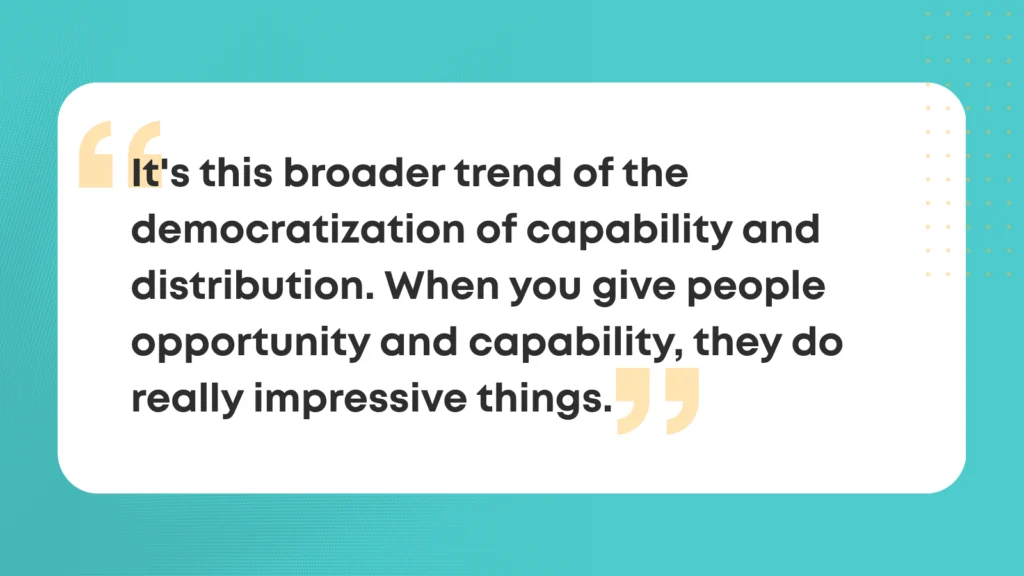
Despite the inherent uncertainties of the global landscape – amplified, as Borthwick notes, by a pervasive and often overwhelming information environment – his outlook remains profoundly optimistic about humanity’s long-term trajectory. He frames this optimism through the lens of a "longer arc of democratization of capability." This concept highlights how technological advancements progressively make sophisticated tools and opportunities accessible to an ever-wider segment of the population.
Borthwick draws a compelling historical parallel: "Twenty years ago, you needed your own server racks." This was the era of significant capital expenditure and specialized infrastructure required for even basic computing power. "Then came cloud compute on demand," a paradigm shift that democratized access to scalable computing resources, enabling startups and individuals to build and deploy complex applications without massive upfront investments. Today, the evolution continues, with "intelligence on demand in the palm of our hands," referring to the ubiquitous access to powerful AI tools, advanced analytics, and global information networks via smartphones and other connected devices. This ongoing democratization empowers individuals and small teams with capabilities that were once the exclusive domain of large corporations or governments.
"When you give people opportunity and capability, they do really impressive things," Borthwick states, emphasizing the inherent ingenuity and problem-solving capacity of humanity when equipped with the right tools. He firmly believes this trend will only accelerate: "And it’s only going to get better tomorrow, and a year from now, and five years from now." This continuous enhancement of human potential, driven by exponential technologies, leads him to conclude, "It’s like we have superpowers – and our superpowers just keep getting stronger." This powerful metaphor encapsulates the profound impact of technological progress, suggesting that humanity is collectively acquiring unprecedented abilities to address challenges and create new realities.
This unwavering optimism is the driving force behind Borthwick’s dedication to BOLD Capital Partners. The companies BOLD chooses to back are not merely developing new products or services; they are, in Borthwick’s view, "building the infrastructure of what humanity will be capable of next." This perspective elevates their investment strategy beyond mere financial returns to a mission-driven endeavor, contributing directly to the foundational elements of future human progress. By supporting these audacious ventures, BOLD Capital aims to play a pivotal role in shaping a future where humanity’s "superpowers" continue to expand, tackling grand challenges and unlocking unforeseen possibilities for generations to come.
The insights from Will Borthwick not only illuminate the specific investment philosophy of BOLD Capital Partners but also provide a comprehensive overview of the modern venture capital landscape. His journey from traditional finance to the forefront of exponential technology investing exemplifies the evolving demands and opportunities within the industry. Through his articulate defense of founders and VCs alike, Borthwick effectively debunks common misconceptions, painting a picture of dedicated professionals committed to fostering innovation and driving meaningful societal change. His enduring optimism, rooted in the belief in humanity’s increasing capabilities, offers a compelling vision for the future, where venture capital plays a critical role in building the very infrastructure of human potential. As the world continues to grapple with complex challenges, firms like BOLD Capital, guided by leaders like Will Borthwick, stand as vital catalysts, ensuring that the promise of exponential technologies is harnessed to move humanity forward.
