

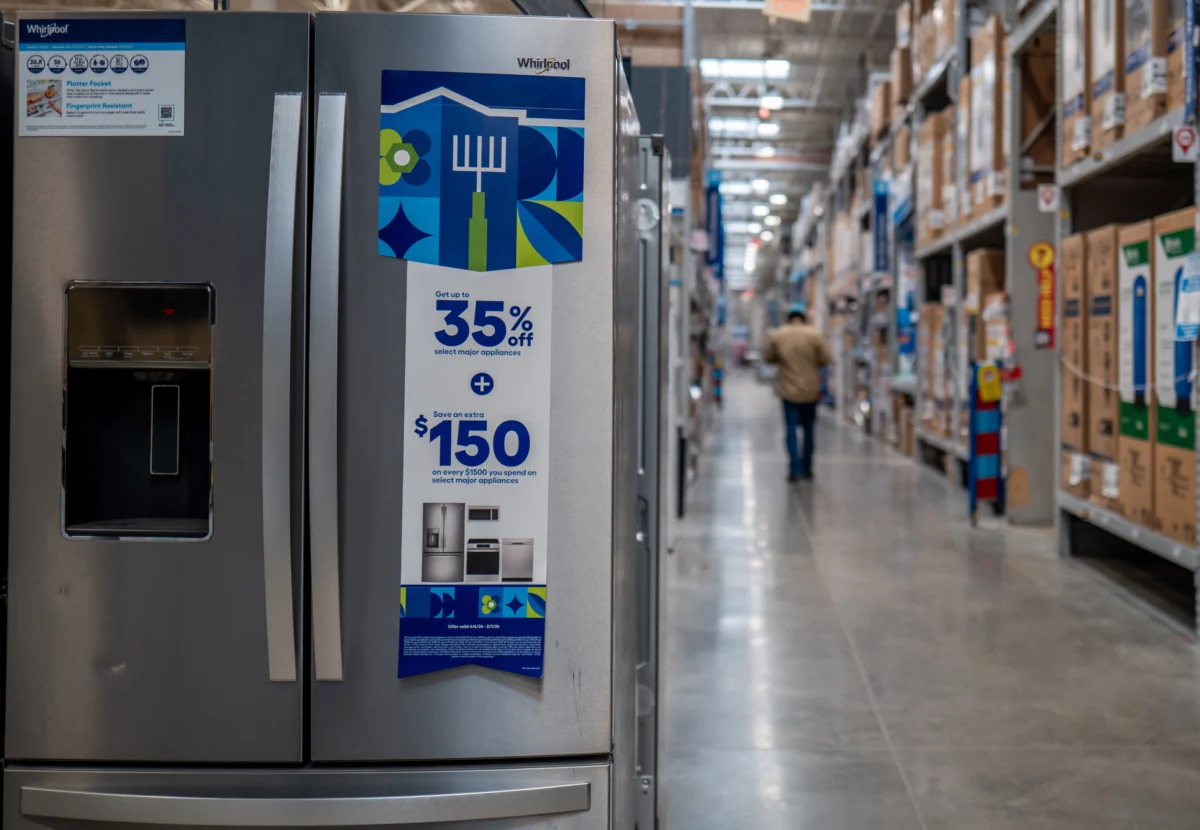
Whirlpool Corporation, the venerable American appliance manufacturer, experienced a significant downturn in its share price Thursday after issuing a stark warning about the economic ramifications of an ongoing geopolitical conflict. The company explicitly stated that the "war in Iran" had precipitated a "recession-level industry decline" within the U.S. market, attributing this severe contraction to a dramatic collapse in consumer confidence observed in late February and March. This declaration from a major producer of durable goods serves as a potent indicator of how escalating fuel prices and widespread economic uncertainty are beginning to profoundly impact big-ticket consumer purchases, diverging sharply from more resilient spending trends reported in the travel and services sectors.
The Geopolitical Catalyst: The Iran Conflict and its Economic Echoes
The company’s pronouncement marks one of the most unambiguous corporate warnings to date regarding the economic fallout from the escalating conflict involving Iran. While specific details of the "Iran war" remain a subject of ongoing global speculation and diplomatic efforts, its immediate economic impact, as articulated by Whirlpool, is undeniable. Geopolitical tensions in the Middle East, particularly those involving major oil-producing nations like Iran, frequently send ripples through global energy markets. The escalation of conflict, reportedly around late February and March, led to a significant disruption in oil supplies and heightened fears of further instability, pushing crude oil prices substantially higher. U.S. oil prices, for instance, remained stubbornly above $90 a barrel, reflecting a premium driven by supply concerns and geopolitical risk. This surge in energy costs translates directly into higher gasoline prices for consumers and increased operational expenses for businesses, exerting inflationary pressure across the economy.
Historically, such spikes in energy costs have a cascading effect. They erode household disposable income, making consumers more cautious about discretionary spending. For industries reliant on the purchase of durable goods, such as home appliances, this caution can manifest as postponed upgrades or outright cancellations of purchases. The direct correlation drawn by Whirlpool between the conflict, fuel prices, and collapsing consumer confidence underscores a classic economic linkage where geopolitical instability directly undermines domestic economic activity by impacting consumer sentiment and purchasing power.
Consumer Confidence in Freefall: A Direct Consequence
The assertion by Whirlpool that consumer confidence "collapsed" in late February and March is corroborated by broader economic indicators. Data from the University of Michigan’s consumer sentiment survey, a closely watched barometer of household optimism, indeed reflected a significant deterioration during this period, touching a record low at one point in April. The Conference Board’s Consumer Confidence Index similarly indicated a sharp decline, with consumers expressing heightened concerns about future economic conditions, job prospects, and their personal financial situations.
Consumer confidence is a critical psychological factor influencing spending patterns, particularly for items that are discretionary and often involve significant financial outlay or financing. When confidence plummets, households tend to retrench, prioritizing essential spending and deferring major purchases like new refrigerators, washing machines, or dishwashers. The uncertainty generated by an international conflict, coupled with the tangible burden of higher fuel and grocery prices, creates an environment where saving becomes more appealing than spending, and perceived economic risks outweigh the desire for new appliances. This phenomenon is particularly acute for big-ticket items, which are often the first to be cut from household budgets during periods of economic apprehension, leading directly to the "recession-level industry decline" observed by Whirlpool.
Whirlpool’s Financial Retrenchment: Navigating Turbulent Waters
The immediate market reaction to Whirlpool’s sobering assessment was severe. Shares of the Benton Harbor, Michigan-based company, renowned for its array of home appliances including washers, dryers, and dishwashers under various brands, plummeted by 12% on Thursday. This sharp decline wiped billions off its market capitalization, reflecting investor alarm over the revised financial outlook and the broader economic headwinds facing the durable goods sector.
In response to the rapidly deteriorating macroeconomic conditions, Whirlpool’s CEO, Marc Bitzer, emphasized the company’s swift and decisive actions to mitigate the impact. "We acted decisively to address pricing and costs in the face of rapid deterioration in macroeconomic conditions," Bitzer stated. These measures likely include a combination of price adjustments for their products, stringent cost-cutting initiatives across operations, and a strategic re-evaluation of production schedules and inventory levels to align with reduced demand.
Furthermore, the company significantly slashed its full-year earnings guidance, nearly halving its forecast. The revised outlook now projects earnings per share (EPS) in the range of $3 to $3.50, a drastic reduction from its prior guidance of approximately $6 a share. This downward revision signals a substantial anticipated hit to profitability, driven by a confluence of factors including lower sales volumes, increased raw material costs, and potentially reduced margins due to competitive pricing pressures in a shrinking market.
Adding to the gravity of its financial restructuring, Whirlpool also announced the suspension of its dividend. This move, a clear signal of prioritizing financial stability, aims to conserve cash flow and allocate resources towards debt reduction. Suspending dividends, while often unpopular with income-focused investors, is a common tactic employed by companies facing significant economic uncertainty or needing to bolster their balance sheets. It underscores the severity of the economic challenges Whirlpool anticipates in the near to medium term.

Analysts at JPMorgan quickly weighed in on Whirlpool’s revised outlook, attributing the lower earnings guidance to several key factors. These included higher raw material inflation, which directly impacts manufacturing costs, a larger-than-expected net tariff impact, and weaker benefits from price and product mix. The mention of "Section 232 changes" by CEO Bitzer refers to U.S. tariffs on imported steel and aluminum, which have historically impacted manufacturing costs. Bitzer’s statement that "Now, with Section 232 changes in favor of domestic manufacturers, Whirlpool Corporation is structurally positioned to win with our American-made products" suggests that recent adjustments or interpretations of these tariffs might now provide a competitive advantage to domestic producers over importers, offering a potential silver lining amidst the otherwise bleak forecast. This indicates a strategic pivot or renewed emphasis on leveraging domestic manufacturing capabilities to navigate the challenging economic environment.
The Broader Economic Landscape: Divergent Spending Trends
Whirlpool’s warning stands in stark contrast to the more buoyant reports from companies in the travel and services sectors. Recent earnings calls from giants like Uber and Disney have indicated little evidence of consumers pulling back on experiential spending, travel, entertainment, and convenience services. This divergence highlights a potential bifurcation in consumer behavior: while households may be curtailing spending on large, durable goods, they appear more willing to maintain or even increase expenditures on services and experiences.
Several factors could explain this phenomenon. Pent-up demand for travel and entertainment following periods of restricted activity, combined with a cultural shift towards valuing experiences over material possessions, may contribute to the resilience of the services sector. Moreover, the cost of a single trip or entertainment event, while not insignificant, is typically far less than that of a new kitchen appliance suite, making it a more manageable expense even for budget-conscious consumers. The decision to postpone a major appliance purchase, which often involves thousands of dollars and may be financed, is a more significant commitment and thus more susceptible to economic uncertainty and eroded confidence.
This divergence suggests that the economic fallout from the "Iran war" and subsequent inflationary pressures may not be uniform across all sectors. While discretionary durable goods are feeling the brunt, other parts of the economy might show greater resilience, at least for now. However, if the "recession-level" decline observed by Whirlpool becomes widespread, it could eventually spill over into other sectors as overall consumer spending power diminishes further.
Policy and Market Responses: Navigating Uncertainty
The market’s reaction to Whirlpool’s announcement reflects a growing concern among investors about the broader economic implications of the Iran conflict. While the stock market had shown signs of a rebound since mid-April, fueled by hopes that a diplomatic resolution to the conflict between the U.S. and Iran could be achieved, the persistent high oil prices above $90 a barrel indicate that traders remain cautious. The prospect of a "peace proposal" is a significant market driver, as an end to hostilities would likely stabilize oil markets and alleviate some of the inflationary pressures impacting consumer confidence.
From a policy perspective, the Federal Reserve and other central banks face a challenging dilemma. On one hand, persistent inflation driven by geopolitical factors and supply chain disruptions may necessitate a continued hawkish stance on monetary policy, potentially involving further interest rate hikes. On the other hand, clear warnings of a "recession-level industry decline" from a bellwether company like Whirlpool could suggest that the economy is already slowing significantly, raising the specter of overtightening and pushing the economy into a deeper recession. Policymakers will be closely monitoring a wide array of economic data points, including employment figures, retail sales, and manufacturing output, to gauge the full extent of the economic slowdown.
Government officials may also face pressure to address the impact of high energy prices on households and businesses. While direct intervention in global oil markets is complex, discussions around strategic petroleum reserve releases or domestic energy production policies could intensify. The interplay between geopolitical events, monetary policy, and fiscal measures will be critical in determining the trajectory of the U.S. economy in the coming months.
Industry-Wide Repercussions and Future Outlook
Whirlpool’s candid assessment is likely to send shivers through the entire durable goods manufacturing sector. Other appliance makers, furniture companies, and even automotive manufacturers could face similar headwinds as consumers delay large purchases. The ripple effect could extend to raw material suppliers, logistics companies, and retailers who stock these products. The industry as a whole may need to recalibrate production, adjust inventory management strategies, and explore innovative ways to stimulate demand, such as enhanced financing options or promotional campaigns.
For Whirlpool, the path forward involves a laser focus on cost management, debt reduction, and leveraging its strategic advantages, such as its "American-made products" in the context of Section 232 changes. The suspension of the dividend, while painful for shareholders, is a clear commitment to strengthening the company’s financial foundation amidst an uncertain economic climate. The ability to quickly adapt pricing and cost structures will be paramount in maintaining profitability and market share in a contracting market.
Looking ahead, the recovery of the durable goods sector, and indeed the broader economy, hinges significantly on the resolution of the Iran conflict and the subsequent stabilization of energy prices. A sustained period of geopolitical calm and declining inflation would be crucial for restoring consumer confidence, encouraging discretionary spending, and pulling the industry out of its "recession-level decline." Until then, companies like Whirlpool will remain in a cautious and conservative operational mode, bracing for continued economic turbulence. The unfolding situation highlights the intricate and often immediate connections between global geopolitical events and the everyday economic realities faced by businesses and consumers worldwide.
