

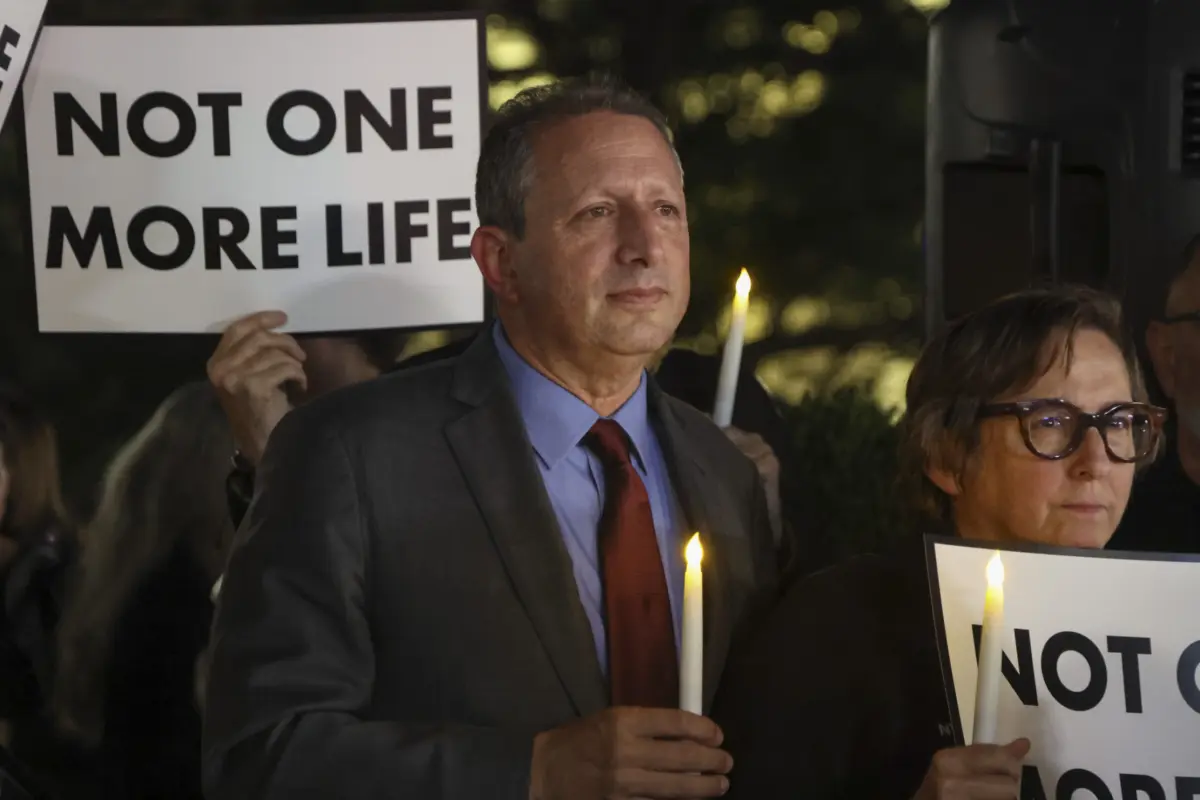
Brad Lander, a prominent American politician and current candidate for the United States Congress, was detained by the Israel Defense Forces (IDF) on Wednesday while participating in a volunteer effort to assist Palestinian farmers with the annual olive harvest in the occupied West Bank. Lander, who recently served as the New York City Comptroller and was a former candidate for New York City Mayor, was among approximately 80 activists and volunteers detained near the village of Nahalin, located just outside Bethlehem. While Lander was released several hours later with an official warning, he confirmed that dozens of other volunteers—including rabbis, international activists, and local Palestinians—remain in military custody. The incident highlights the escalating tensions in the West Bank during the harvest season, a period traditionally marked by increased friction between Palestinian agricultural communities, Israeli settlers, and the military.
According to statements released by Lander and the advocacy group Rabbis for Human Rights, the detention occurred after the group had spent approximately two hours peacefully assisting local families in gathering olives. The volunteer cohort was composed of a diverse international delegation, including citizens from the United States, Israel, the United Kingdom, and Canada. Witnesses reported that Israeli soldiers and police arrived at the groves and declared the area a "closed military zone," a designation frequently used by the IDF to restrict access to specific parcels of land in the West Bank. Following this declaration, the volunteers were reportedly moved to a nearby police station for processing.
Details of the Detention and Lander’s Statement
Brad Lander took to social media shortly after his release to provide a first-hand account of the encounter. Writing on the platform X (formerly Twitter), Lander noted that his release appeared to be influenced by his political standing in the United States. "I’ve been released from IDF custody with a ‘warning,’ apparently because of my public profile," Lander stated. He further noted that during his interaction with the authorities, he clarified his current status: "I told them I wasn’t even a congressmember yet, just a nominee."
Lander’s involvement in the harvest was part of a coordinated effort by Rabbis for Human Rights, an organization that seeks to provide a "protective presence" for Palestinian farmers who often face harassment or violence from extremist settlers during the harvest. Lander’s detention has drawn significant attention due to his high-profile career in New York City politics, where he has been a vocal advocate for progressive causes and a prominent figure within the Jewish American community. His decision to join the harvest mission was intended to draw attention to the difficulties faced by Palestinian rural communities and to advocate for a peaceful resolution to territorial disputes.
While Lander has been freed, the fate of the remaining detainees remains a point of concern for human rights organizations. "Several dozen others, including rabbis and international volunteers, remain in detention," Lander noted in his public appeal, calling for their immediate and unconditional release. The Israeli government and the IDF spokesperson’s unit have not yet issued a formal response to requests for comment regarding the specific legal grounds for the mass detention or the status of those still held.
Chronology of the Incident at Nahalin
The events of Wednesday began early in the morning when the delegation of 80 volunteers arrived in the village of Nahalin. The village, situated in the Bethlehem Governorate, is surrounded by several Israeli settlements, making its agricultural lands a frequent site of jurisdictional disputes.
- 8:00 AM: The volunteer group, organized by Rabbis for Human Rights, joins Palestinian families in the olive groves. The atmosphere is reported as calm, with volunteers focusing on the labor-intensive process of hand-picking olives.
- 10:00 AM: After two hours of work, Israeli military vehicles arrive on the scene. Soldiers inform the group that the land has been designated a closed military zone and order all individuals to cease activities and vacate the area.
- 10:30 AM: When the volunteers and farmers do not immediately disperse, or seek clarification on the boundaries of the order, the IDF and Israeli police begin the process of detaining the participants.
- 11:30 AM – 1:00 PM: The detainees are transported to a regional police station. During this time, identities are checked, and international passports are scrutinized.
- Mid-afternoon: Brad Lander is singled out for processing and subsequently released with a formal warning against returning to the restricted area.
- Evening: Reports emerge that while some Israeli citizens in the group were released, many international volunteers and Palestinian residents remain under guard or are being processed for potential visa violations or "disturbing the peace."
The Economic and Cultural Significance of the Olive Harvest
The olive harvest is a cornerstone of the Palestinian economy and a vital cultural tradition. For thousands of families in the West Bank, the harvest provides a primary source of income through the sale of olive oil, table olives, and soap. According to data from the United Nations Office for the Coordination of Humanitarian Affairs (OCHA), the olive oil sector contributes as much as $100 million annually to the Palestinian economy in high-yield years.
However, the 2024 harvest season has been described by humanitarian agencies as one of the most perilous in recent history. The ongoing conflict in Gaza and heightened security measures across the West Bank have led to increased restrictions on movement. Many farmers find themselves unable to access their groves due to the proximity of Israeli settlements or military checkpoints. In many instances, the "closed military zone" designation is applied to areas where the military claims there is a risk of friction between Palestinians and settlers, effectively preventing the harvest from taking place.
Data from the Palestinian Ministry of Agriculture suggests that thousands of hectares of olive trees remain unharvested each year due to security restrictions. Furthermore, organizations like Yesh Din and B’Tselem have documented hundreds of incidents of olive tree destruction, theft of crops, and physical assaults against farmers. The presence of international volunteers like Lander is specifically designed to mitigate these risks, under the belief that the presence of foreign nationals and high-profile figures may deter violence and provide a level of international scrutiny.
Political Implications and US-Israel Relations
The detention of a US Congressional candidate is likely to resonate within the halls of the United States Capitol and the State Department. Brad Lander is a well-known figure in the Democratic Party, and his detention occurs at a sensitive time for US-Israel relations. The Biden-Harris administration has faced increasing pressure from the progressive wing of the Democratic Party to take a firmer stance against settler violence and the expansion of Israeli control in the West Bank.
Lander’s detention highlights a growing trend of American citizens—including activists and dual nationals—being caught up in military operations in the West Bank. Earlier this year, the death of Aysenur Eygi, a Turkish-American activist killed during a protest in the West Bank, prompted calls for a thorough and independent investigation from US officials. While Lander was not harmed, the act of detaining a political nominee sends a complicated diplomatic signal regarding the limits of political immunity and the treatment of American observers.
Political analysts suggest that this incident may embolden calls for more stringent monitoring of how US-funded military equipment is used in the West Bank. Lander’s "warning" from the IDF serves as a reminder of the broad powers exercised by the military administration in Area C of the West Bank, where Israel maintains full civil and security control.
Broader Context of Human Rights Activism in the West Bank
The group Rabbis for Human Rights has long been at the forefront of the "protective presence" movement. Their philosophy is rooted in the Jewish tradition of justice and the belief that the dignity of all people in the Holy Land must be preserved. By bringing together Jews, Christians, and Muslims to harvest olives, they aim to create a model of coexistence that challenges the prevailing narrative of intractable conflict.
However, the Israeli government under the current coalition has taken a increasingly firm line against such activism. Some members of the Israeli cabinet have characterized international volunteers as "provocateurs" who interfere with military operations and embolden Palestinian resistance. This ideological divide often manifests in the field, where soldiers must balance security directives with the rights of individuals to engage in agricultural labor.
The use of "closed military zone" orders has been a particular point of legal contention. Human rights lawyers argue that these orders are often applied arbitrarily to prevent Palestinians from exercising their land rights, rather than to address genuine, immediate security threats. The detention of 80 people at once suggests a large-scale enforcement action intended to clear the area of outside observers.
Future Outlook for the 2024 Harvest
As the olive harvest continues through the month of November, the international community remains watchful. The detention of Brad Lander serves as a high-profile flashpoint in a much larger, systemic struggle over land and rights. For the farmers of Nahalin and surrounding villages, the loss of even a single day of harvesting can result in significant financial hardship.
Humanitarian organizations have called for the Israeli authorities to ensure that farmers are granted safe and unhindered access to their lands. They also urge the release of the remaining volunteers detained alongside Lander, arguing that peaceful participation in an agricultural harvest does not constitute a criminal offense.
The incident is expected to be a topic of discussion among New York’s political circles and may influence Lander’s platform as he continues his run for Congress. As a candidate who has often bridged the gap between traditional Jewish communal leadership and progressive activism, Lander’s firsthand experience in an Israeli military detention facility adds a new dimension to his advocacy on Middle East policy.
For now, the focus remains on the "dozens" of volunteers still in custody. Their legal representatives are reportedly working to secure their release, while the IDF maintains its stance on the necessity of security zones to prevent regional escalation. The 2024 olive harvest, intended to be a season of bounty, remains overshadowed by the complexities of occupation, the volatility of regional politics, and the persistent struggle for human rights on the ground.
