

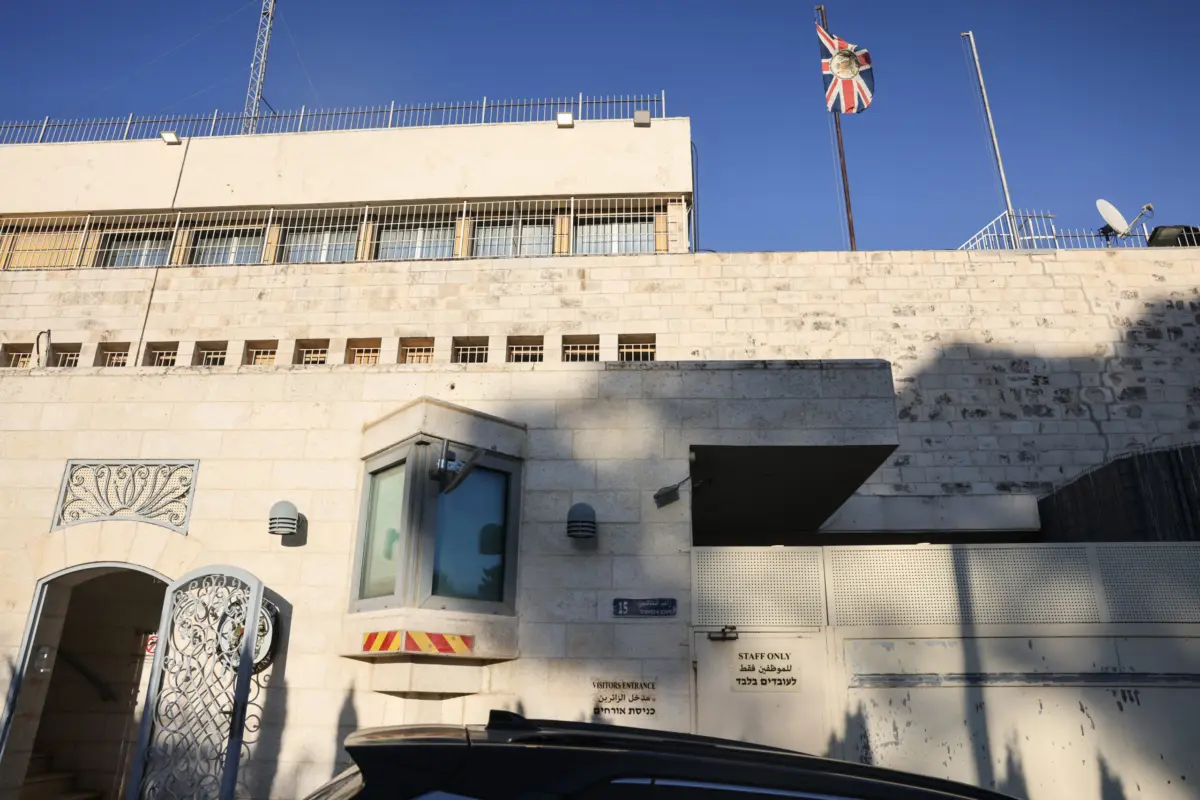
The diplomatic relationship between the United Kingdom and Israel has entered a period of unprecedented turbulence following reports that the British government has threatened to expel 27 Israeli diplomats. This stern warning comes as a direct response to an order from the Israeli government to shutter the British consulate in East Jerusalem by October 8. The escalating row marks one of the most significant fractures in the bilateral ties between the two nations in decades, highlighting a deepening divide over the legal status of the occupied West Bank and the future of Palestinian representation.
The dispute was triggered by the Israeli government’s decision to retaliate against recent British sanctions aimed at illegal Israeli settlements in the West Bank. According to reports from the Israeli news outlet Ynet, British Ambassador to Israel Simon Walters delivered a clear message to Israeli officials: should the diplomatic status of the 27 British staff members at the East Jerusalem consulate be revoked or the facility forced to close, the United Kingdom is prepared to expel an equal number of Israeli diplomats from its mission in London. This "tit-for-tat" strategy underscores the severity with which the Foreign, Commonwealth & Development Office (FCDO) views the potential loss of its primary diplomatic conduit to the Palestinian people.
The Genesis of the Dispute: Sanctions and Settlements
The current crisis did not emerge in a vacuum. It is the culmination of months of increasing friction regarding Israel’s settlement policy in the West Bank. Under the administration of Prime Minister Keir Starmer, the British government has taken a more assertive stance against the expansion of settlements, which the UK, along with the majority of the international community, considers illegal under international law.
In recent months, the UK has imposed targeted sanctions on several extremist settler groups and individuals involved in violence against Palestinian communities. These sanctions included asset freezes and travel bans. Furthermore, the British government moved to restrict certain imports from these settlements, a move that the Israeli government viewed as a violation of trade agreements and a hostile political act. In response, the Israeli Ministry of Foreign Affairs ordered the closure of the British consulate in East Jerusalem, arguing that the facility’s operations—which bypass the central Israeli government—undermine Israeli sovereignty over the city.
Israel’s demand for the closure is rooted in its long-standing claim that Jerusalem is its "undivided and eternal capital." However, the United Kingdom, like most of the world, does not recognize Israeli sovereignty over East Jerusalem, which was captured in the 1967 Six-Day War. By maintaining a consulate in East Jerusalem that reports directly to London rather than through the embassy in Tel Aviv, the UK reinforces its position that the final status of Jerusalem must be determined through negotiations and that the East Jerusalem territory remains occupied.
The Consulate’s Unique Status and Historical Significance
The British Consulate-General in Jerusalem is not merely a modern administrative office; it is an institution with deep historical roots. Established in 1838, during the Ottoman era, the consulate predates the modern State of Israel by more than a century. Its primary function for the last several decades has been to manage relations with the Palestinian Authority and the Palestinian population in East Jerusalem, the West Bank, and the Gaza Strip.
Unlike the British Embassy, which is located in Tel Aviv and handles state-to-state relations with the Israeli government, the East Jerusalem consulate serves as a de facto diplomatic mission to the Palestinians. It provides essential consular services, oversees aid projects, and acts as a political listening post for British diplomats. Closing the consulate would effectively sever the UK’s direct diplomatic link to the Palestinian leadership, forcing all interactions to be filtered through the Tel Aviv embassy—a move that would be seen as a tacit endorsement of Israeli control over the Palestinian territories.
A Timeline of Deteriorating Relations
The path to the current diplomatic standoff can be traced through a series of escalatory steps taken by both London and Jerusalem over the past year:
- February 2024: The UK government, then under Conservative leadership, followed the United States in imposing sanctions on four "extremist Israeli settlers" accused of human rights abuses against Palestinians.
- May 2024: Further sanctions were applied to entities supporting settler violence, including the group Hilltop Youth.
- July 2024: Following the UK General Election, the new Labour government signaled a shift in policy, resuming funding to UNRWA and indicating a more critical review of arms export licenses to Israel.
- September 2024: The UK announced a ban on imports from illegal settlements and expanded its sanctions list to include organizations like Amana, the settlement development arm.
- Late September 2024: In a retaliatory move, Israel issued a formal order for the UK to close its East Jerusalem consulate by October 8, stripping its staff of diplomatic immunity.
- Early October 2024: British National Security Adviser Jonathan Powell traveled to Israel for "discreet" talks to de-escalate the situation, while the threat of expelling 27 Israeli diplomats was reportedly conveyed to the Israeli Ministry of Foreign Affairs.
The ‘Tit-for-Tat’ Ultimatum: 27 for 27
The reported threat to expel 27 Israeli diplomats is a massive escalation in diplomatic protocol. Typically, such measures are reserved for instances of espionage or severe breaches of national security. By framing the threat as a direct numerical response—one Israeli diplomat for every one British diplomat affected—the UK is signaling that it views the closure of its consulate as a direct assault on its diplomatic infrastructure.
If carried out, such a move would hollow out the Israeli embassy in London, significantly hindering Israel’s ability to conduct public diplomacy, trade negotiations, and security cooperation in one of its most important European partner nations. Analysts suggest that the UK is betting on the fact that Israel cannot afford to lose such a high volume of diplomatic representation in London at a time when it is already facing international isolation over the ongoing conflict in Gaza and Lebanon.
The Role of the National Security Adviser
The involvement of Jonathan Powell, the UK’s National Security Adviser and former Chief of Staff to Tony Blair, indicates that the British government views this not just as a consular issue, but as a threat to national security interests in the Middle East. Powell’s secret visit to Israel last week was an attempt to find a "face-saving" exit for both parties.
While Reuters reported that the talks did not immediately yield a resolution, the fact that discussions are continuing suggests that neither side is yet willing to pull the trigger on the October 8 deadline. Powell is known for his role in the Northern Ireland peace process and is considered a veteran negotiator. His presence in the region signifies that London is willing to use its most experienced diplomatic assets to prevent a total collapse of the bilateral relationship.
Wider Geopolitical and Legal Implications
The standoff has broader implications for international law and the "Two-State Solution." For the UK, maintaining the consulate is a matter of principle regarding the 1967 borders. If London were to acquiesce to the closure, it would be seen as a significant win for the Israeli right-wing government, which seeks to erase the distinction between sovereign Israel and the occupied territories.
Furthermore, this dispute places other European nations in a difficult position. Countries like France, Italy, and Spain also maintain consulates in East Jerusalem that serve Palestinians. If Israel succeeds in forcing the UK to close its mission, these nations fear they could be next. This creates a potential "domino effect" that could lead to the complete dismantling of the international diplomatic presence in East Jerusalem, further marginalizing Palestinian voices on the world stage.
From the Israeli perspective, the government of Benjamin Netanyahu is under intense domestic pressure from far-right coalition partners, such as Bezalel Smotrich and Itamar Ben-Gvir. These ministers have long advocated for the expulsion of foreign missions that "interfere" in Israeli domestic affairs or support Palestinian claims to Jerusalem. For Netanyahu, standing firm against the UK is a way to signal strength to his political base, even at the risk of damaging vital strategic alliances.
Impact on the Ground: Consular Services and Palestinian Engagement
Beyond the high-level political maneuvering, the closure of the consulate would have tangible impacts on the ground. The mission provides vital services to British nationals living in the West Bank and Gaza, as well as to Palestinians seeking visas to the UK.
Perhaps more importantly, the consulate serves as a bridge for British aid and development projects. The UK provides millions of pounds in assistance to the Palestinian people, focusing on healthcare, education, and economic development. The consulate’s staff are responsible for ensuring this aid reaches its intended recipients and is not diverted. Without a physical presence in East Jerusalem, monitoring and implementing these programs would become significantly more difficult, potentially leading to a reduction in British humanitarian influence in the region.
Economic and Strategic Partnership at a Crossroads
Despite the current friction, the UK and Israel share a deep and multifaceted relationship. Bilateral trade is valued at over £6 billion annually, with significant cooperation in sectors such as technology, pharmaceuticals, and defense. Furthermore, the two nations share intelligence and security interests regarding regional threats.
However, the diplomatic row over the consulate threatens to spill over into these other areas. If the situation escalates to the point of mass expulsions, it is likely that cooperation in security and trade will suffer. The British government’s willingness to risk such a vital partnership over the status of a consulate suggests a fundamental shift in how London perceives the balance between its strategic interests and its commitment to international law and the Palestinian cause.
As the October 8 deadline approaches, the international community is watching closely. The outcome of this standoff will not only determine the future of British-Israeli relations but will also serve as a barometer for the future of diplomatic engagement in one of the world’s most contested cities. Whether a compromise can be reached through the efforts of negotiators like Jonathan Powell remains to be seen, but the stakes have rarely been higher for the diplomats on both sides of the divide.
