

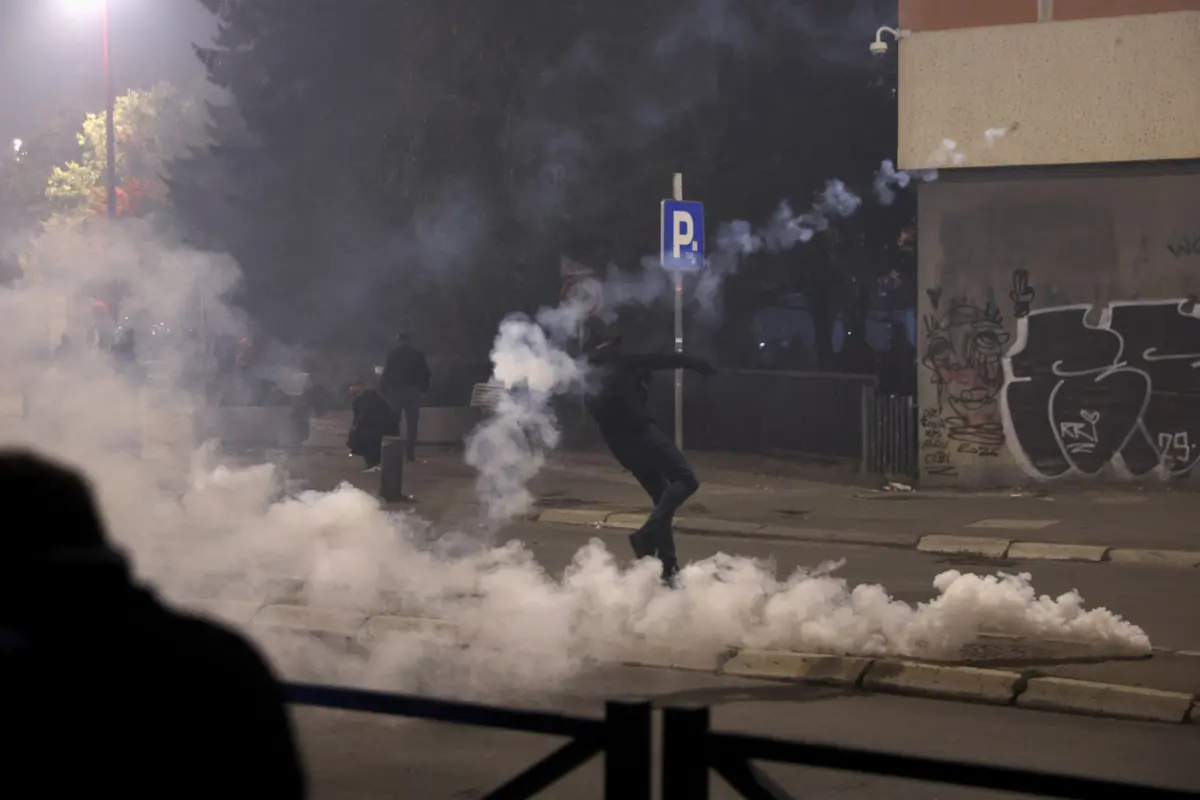
The capital city of Pristina became a flashpoint of civil unrest on Monday evening as riot police engaged in violent confrontations with hundreds of protesters outside the Kosovo Parliament. The demonstrations were sparked by a contentious legislative attempt to significantly curtail the powers of the Kosovo Specialist Chambers (KSC), a Hague-based international court established to prosecute war crimes committed during the 1998-2000 conflict. The escalation in the streets mirrors a deepening constitutional crisis within the government, where a looming deadline to elect a new president has become inextricably linked to the fate of the war crimes tribunal.
The violence erupted shortly after the parliamentary session concluded without a final vote on the proposed judicial amendments. Protesters, many of whom are veterans or supporters of the Kosovo Liberation Army (KLA), attempted to block lawmakers from exiting the building, prompting a forceful response from security forces. Local authorities confirmed that police deployed tear gas and water cannons to disperse the crowd after demonstrators began hurling flares, stones, and firecrackers at the legislative building. Naser Syla, the emergency director at a Pristina hospital, reported that at least 12 individuals required medical treatment following the clashes, including 11 civilians and one security official.
The Legislative Dispute: Reforming the Specialist Chambers
The legislative package at the center of the unrest seeks to fundamentally alter the operational framework of the Kosovo Specialist Chambers. Established in 2015 under intense international pressure, the KSC functions as a "hybrid" court—it is technically part of Kosovo’s own judicial system but is located in The Hague, Netherlands, and is staffed entirely by international judges and prosecutors. This arrangement was designed to ensure witness protection and to insulate the judicial process from local political interference.
The proposed amendments, sponsored by the opposition Democratic Party of Kosovo (PDK), include three primary changes that critics argue would effectively neuter the court’s independence:

- Sentencing Caps: A mandatory maximum sentence of 15 years for any individual convicted by the court.
- Domestic Incarceration: A requirement that all individuals convicted by the Hague-based court serve their prison sentences within the territory of Kosovo rather than in international facilities.
- Appellate Oversight: The granting of jurisdictional authority to Kosovo’s own Supreme Court to hear appeals and potentially overturn verdicts issued by the Specialist Chambers.
While the amendments successfully passed a first reading earlier on Monday, the session was adjourned before a second, definitive vote could be held. The delay fueled the frustrations of the protesters outside, who view the court as an illegitimate institution that unfairly targets ethnic Albanian freedom fighters while overlooking crimes committed by Serbian forces during the war.
Historical Context: The KLA Legacy and the 1998-1999 War
To understand the intensity of the current protests, one must look at the central role the Kosovo Liberation Army plays in the national identity of the ethnic Albanian majority. For many in Kosovo, the KLA is revered as the insurgent force that defended the population against the repressive regime of Serbian leader Slobodan Milošević. The conflict, which spanned from 1998 to 1999, was characterized by brutal ethnic cleansing and mass displacement.
According to humanitarian data, the war resulted in the deaths of approximately 13,000 people, the vast majority of whom were ethnic Albanians. Furthermore, nearly one million people—roughly half of Kosovo’s population at the time—were forced to flee their homes. The war ended only after a 78-day NATO bombing campaign targeted Serbian military infrastructure, eventually forcing the withdrawal of Serbian troops and the establishment of a United Nations protectorate.
Kosovo unilaterally declared independence from Serbia in 2008, a move recognized by the United States and most European Union members, but vehemently rejected by Belgrade, Russia, and several other nations. The Specialist Chambers were created following a 2010 Council of Europe report by Swiss Senator Dick Marty, which alleged that KLA members were involved in organ trafficking and the extrajudicial killing of Serbs and political rivals. The court’s existence has remained a point of deep resentment among the populace, who see it as an attempt to equate the actions of the "liberators" with those of the "aggressors."
The Thaci Verdict: A Catalyst for Unrest
The current wave of political instability was directly triggered by the landmark legal rulings delivered on September 16, 2026. The Kosovo Specialist Chambers handed down guilty verdicts against former President Hashim Thaci and three other high-ranking KLA commanders. Thaci, a foundational figure in Kosovo’s path to independence and its first prime minister, was sentenced to 25 years in prison for war crimes and crimes against humanity, including illegal detention, torture, and murder.

His co-defendants received sentences ranging from 13 to 25 years. The convictions sent shockwaves through Kosovo’s political establishment. In late September, the Parliament took the extraordinary step of passing a resolution unanimously condemning the court’s rulings, describing them as a "distortion of historical truth."
The PDK, the party formerly led by Thaci, has since led the charge to reform the court. They argue that the Hague-based tribunal has overstepped its mandate and is practicing "selective justice." Supporters of the KLA veterans’ associations have been camping outside government buildings since the verdict, demanding that the government take action to protect the legacy of the "liberation war."
Political Deadlock and the Presidential Deadline
The dispute over the court has now morphed into a full-scale constitutional crisis. Kosovo is currently without a permanent president, and the Constitutional Court has mandated a strict deadline of October 6 to elect a successor. Under Kosovo’s legal framework, the president is elected by a two-thirds majority in the 120-seat Parliament.
The Democratic Party of Kosovo (PDK) has leveraged its voting power to create a political stalemate. The party has explicitly stated that it will refuse to participate in the presidential election process unless the governing coalition passes the court reform bill. Without the PDK’s participation, the Parliament cannot reach the necessary quorum or the required majority to elect a president.
Prime Minister Albin Kurti and his governing Vetevendosje (Self-Determination Movement) party find themselves in a precarious position. While Kurti has historically been a critic of the international community’s oversight of Kosovo, he has expressed reservations about the "rushed" nature of the proposed judicial changes. During Monday’s session, Kurti argued that the proper venue for challenging the September convictions is through the established international appeals process within the Specialist Chambers themselves, rather than through domestic legislative maneuvers that could isolate Kosovo from its Western allies.

If the Parliament fails to elect a president by the October 6 deadline, the assembly will be automatically dissolved, and the country will be forced into an early general election—the third in as many years. This prospect threatens to paralyze the government at a time when it is facing significant economic challenges and ongoing tensions with Serbia.
Chronology of Recent Escalations
- September 16, 2026: The Kosovo Specialist Chambers in The Hague sentences former President Hashim Thaci to 25 years for war crimes. Three other KLA commanders are also convicted.
- September 20-25, 2026: Widespread protests erupt across Pristina and other major cities. The Kosovo Parliament passes a non-binding resolution condemning the court’s decision.
- September 30, 2026: The PDK introduces a bill to limit the court’s sentencing power and move appeals to the Kosovo Supreme Court.
- October 5, 2026 (Morning): Parliament holds the first reading of the reform bill; it passes with a slim majority.
- October 5, 2026 (Evening): The session is adjourned without a second vote. Protesters clash with police outside the building.
- October 6, 2026: The constitutional deadline for electing a new president.
International Implications and Analysis
The international community, particularly the European Union and the United States, has viewed the attempts to undermine the Specialist Chambers with grave concern. Diplomatic sources suggest that any move to strip the court of its international character would be viewed as a breach of Kosovo’s international obligations and could jeopardize its aspirations for EU and NATO membership.
Legal analysts point out that the proposed 15-year sentencing cap would be significantly lower than international standards for crimes against humanity. Furthermore, allowing the Kosovo Supreme Court to act as an appellate body for the Hague tribunal would create a jurisdictional conflict that could lead to the court’s total collapse.
"The Specialist Chambers were established precisely because the domestic judiciary was deemed unable to handle these sensitive cases due to intimidation and political pressure," noted an international legal observer based in Pristina. "If these amendments pass, it essentially signals the end of the rule of law as defined by Kosovo’s Western partners."
As the clock ticks toward the October 6 deadline, the streets of Pristina remain tense. The intersection of wartime legacy, judicial independence, and domestic political survival has created a volatile environment where the future of Kosovo’s democracy hangs in the balance. Whether a last-minute compromise can be reached to save the presidency and appease the KLA veterans remains uncertain, but the events of Monday evening have made it clear that the ghosts of the 1998 war continue to haunt the halls of power in Kosovo.
