

New Prime Minister Andy Burnham is set to embark on a month-long "cost of living" tour across the United Kingdom, a political initiative aimed at understanding and addressing the pervasive economic challenges facing the nation. The announcement was met with a cynical yet illustrative comment from a user on the social media chat platform Reddit, who remarked: "Housing is too expensive, energy is too expensive, food is too expensive etc. There you go, Andy, I’ve saved you some fuel (very expensive)." This sentiment encapsulates the frustration of millions of Britons grappling with persistently high prices for essential goods and services, a crisis exacerbated by recent geopolitical developments.
Like much of the global economy, the UK finds itself in a precarious position, battling inflationary pressures that show little sign of abating quickly. The Bank of England has revised its forecasts, now expecting inflation to climb further in the second half of the year. This grim outlook is largely attributed to the escalating fallout from the United States-Israel war on Iran, which has sent shockwaves through global energy markets, directly pushing up fuel prices and, consequently, household bills across the country. The conflict has added a critical new dimension to an already challenging economic landscape, which had previously been shaped by post-pandemic supply chain disruptions and the ongoing effects of the war in Ukraine.
The Anatomy of UK Inflation: A Deep Dive into Rising Prices
The annual rate of inflation in the UK, as measured by the Consumer Prices Index (CPI), stood at 2.8 percent in June, a marginal decrease from 3 percent recorded in May. While this suggests a slight deceleration in the pace of price increases, it is crucial to understand that prices are still rising, albeit at a slightly slower rate than earlier in the year. In practical terms, an item that cost 100 pounds (approximately $135) in June of the previous year would now command a price of 102.80 pounds ($138.65). This erosion of purchasing power, even if incremental month-on-month, accumulates significantly over time and across a basket of goods.
The trajectory of inflation has deviated sharply from earlier projections. Before the US and Israel launched their offensive against Iran on February 28, the Bank of England had forecast a more optimistic scenario, predicting that CPI inflation would gradually fall from 3.4 percent in 2025 to a more manageable 2.3 percent in 2026. However, the conflict abruptly altered this outlook. Instead of a decline, inflation surged back to 3.4 percent in March of this year, primarily driven by a sharp escalation in fuel and heating costs directly linked to the geopolitical instability. This reversal underscores the fragility of economic forecasts in the face of unpredictable global events.
Geopolitical Shockwaves: The Middle East Conflict’s Economic Ripple
The most significant immediate catalyst for the renewed inflationary spike has been the closure of the Strait of Hormuz. This narrow waterway, strategically vital, serves as a conduit for approximately one-fifth of the world’s oil and liquefied natural gas (LNG) supplies. Its closure, a direct consequence of the US-Israel war on Iran, has severely disrupted global energy markets, leading to an immediate and substantial surge in the cost of crude oil and natural gas. This, in turn, has had a cascading effect on the UK economy, pushing up the cost of petrol, broader transport services, food production, and a wide array of other imported and domestically produced goods.
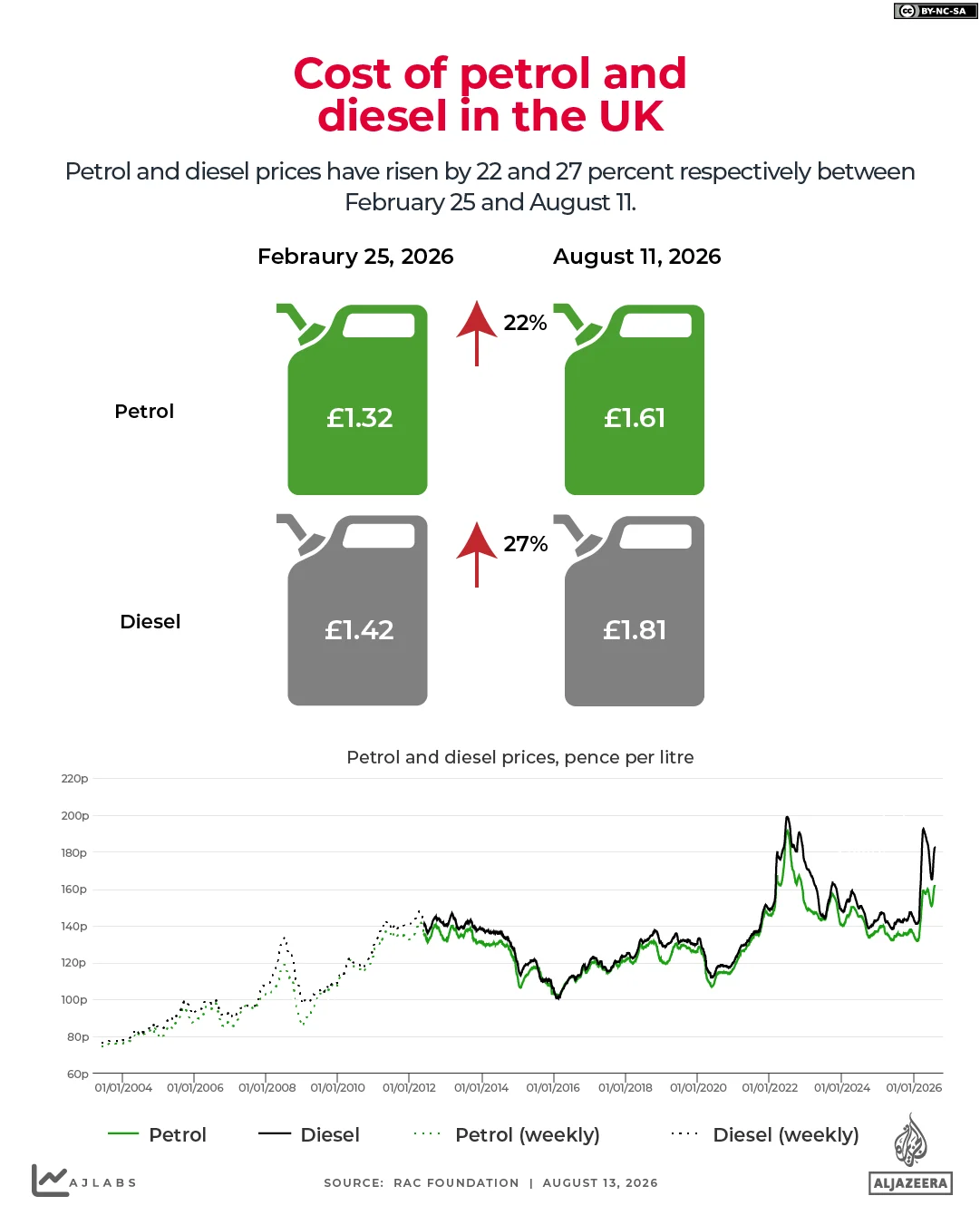
The impact on UK motorists has been particularly acute, with petrol prices hitting a three-and-a-half-year high. Data compiled by the RAC Foundation reveals a stark increase: the average price of petrol rose by 22 percent between February 25 and August 11, while diesel saw an even steeper increase of 27 percent over the same period. To put this into perspective, the average price of a litre of petrol increased from 1.32 pounds ($1.78) to 1.61 pounds ($2.17), while diesel soared from 1.42 pounds ($1.92) to 1.81 pounds ($2.44) per litre. These increases translate directly into higher operational costs for businesses relying on transport, from logistics and manufacturing to agriculture, inevitably feeding into consumer prices. For ordinary households, the increased cost of commuting and travel further strains already tight budgets, forcing difficult choices regarding discretionary spending.
The closure of the Strait of Hormuz not only impacts immediate supply but also fuels speculation and uncertainty in futures markets, driving up global oil benchmarks like Brent Crude, which saw a significant spike in the weeks following the conflict’s escalation. This supply shock, compounded by already tight global energy markets, demonstrates the interconnectedness of geopolitical events and everyday economic realities for UK citizens.
The Unequal Burden: Who is Hardest Hit?
Inflation, while a national statistic, is not experienced uniformly across all households. Its impact is profoundly shaped by income levels, spending patterns, and access to financial buffers. For the average UK household, weekly expenditure on goods and services amounts to approximately 677 pounds ($914). A significant portion of this spending is allocated to essential categories such as housing, fuel and power, transport, food, and recreation.
However, the burden of rising prices falls disproportionately on households with lower incomes. The Office for National Statistics (ONS) has highlighted this disparity, finding that the poorest 20 percent of households spent an average of 407 pounds ($549) a week. In stark contrast, the richest 20 percent of households spent more than double that amount, averaging 1,084 pounds ($1,462) weekly. This difference becomes critically important when prices are rising across the board. Lower-income households typically allocate a much larger proportion of their income to non-discretionary expenses like rent, energy, basic food, and essential transport. Consequently, they have far less financial flexibility or "cushion" to absorb any increase in these fundamental costs.
Research from the Joseph Rowntree Foundation (JRF), a charity dedicated to combating poverty in the UK, paints a stark picture of widespread hardship. Their cost-of-living tracker revealed that 7.4 million low-income families were unable to afford essential items this year, marking the highest figure since the tracker began in 2021. This indicates a deepening crisis that is pushing more families into financial precarity, often forcing them to choose between heating their homes and putting food on the table. Vulnerable groups, including pensioners on fixed incomes, single-parent households, and those reliant on state benefits, are particularly exposed to these inflationary pressures, as their incomes often fail to keep pace with the accelerating cost of living. Specific price increases on basic necessities like milk, bread, and vegetables, while seemingly small individually, accumulate to significantly strain the budgets of those with the least disposable income.

The Wage Squeeze: Real Earnings Lag Behind
While the weekly food shop remains more expensive than a year ago, recent figures offer a glimmer of hope: food price inflation has shown signs of slowing. According to the ONS, food and non-alcoholic drink prices were 1.7 percent higher in June compared to a year earlier, a decrease from the 2.2 percent recorded in May. It is crucial to note, however, that this slowdown does not signify falling prices, but rather a less rapid rate of increase.
Despite this marginal easing, further pressure on food prices is anticipated. The Bank of England has warned that food prices are likely to be affected by higher energy costs, which impact both agricultural production and the extensive transport networks required to bring food to market. The central bank predicts that food inflation could rise to nearly 3.5 percent by December. Supermarkets, often at the forefront of these cost fluctuations, have echoed similar concerns, projecting food inflation of 4 to 5 percent by the end of the year.
Compounding the problem for British households is the decline in real earnings. Weekly regular real earnings, which measure workers’ standard pay adjusted for inflation, have dipped in recent months. This crucial metric fell from approximately 0.4 percent at the start of the year to a meagre 0.1 percent after the Iran war began, effectively meaning that for many, pay rises are barely, if at all, keeping pace with the rising cost of living. This real-terms pay cut makes it increasingly difficult for people to afford escalating prices, eroding their purchasing power and reducing their overall quality of life. The persistent gap between nominal wage growth and inflation fuels calls for higher pay and contributes to an environment ripe for industrial action in various sectors.
Monetary Policy and Government Response
In response to these persistent inflationary pressures, the Bank of England faces a difficult balancing act. Its primary mandate is to maintain price stability, typically through adjusting interest rates. The Bank has already implemented a series of rate hikes over the past year to cool demand and bring inflation under control. However, the current inflationary surge, largely driven by external supply shocks from the Middle East conflict, presents a challenge that conventional monetary policy may struggle to address alone. Raising interest rates too aggressively risks stifling economic growth and potentially tipping the country into recession, while inaction could allow inflation to become entrenched. The Bank’s Monetary Policy Committee continues to monitor global developments closely, with future decisions dependent on the evolving geopolitical landscape and domestic economic data.
On the governmental front, Prime Minister Andy Burnham’s month-long "cost of living" tour is a highly visible attempt to demonstrate responsiveness to public concerns. The tour’s stated purpose is to directly engage with communities across the UK, listening to their experiences and gathering insights that will inform policy formulation. While the exact policy remedies remain to be fully unveiled, potential government responses could include targeted financial support for vulnerable households, such as further cost-of-living payments or energy bill support schemes, drawing parallels from previous administrations’ efforts. Other measures might involve exploring options for energy market regulation, investing in long-term energy security, or implementing housing affordability initiatives. The Reddit user’s comment, however, underscores a broader public skepticism regarding the efficacy of such tours without concrete, impactful policy announcements. The government’s challenge lies not just in understanding the problem, but in delivering credible and effective solutions that can alleviate the financial strain on millions of families.
UK’s Standing in the G7: A Comparative View
When compared to other advanced industrial democracies within the Group of Seven (G7), the UK’s inflation rate of 2.8 percent in June places it roughly in the middle of the pack. This comparative analysis provides crucial context, highlighting shared global challenges while also revealing unique national vulnerabilities.
The United States currently records the highest inflation rate among the G7 at 3.5 percent, grappling with strong consumer demand and ongoing supply chain issues. Italy follows with 3 percent, also facing significant energy cost pressures. Canada, like the UK, sits at 2.8 percent. Germany, a major European economy, shows a lower rate of 2.3 percent, while France, at 1.8 percent, and Japan, at 1.7 percent, demonstrate relatively greater success in containing inflationary pressures.
These differences can be attributed to a variety of factors, including each country’s specific energy mix (e.g., reliance on imported gas vs. nuclear power), the extent of government subsidies to buffer consumers from price hikes, prevailing wage pressures, and distinct monetary and fiscal policies. For the UK, the primary drivers of inflation are threefold: the acute energy price shock triggered by the conflict in the Middle East; persistent services inflation, which reached 3.6 percent in June, largely driven by higher costs in sectors like restaurants and hotels; and, critically, slowing real wage growth, which exacerbates the impact of rising prices on household budgets. Unlike some European counterparts, the UK’s high reliance on imported energy and its specific exposure to global commodity price fluctuations, particularly via the Strait of Hormuz, have rendered it more susceptible to the current geopolitical storm.
Broader Economic and Social Implications
The ongoing cost of living crisis, amplified by geopolitical instability, casts a long shadow over the UK’s economic and social landscape. Economically, there is an elevated risk of recession as consumer spending, a key driver of growth, is curtailed by diminished purchasing power. Businesses face increased operational costs, potentially leading to reduced investment, slower hiring, and even insolvencies, particularly among small and medium-sized enterprises. Consumer confidence, a vital indicator of future spending, remains fragile, creating a challenging environment for economic recovery.
Socially, the implications are profound. The crisis is widening the gap between the rich and poor, deepening existing inequalities, and pushing more families into poverty. The constant stress of financial insecurity can have severe impacts on mental health, community cohesion, and overall societal well-being. Food bank usage is likely to remain high, and charitable organizations will continue to face unprecedented demand for support. The political ramifications are also significant. Public dissatisfaction with the government’s handling of the crisis could lead to shifts in public opinion, pressure for more radical policy interventions, and potential electoral consequences for the ruling party.
In the long term, the crisis underscores the urgent need for the UK to enhance its energy security, diversify its supply chains, and build greater resilience against external shocks. It necessitates a strategic re-evaluation of economic policies to ensure sustainable growth that is inclusive and protects the most vulnerable segments of society. The path ahead for policymakers is fraught with challenges, demanding careful navigation between controlling inflation, supporting economic growth, and addressing the mounting social costs. The UK’s ability to weather this storm will depend on a combination of effective domestic policy and a degree of stability in the volatile global geopolitical environment.
