

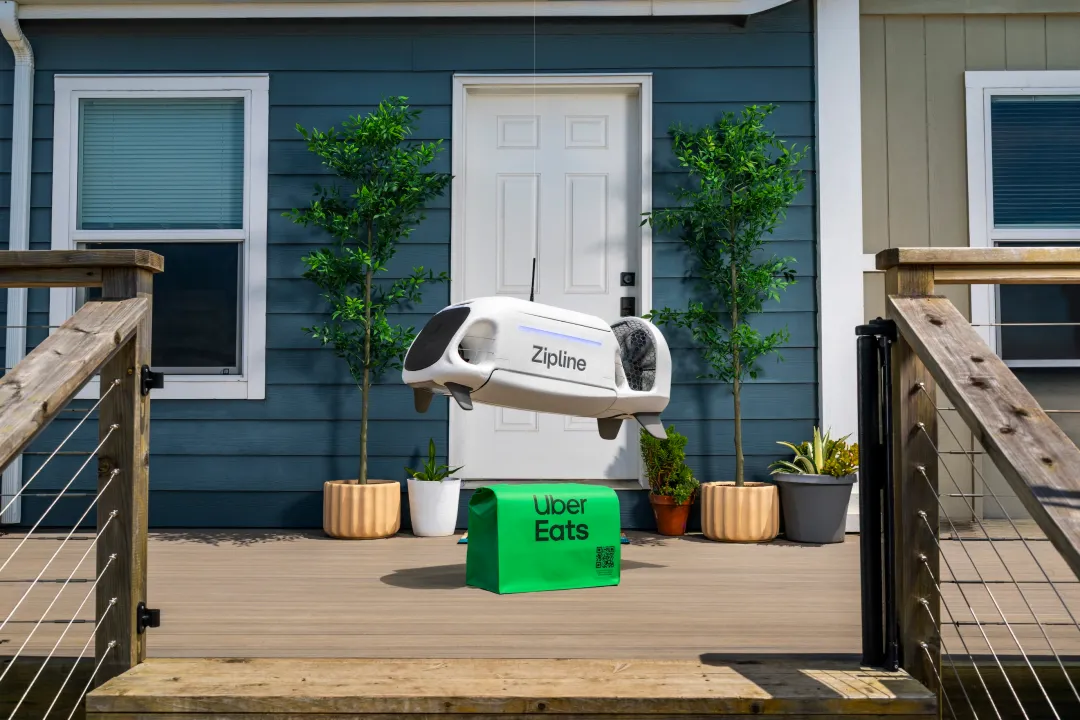
Residents of Spring, Texas, a suburb of Houston, have become the first in the nation to experience the commercial realization of a high-profile partnership between Uber Eats and Zipline. The launch, which officially commenced on Tuesday, marks the inaugural phase of a strategic collaboration aimed at transforming the "last-mile" delivery landscape through autonomous aerial technology. While the service is currently localized to the Houston area, both companies have signaled that this is merely the starting point for a massive logistical overhaul intended to span dozens of American cities by the end of the decade.
Under the new service, customers within the designated flight radius can select a "drone" option directly through the Uber Eats mobile application. The integration represents a significant step in making autonomous delivery a mainstream consumer expectation rather than a niche experimental project. According to company officials, the expansion into the Dallas-Fort Worth metroplex is slated to follow shortly, serving as a precursor to a nationwide rollout.
Technical Specifications and the Delivery Experience
The delivery mechanism utilizes Zipline’s "Platform 2" (P2) system, which is specifically engineered for precise urban and suburban logistics. Unlike traditional delivery drones that may require a large landing pad or clear ground space to touch down, Zipline’s aircraft operate at a hovering altitude of approximately 300 feet. Once the drone reaches its destination, it deploys a tethered, protective pod that lowers the order gently to a precise location—such as a driveway or a backyard—before retracting the cable and returning to its base.
The drones are capable of carrying payloads weighing up to eight pounds, a capacity that covers the vast majority of standard quick-service restaurant orders. Operating at speeds of up to 70 miles per hour, these autonomous aircraft can bypass ground-level traffic congestion, which often plagues the sprawling suburbs of major Texas cities. By maintaining a high cruising speed and utilizing direct-line-of-sight flight paths, the service aims to reduce delivery times from the standard 30-to-45-minute window to less than 15 minutes.
The initial merchant roster in the Houston area includes a mix of national franchises and local favorites. Large chains such as Jersey Mike’s Subs and Zaxby’s have signed on for the launch, joined by regional brands like Urban Bird and Abu Omar Halal. Uber has indicated that the number of participating restaurants will grow as the service area expands and the technology proves its reliability in a high-volume commercial environment.
The Road to One Million Deliveries
The partnership between Uber and Zipline is underpinned by an audacious objective: to complete one million drone deliveries per day by the end of 2029. This target reflects a broader shift in the logistics industry toward automation as a solution to the rising costs and inefficiencies of traditional courier-based delivery models.
For Uber, the collaboration with Zipline allows the company to leverage advanced hardware without the overhead of developing the technology entirely in-house. Uber’s relationship with the drone startup is not merely operational; the ride-hailing giant is also a strategic investor. While the specific amount of Uber’s contribution remains undisclosed, it was part of a recent $1.5 billion funding round for Zipline that valued the startup at approximately $13 billion. Other major backers in the round included Paradigm, WCM Investment Management, and Layer Global, signaling strong institutional confidence in the future of autonomous logistics.
Zipline CEO and co-founder Keller Rinaudo Cliffton emphasized the transformative nature of the project, stating that the partnership is designed to "create a new expectation for delivery in America." The focus on speed, precision, and environmental sustainability is central to Zipline’s value proposition as it seeks to scale its operations across the continental United States.
Historical Context and Regulatory Milestones
Founded in 2014, Zipline initially gained international acclaim for its humanitarian efforts in Rwanda and Ghana, where it operated a robust network for delivering life-saving medical supplies, including blood and vaccines, to remote clinics. These early operations allowed the company to refine its autonomous flight software and hardware in challenging environments, logging millions of miles of flight data long before it entered the American commercial market.
The company’s pivot to U.S. commercial operations was accelerated by significant regulatory breakthroughs. In 2022, Zipline received its Part 135 air carrier certification from the Federal Aviation Administration (FAA). This certification is a critical legal requirement that allows a company to operate as a commercial airline, enabling long-range drone deliveries beyond the visual line of sight (BVLOS) of the operator. This regulatory approval placed Zipline in an elite group of companies—including Alphabet’s Wing and Amazon’s Prime Air—authorized to conduct complex drone operations at scale.

The evolution of the industry has seen a transition from small-scale pilot programs to integrated ecosystems. Zipline has developed a comprehensive infrastructure that includes specialized aircraft, automated launch and recovery systems, and sophisticated logistics software that integrates directly into existing merchant workflows.
Economic and Environmental Implications
The move toward drone delivery is frequently cited by industry proponents as a net benefit for urban planning and environmental sustainability. By shifting small-package delivery from two-ton internal combustion engine vehicles to lightweight, electric drones, companies hope to significantly reduce carbon emissions associated with the "last mile."
Furthermore, drone delivery addresses the "hidden costs" of urban delivery, such as traffic congestion and road wear. In cities like Houston and Dallas, which consistently rank among the most congested in the United States, removing delivery vehicles from the streets could theoretically improve traffic flow. From a consumer perspective, the removal of the traditional tipping model associated with human couriers and the potential for lower delivery fees once the technology scales could make drone delivery a more cost-effective option for frequent users.
However, the transition is not without its detractors. As drone operations become more frequent, residents in testing areas have raised concerns regarding noise pollution and privacy. The high-pitched whine of drone rotors has been a point of contention in other markets, leading companies like Zipline to invest heavily in acoustic engineering to make their aircraft as quiet as possible. Additionally, there are ongoing debates regarding the impact of low-flying autonomous aircraft on local bird populations and wildlife.
Competitive Landscape and Market Analysis
Uber and Zipline are entering a crowded and well-funded arena. Alphabet’s Wing has already established a strong presence in parts of Texas and Australia, while Amazon continues to iterate on its Prime Air service. Walmart, a major player in the retail space, has also been aggressive in its drone adoption, recently expanding its partnership with Zipline to bolster its own delivery network.
The competition is no longer just about who has the best drone, but who can integrate most seamlessly into the existing consumer habit. By embedding the drone option directly within the Uber Eats app—an interface already used by millions—Uber is betting that ease of use will be the primary driver of adoption.
Market analysts suggest that the success of the Spring, Texas, launch will be a bellwether for the industry. If Zipline can demonstrate that its P2 system can handle the high-volume, high-frequency demands of a suburban food delivery market without significant downtime or safety incidents, it will likely pave the way for faster regulatory approvals and increased merchant participation.
Future Outlook: The Autonomous Urban Sky
As the service moves toward its Dallas expansion, the focus will remain on the reliability of the "tether" delivery system and the ability of the autonomous software to navigate complex suburban environments. The long-term vision of one million deliveries a day suggests a future where the sky above American suburbs is a constant thoroughfare for autonomous logistics.
The integration of drones into the Uber Eats network also raises questions about the future of the gig economy. While Uber continues to rely on hundreds of thousands of human couriers, the shift toward automation suggests a hybrid model where drones handle short-distance, lightweight packages in suburban areas, while humans continue to manage complex deliveries in dense urban cores or for larger, multi-package orders.
For now, the residents of Spring are at the forefront of a technological shift. As the first pods are lowered to Texas driveways, the industry will be watching closely to see if the "new expectation for delivery" can live up to its lofty promises of speed, efficiency, and safety. With billions of dollars in investment and the regulatory path slowly clearing, the era of widespread commercial drone delivery appears to have finally moved from the realm of science fiction into the daily lives of American consumers.
