

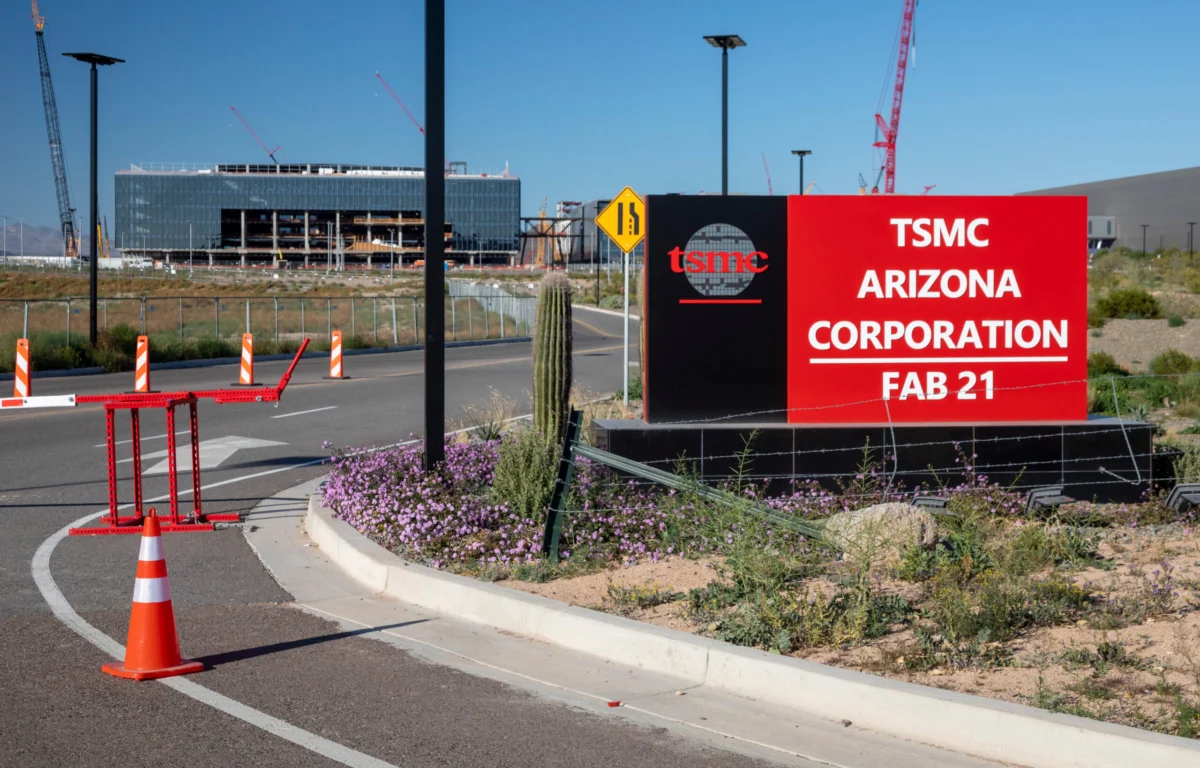
Taiwan Semiconductor Manufacturing Co. (TSMC), the world’s largest contract chipmaker, has announced a massive acceleration of its production capacity in the United States, committing an additional $100 billion to its ongoing expansion in Arizona. This fresh infusion of capital raises the company’s total planned investment in the state to a staggering $265 billion, a move designed to capitalize on what Chief Financial Officer Wendell Huang describes as a "multi-year demand mega trend" driven by the global surge in artificial intelligence (AI) development. Speaking in a recent interview, Huang emphasized that the company is moving aggressively to ensure it maintains its dominant market position, stating that TSMC does not plan to "leave any food on the table for anybody else."
The decision to scale up investment comes as TSMC revises its full-year capital expenditure forecast upward, now projecting spending between $60 billion and $64 billion for the current fiscal year. This financial pivot reflects the sheer scale of the structural demand for high-performance computing (HPC) and AI-specific semiconductors, which have become the primary growth engines for the semiconductor industry. As tech giants and sovereign nations alike race to secure the hardware necessary for generative AI and large language models, TSMC finds itself at the center of a global supply chain bottleneck that it is now moving rapidly to alleviate.
The Strategic Pivot to United States Soil
The expansion in Arizona represents more than just a capacity increase; it is a strategic realignment of the global semiconductor manufacturing footprint. For decades, the most advanced logic chips were produced almost exclusively in Taiwan. However, rising geopolitical tensions and the lessons learned from pandemic-era supply chain disruptions have prompted a "China Plus One" strategy and a push for geographical diversification. TSMC’s Arizona project is the cornerstone of the U.S. government’s efforts to re-shore critical technology manufacturing, supported heavily by the CHIPS and Science Act.
Wendell Huang noted that the decision to commit an additional $100 billion was informed by robust customer demand within the U.S. market and significant support from federal and state governments. The investment will fund both front-end wafer fabrication facilities (fabs) and back-end advanced packaging facilities. Advanced packaging has become a critical differentiator in the AI era, as it allows multiple chips to be integrated into a single package to improve performance and energy efficiency—a necessity for the massive GPU clusters used by companies like Nvidia and AMD.
Navigating the Technological Frontier: From 5nm to 2nm
A key component of TSMC’s strategy involves the aggressive optimization of its leading-edge capacities. Huang revealed that the company is currently fast-tracking the conversion of its 5-nanometer (nm) capacity to the more advanced 3-nanometer node. In the semiconductor world, "nanometer" refers to the size of the transistors on a chip; smaller transistors allow for higher density, which translates to more processing power and lower energy consumption.

Currently, TSMC’s first phase in Arizona, utilizing 4-nanometer technology, is operational and expected to scale significantly over the coming quarters. However, the company is already looking toward the next horizon. Huang identified 2-nanometer technology as the company’s newest revenue driver, following its initial revenue generation in the second quarter of 2026. This rapid progression through the nodes is essential for meeting the requirements of AI developers who demand exponential increases in computational efficiency every year.
A Chronology of TSMC’s Arizona Expansion
The journey of TSMC’s presence in Arizona has been one of constant escalation, reflecting the accelerating pace of the digital economy:
- May 2020: TSMC initially announces plans to build a $12 billion facility in Arizona, focusing on 5-nanometer technology.
- December 2022: Amid rising demand, the company triples its investment to $40 billion and announces a second fab capable of 3-nanometer production.
- April 2024: Following the finalization of CHIPS Act grants and loans, TSMC signals a further expansion, including a third fab and the introduction of 2-nanometer technology.
- July 2026: The current announcement of an additional $100 billion brings the total pipeline to $265 billion, incorporating advanced packaging and further scaling of front-end operations.
This timeline illustrates a shift from a cautious entry into the U.S. market to a full-scale commitment to making Arizona a global hub for semiconductor excellence.
The Economic Reality of Domestic Manufacturing
Despite the strategic necessity of the Arizona expansion, it is not without significant financial hurdles. Huang admitted that the cost of constructing and operating fabs in the United States remains four to five times higher than in Taiwan. These costs are driven by higher labor wages, regulatory compliance, and the lack of a pre-existing, mature ecosystem of suppliers and specialized contractors in the Phoenix area.
The CFO acknowledged that the initial "dilution" of profit margins will likely widen as the scale of overseas operations grows. However, TSMC views this as a long-term investment in the "U.S. semiconductor ecosystem." By establishing a massive footprint, the company expects to attract a network of suppliers to the region, eventually driving down costs through economies of scale and localized logistics. Furthermore, TSMC’s focus on the high-end market allows it to maintain premium pricing, which helps offset the increased operational expenditures.
Market Volatility and Financial Performance
The announcement of the expanded investment was met with a complex reaction from the financial markets. On the day leading up to the earnings release, TSMC shares rose 1.23%. However, the stock experienced a sharp correction on the following Friday, closing down 7.29%. This volatility occurred despite the company’s strong fundamentals and the stock remaining up approximately 48% year-to-date.

Huang remained unfazed by the short-term fluctuations, stating that the company focuses on its business fundamentals rather than market sentiment. Analysts suggest the dip may have been a "sell on the news" event or a reaction to the massive capital expenditure hike, which some investors fear could impact short-term free cash flow. Nevertheless, the consensus remains that TSMC’s strategic positioning in the AI sector makes it a primary beneficiary of the current technological cycle.
Geopolitical Considerations and Global Market Dynamics
TSMC’s role as the world’s "silicon shield" places it in a delicate position regarding international trade and regulation. On the subject of China, Huang confirmed that the company continues to serve its Chinese customers while remaining in strict compliance with all international export controls. Currently, the Chinese market contributes roughly 8% of TSMC’s total revenue.
While the U.S. expansion is a priority, TSMC is also diversifying elsewhere, including a joint venture with Sony in Japan for image sensors and specialty technologies. This move toward "Physical AI"—the integration of AI into tangible devices like sensors, robotics, and automotive systems—is a key part of the company’s long-term growth strategy.
Industry Implications and the Path Forward
The $100 billion commitment by TSMC sends a clear signal to competitors like Intel and Samsung: the race for semiconductor supremacy will be won by those with the deepest pockets and the most advanced technology. By locking in capacity for the next several years, TSMC is effectively securing its relationship with high-value customers like Apple, Nvidia, and Qualcomm, who require guaranteed access to the world’s most advanced nodes.
The broader implications for the U.S. economy are substantial. The expansion is expected to create thousands of high-tech jobs and solidify Arizona’s reputation as the "Silicon Desert." Moreover, it provides a level of national security by ensuring that the chips powering everything from military hardware to critical infrastructure are manufactured on domestic soil.
As the industry moves toward the 2-nanometer era and beyond, the challenges of physics and finance will only increase. However, with a $265 billion roadmap in Arizona and a firm grip on the AI megatrend, TSMC is positioning itself not just as a manufacturer, but as the indispensable foundation of the future digital world. The company’s willingness to double down on its U.S. operations suggests a high level of confidence that the AI boom is not a bubble, but a structural shift that will define the global economy for decades to come.
