

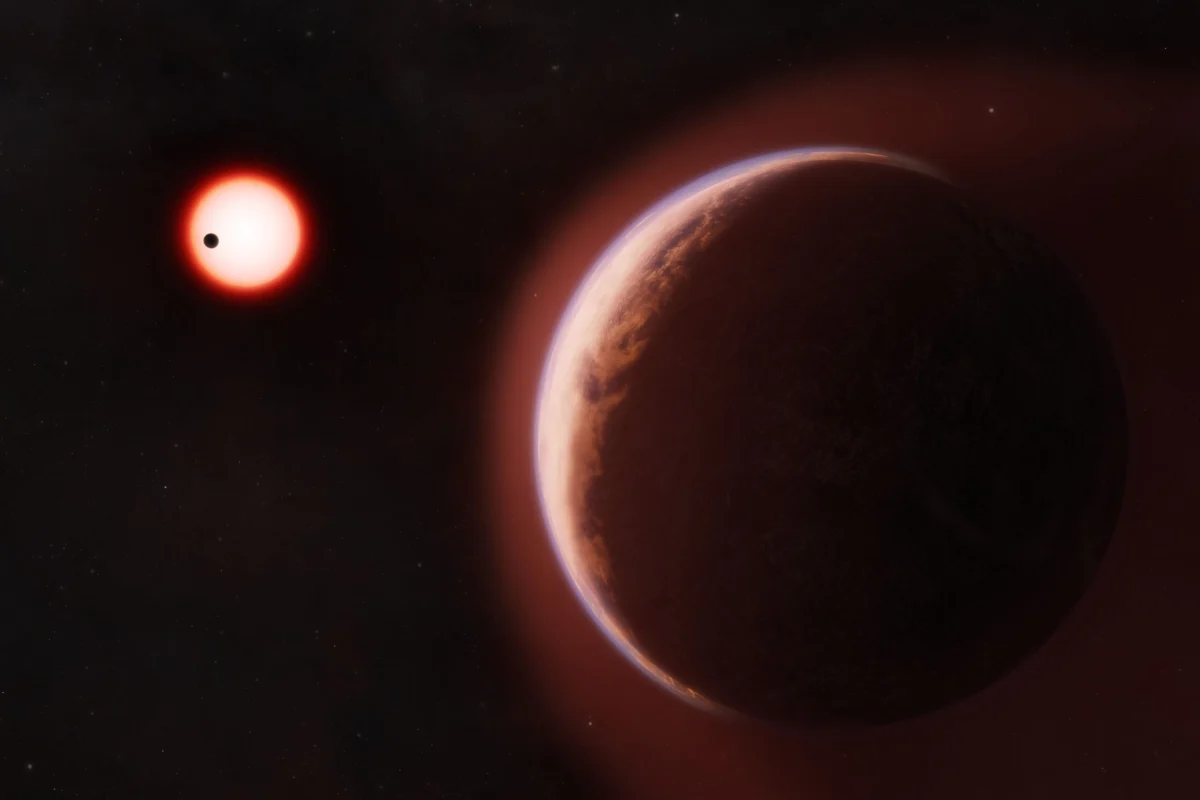
The search for a terrestrial world beyond our solar system that mirrors the life-sustaining conditions of Earth has reached a pivotal milestone. For the first time, an international team of researchers has confirmed the existence of a rocky exoplanet that possesses both an atmosphere and a location within its host star’s habitable zone. This celestial body, designated as LHS 1140 b, is located approximately 48 light-years away in the constellation Cetus. While thousands of exoplanets have been discovered over the last three decades, LHS 1140 b stands out as the most compelling candidate for habitability identified to date, bridging the gap between theoretical models of "Earth-like" worlds and observed reality.
The discovery, led by researchers at the Harvard-Smithsonian Center for Astrophysics and documented in the journal Science, centers on the detection of helium signatures emanating from the planet. This finding provides the definitive evidence required to confirm that the planet has retained a gas envelope despite the intense radiation often associated with the red dwarf stars that these planets typically orbit. The presence of an atmosphere is a non-negotiable requirement for life as we understand it, serving as a protective shield against cosmic radiation and a regulator for surface temperatures.
A Profile of LHS 1140 b: The Super-Earth Candidate
LHS 1140 b was first identified in 2017, but it has taken years of rigorous observation to characterize its physical properties with precision. The planet is classified as a "Super-Earth," a category of exoplanets with a mass larger than Earth’s but substantially smaller than gas giants like Neptune or Uranus. Specifically, LHS 1140 b is approximately 1.7 times the radius of Earth and possesses roughly 5.6 times its mass.
The planet orbits a cool red dwarf star, known as LHS 1140, which is much smaller and dimmer than our Sun. Because the star is cooler, its "habitable zone"—the orbital region where temperatures are moderate enough for liquid water to exist on a planet’s surface—is much closer to the star than the habitable zone in our solar system. LHS 1140 b completes one full orbit every 25 days. Despite this proximity, the planet receives less sunlight than Earth does, placing it on the cooler edge of the habitable zone, a position that may actually help it retain its atmosphere and potential surface oceans.
Initial data suggested a rocky composition, but the breakthrough came with the confirmation of its atmosphere. Without an atmosphere, any water on the surface would either freeze or boil away into the vacuum of space. The atmosphere acts as a pressurized blanket, allowing water to remain in a liquid state and stabilizing the planetary climate over geological timescales.
The Scientific Breakthrough: Detecting Helium Leaks
To detect an atmosphere on a world 48 light-years away, astronomers utilized a sophisticated technique involving the detection of escaping helium. As a planet transits, or passes in front of its host star, the star’s light filters through the planet’s outer atmospheric layers. Different gases absorb specific wavelengths of light, leaving behind a "spectral signature" that acts as a chemical fingerprint.
Observations conducted between 2024 and 2025 allowed the Harvard-Smithsonian team to identify the spectral signature of helium. By analyzing the rate at which helium was "leaking" or escaping from the planet’s upper atmosphere into space, researchers were able to reconstruct physical models of the atmosphere’s structure. The data indicates that LHS 1140 b has maintained this atmosphere for at least 3 billion years, suggesting a level of stability that is rare among planets orbiting red dwarf stars.
While the upper atmosphere is dominated by helium, scientists believe the lower layers may contain heavier molecules. On Earth, the atmosphere is composed primarily of nitrogen and oxygen. On LHS 1140 b, the presence of helium suggests a primitive or secondary atmosphere that could be rich in nitrogen, carbon dioxide, or carbon monoxide. The density of the planet also suggests that it could be a "water world," potentially containing significantly more water by mass than Earth, possibly in the form of a global ocean or a thick icy mantle beneath the atmosphere.
A Chronology of Discovery and Exploration
The journey to characterizing LHS 1140 b has been a multi-stage effort involving various ground-based and space-based observatories.
- 2017: Initial Discovery. The planet was first detected using the MEarth-South telescope array and the High Accuracy Radial velocity Planet Searcher (HARPS) instrument at the European Southern Observatory. These tools confirmed the planet’s existence and provided initial estimates of its size and mass.
- 2018–2023: Density Refinement. Follow-up observations using the Spitzer Space Telescope and the Hubble Space Telescope helped researchers narrow down the planet’s density. This period established that LHS 1140 b was likely rocky rather than a "mini-Neptune" (a small gas giant).
- 2024: Atmospheric Confirmation. Utilizing high-resolution spectroscopy, the team at the Harvard-Smithsonian Center for Astrophysics detected the helium leaks. This provided the first concrete proof that the planet had not lost its gases to stellar winds.
- 2025: Modeling and Validation. Physical models were finalized, confirming that the atmosphere had been stable for billions of years, a timeframe sufficient for the potential emergence of biological processes.
The Significance of the Red Dwarf Environment
The majority of stars in the Milky Way are M-dwarfs, or red dwarfs. Because they are so numerous and long-lived, they are the primary targets for astronomers searching for habitable worlds. However, red dwarfs are notoriously volatile, frequently emitting powerful flares and X-ray radiation that can strip the atmosphere off nearby planets.
The fact that LHS 1140 b has retained its atmosphere for 3 billion years is a significant finding for the field of astrobiology. It suggests that not all planets orbiting red dwarfs are doomed to be barren, airless rocks. Robin Wordsworth, a professor at Harvard University and a co-author of the study, noted the progression of the field over the last two decades. "Twenty years ago we wondered whether other terrestrial-type planets even existed," Wordsworth stated. "Then we learned they’re common, and found some in the habitable zone. The next question was whether any of them had managed to keep an atmosphere. Now, we know at least one has."
This stability makes LHS 1140 b a superior candidate for study compared to the planets in the TRAPPIST-1 system. While the TRAPPIST-1 system contains seven Earth-sized planets, many of them are subjected to much harsher radiation, and recent James Webb Space Telescope (JWST) observations have suggested that the innermost planets in that system may lack significant atmospheres.
Broader Implications and Future Research
The confirmation of an atmosphere on LHS 1140 b changes the trajectory of exoplanet research. The focus now shifts from "finding" planets to "characterizing" them. The technique used to detect helium leaks has been proven viable, providing a roadmap for studying other candidate worlds.
Moving forward, the scientific community plans to use more powerful instruments, such as the James Webb Space Telescope and the upcoming Extremely Large Telescope (ELT) in Chile, to perform a deeper analysis of the planet’s chemical composition. Researchers will look for "biosignatures"—gases like oxygen, methane, or ozone that could indicate the presence of life. They will also seek to confirm whether the planet possesses liquid surface oceans. Given the planet’s density, some models suggest that LHS 1140 b could be 10% to 20% water by mass, compared to Earth’s 0.02%.
However, scientists remain cautious. An atmosphere and a location in the habitable zone do not guarantee that a planet is habitable, let alone inhabited. The specific chemistry of the atmosphere on LHS 1140 b remains unknown, and the high concentration of helium in the upper layers suggests an environment that is still very different from Earth’s.
The discovery of LHS 1140 b represents a definitive "step up" in the search for life. It is no longer a matter of speculating about the existence of such worlds; the data now confirms that rocky, temperate planets with atmospheres exist and are within our reach for detailed study. As instrumentation improves, LHS 1140 b will likely remain at the forefront of astronomical inquiry, serving as a primary laboratory for understanding the conditions that allow life to flourish in the universe.
