

The Greenbuild International Conference + Expo 2026, held in the North Hall of the Javits Center in New York City, showcased a significant pivot in the sustainable construction industry, moving beyond simple energy efficiency toward a profound reimagining of building materials. While previous industry gatherings such as CES and InterSolar Europe focused heavily on battery storage and renewable energy hardware, Greenbuild 2026 centered on the "embodied carbon" of the structures themselves. This shift comes at a critical juncture for the global construction sector, which is currently responsible for approximately 40% of global carbon dioxide emissions. The event highlighted a growing consensus among architects, engineers, and developers: to meet international climate goals, the industry must address the environmental cost of materials like concrete, steel, and insulation.
The Evolution of Greenbuild and the Regulatory Landscape
Greenbuild 2026 arrived during a period of intense regulatory pressure, particularly in metropolitan hubs like New York City. The implementation of Local Law 97 (LL97) continues to be a primary driver for innovation in the region. LL97 requires most buildings over 25,000 square feet to meet stringent energy efficiency and greenhouse gas emissions limits by 2024 and 2030, with increasingly severe penalties for non-compliance. Despite the weight of these regulations, many exhibitors at the 2026 expo appeared focused on the broader global market for green materials rather than local compliance alone. This suggests a maturing industry where sustainability is viewed as a fundamental requirement for new construction rather than a response to regional mandates.
The scale of the 2026 conference allowed for deeper technical engagement than the massive, consumer-oriented electronics shows. This intimacy facilitated a detailed exploration of "regenerative" building practices—a step beyond "net-zero" that seeks to create buildings that actually improve their surrounding environment.
Revolutionizing the Building Envelope with Compressed Straw
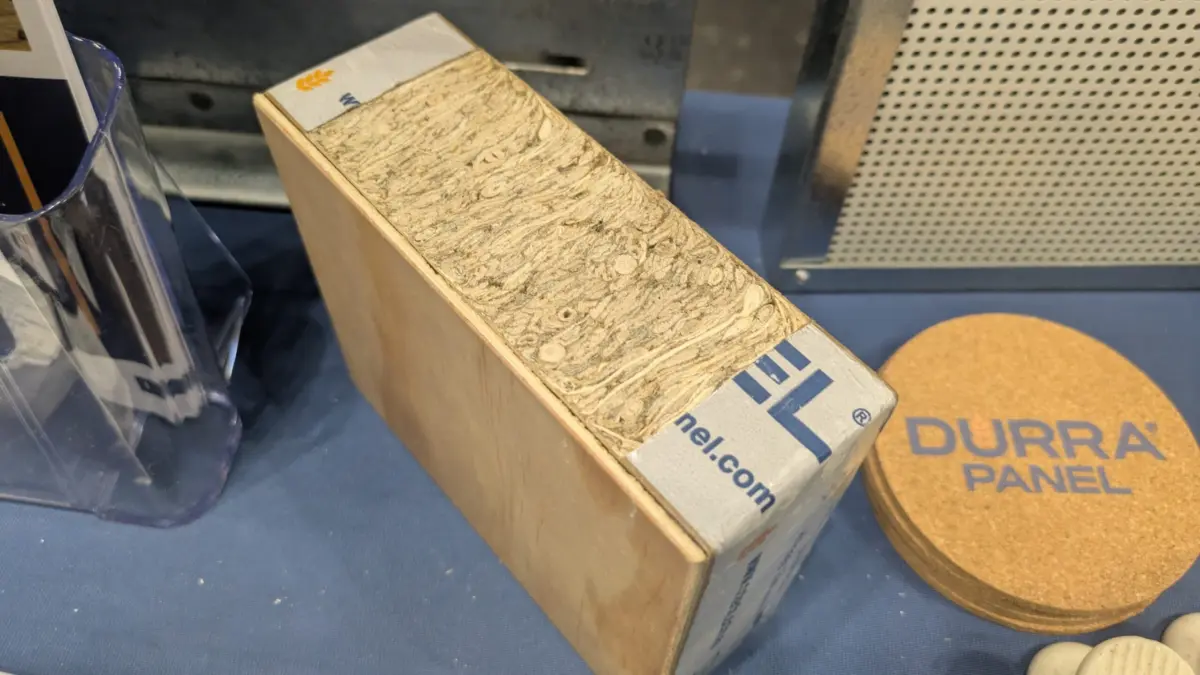
One of the most significant breakthroughs featured at the expo involved the use of agricultural waste as a primary structural component. Durra Panel, an Australian-born technology now expanding into the United States, presented a compelling case for the use of compressed straw. While straw has historically been overlooked in modern construction, the panels demonstrated at Greenbuild 2026 utilize high-heat and high-pressure manufacturing to bond straw with its naturally occurring lignin. This process requires no added chemical binders or glues, resulting in a product that is 99.9% free of Volatile Organic Compounds (VOCs).
The technical specifications of these panels address several traditional concerns regarding bio-based materials. The panels achieve a 60-minute Fire Resistance Level (FRL) and offer significant acoustic insulation, leading to their widespread use in high-performance environments like recording studios. Furthermore, the inclusion of biochar in certain iterations allows the panels to actively absorb VOCs from the indoor environment.
From a carbon perspective, the implications of straw-based construction are vast. According to data presented at the conference, the burning of agricultural straw waste globally generates more CO2 emissions than the entire commercial aviation industry. By sequestering this straw into building panels, the industry could potentially lock away up to 3.7 gigatonnes of CO2. The embodied energy of these panels is approximately 12.6 MJ/m², a staggering reduction compared to the 153 MJ/m² required for a standard timber or steel stud wall. Durra Panel recently announced the selection of Brockton, Massachusetts, as the site for its first U.S. manufacturing facility, signaling a major move toward localized production in North America.
Decarbonizing the Concrete Industry
Concrete remains the most widely used man-made material on Earth, but its environmental toll is immense, accounting for roughly 8% of global CO2 emissions. Greenbuild 2026 featured several companies working to transform concrete from a carbon liability into a carbon sink.
ZeroTwelve, a leader in carbon-negative masonry, demonstrated how biochar can be integrated into concrete mixes to replace a portion of traditional Portland cement. By utilizing the carbon-sequestering properties of biochar, the company claims to produce concrete that sequesters more carbon than was emitted during its manufacture. Beyond the environmental benefits, the biochar provides a natural aesthetic advantage, giving the concrete a deep, slate-like gray finish that is increasingly popular in modern architectural design.
Another approach to "urban mining" was presented by Pozzotive, a company that utilizes post-consumer recycled glass. Much of the glass collected in municipal recycling programs currently ends up in landfills due to the costs associated with sorting by color and quality. Pozzotive bypasses these hurdles by milling all types of recycled glass into a high-performance pozzolan—a supplementary cementitious material. This powdered glass can replace up to 50% of the cement in a concrete mix, reducing CO2 emissions by up to 94% for that portion of the material. The resulting concrete is not only more durable and chemical-resistant but also more reflective, which helps mitigate the "urban heat island" effect in densely populated cities.
Complementing these cement replacements, Glavel showcased its foamed glass aggregate. This lightweight material is manufactured from recycled glass using 100% renewable energy. It serves a dual purpose: replacing traditional crushed stone aggregate while providing inherent thermal insulation. This "all-in-one" approach simplifies the building process and reduces the need for petroleum-based foam insulation boards.
Chronology of Sustainable Material Adoption
The innovations seen at Greenbuild 2026 represent the "Third Wave" of green building evolution:
- The First Wave (1990s–2000s): Focused on operational efficiency—reducing the amount of electricity and gas a building consumes through better windows and HVAC systems.
- The Second Wave (2010s–2020s): Focused on renewable energy integration—adding solar panels, battery storage, and heat pumps to move toward net-zero energy.
- The Third Wave (2025 and beyond): Focuses on embodied carbon and regenerative materials—addressing the carbon footprint of the materials themselves and the lifecycle of the building.
The transition to this third wave is evidenced by the move of companies like Durra Panel and Glavel into the U.S. market. The opening of the Brockton facility in 2026 marks a turning point where these technologies move from niche international imports to domestic industrial staples.
Technical Analysis: The Shift to Regenerative Systems
A highlight of the conference was the presence of David Gottfried, the co-founder of the U.S. Green Building Council (USGBC) and the World Green Building Council. Gottfried’s latest work, Regen360, served as a philosophical backdrop for the event. The concept of "regenerative" design argues that being "less bad" is no longer sufficient. Instead, buildings must be designed as part of a living system that restores the environment.

This philosophy is grounded in data. If the global building stock is expected to double by 2060, the industry cannot rely on traditional materials without catastrophic environmental consequences. The integration of biochar, agricultural waste, and recycled glass represents a move toward a circular economy where "waste" from one industry becomes the "raw material" for another.
Economic Implications and Market Reaction
The economic case for these materials is becoming increasingly persuasive. Durra Panel reported that its systems could offer up to 21% in cost savings and an 84% reduction in installation time compared to traditional materials. In high-cost labor markets like New York City, where the commercial real estate sector is under pressure to adapt to hybrid work models, the ability to quickly and sustainably install or remove partition walls is a significant financial advantage.
Furthermore, the "de-constructability" of these new materials allows for a secondary market. Unlike traditional drywall, which is often destroyed during renovation and sent to landfills, modular straw panels and glass-based aggregates can be reclaimed, reused, or composted. This reduces tipping fees for developers and aligns with the growing "Environmental, Social, and Governance" (ESG) requirements of institutional investors.
Broader Impact and Future Outlook
The Greenbuild 2026 Expo demonstrated that the technology required to decarbonize the built environment is no longer experimental; it is ready for industrial-scale application. The challenge remains one of adoption and supply chain logistics. As the industry moves forward, the focus will likely shift toward "carbon labeling" for building materials, similar to nutrition labels on food, allowing architects to make real-time decisions based on the carbon footprint of their specifications.
The transition to a regenerative building model will require continued collaboration between policymakers, manufacturers, and the financial sector. However, the innovations showcased in New York—from the straw-filled walls of Massachusetts to the glass-infused concrete of local urban mines—suggest that the path to a carbon-negative built environment is not only possible but is already being paved. The success of these materials in the coming years will be the ultimate litmus test for the global construction industry’s commitment to a sustainable future.
