

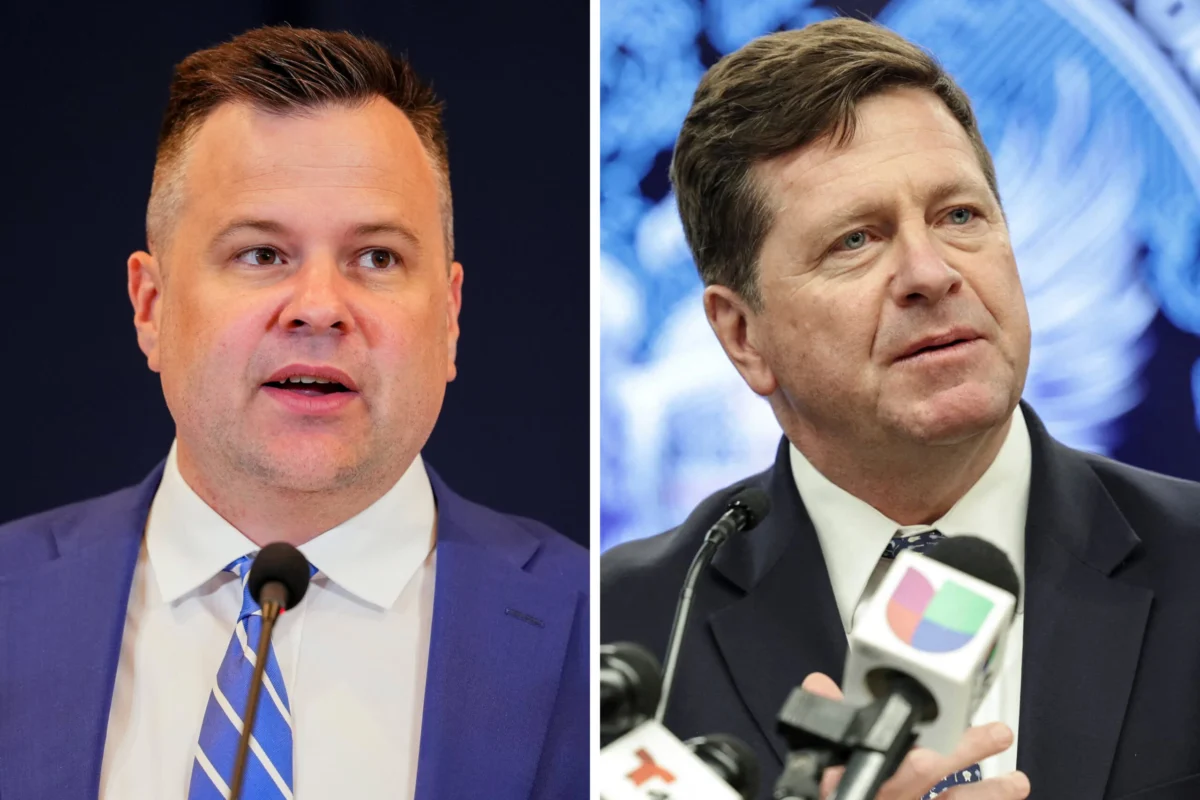
President Donald Trump on Wednesday ignited a fresh political firestorm by announcing the abrupt cancellation of the Senate confirmation hearing for his nominee for Director of National Intelligence (DNI), Jay Clayton. The move, communicated via a social media post, immediately plunged the critical intelligence-gathering authority known as Section 702 of the Foreign Intelligence Surveillance Act (FISA) into deeper jeopardy, following its lapse the previous week. The unprecedented intervention by a president to halt his own nominee’s hearing underscored a deepening chasm between the White House and Congress on national security matters and critical appointments.
A Sudden Reversal and a Cascade of Demands
Jay Clayton, currently the U.S. Attorney for the Southern District of New York (SDNY), had been slated to appear before the Senate Intelligence Committee for his confirmation hearing on Wednesday afternoon. The former chairman of the Securities and Exchange Commission, Clayton was seen by many as a potentially bipartisan choice, albeit one without a traditional intelligence background, to lead the nation’s 18 intelligence agencies. His nomination was intended to bring stability to an office that had seen significant turnover and controversy.
However, just hours before the scheduled hearing, President Trump took to Truth Social, his preferred platform for direct communication, to declare the hearing canceled. His post was not merely an announcement but a laundry list of grievances and demands, effectively linking Clayton’s confirmation to several unrelated political objectives. "Regarding the approval of our Great Patriot, Jay Clayton, we are cancelling the Senate Hearing RE: DNI today, and will not be going forward until Jamie McDonald is approved to be U.S. Attorney," Trump wrote, referring to his pick to succeed Clayton at the SDNY. He further stated, "In the meantime, Bill Pulte will remain as the Acting Director of National Intelligence."
Adding another layer of complexity, the President also demanded that a controversial voter-ID bill, the SAVE America Act, be attached to the FISA reauthorization legislation. "Therefore, to add a slight bit of intrigue but, for the Good of the Nation, and the People of our Country, I will not approve FISA without THE SAVE AMERICA ACT going along with it," he asserted. This linkage immediately drew sharp condemnation from Democrats, who have consistently opposed the voting access legislation, viewing it as an attempt at voter suppression.
Confirmation of Cancellation and Congressional Frustration
Senate Intelligence Committee Chair Tom Cotton (R-Ark.) swiftly confirmed the President’s directive. In a post on X (formerly Twitter), Cotton expressed regret over the development. "It’s regrettable that the president has directed Jay Clayton not to appear at his confirmation hearing today. Mr. Clayton is a patriot and a highly qualified nominee, as the president has said repeatedly," Cotton stated, adding, "While today’s hearing is now unfortunately postponed, I look forward to proceeding with his confirmation in the near future." This statement, while deferential to the President, subtly highlighted the unusual nature of the executive’s direct interference in the legislative confirmation process.
The sentiment of frustration was echoed across the aisle. Senator Mark Warner (D-Va.), the ranking member of the Intelligence Committee, minced no words, calling Trump’s about-face an "extraordinary display of dysfunction." In a public statement, Warner remarked, "The president’s latest intervention only underscores a simple reality: the biggest obstacle to resolving these issues has not been Senate Democrats or Senate Republicans. It has been the chaos and confusion coming from the White House itself." Later, at a press conference, Warner speculated on Clayton’s uncertain status, questioning whether the nominee himself knew if his nomination was merely postponed or effectively withdrawn.
The Director of National Intelligence: A Post-9/11 Imperative
The role of the Director of National Intelligence was established by the Intelligence Reform and Terrorism Prevention Act of 2004, a direct response to the intelligence failures that preceded the September 11, 2001, terrorist attacks. The DNI serves as the head of the U.S. Intelligence Community (IC), comprising 18 organizations, and acts as the principal intelligence advisor to the President, the National Security Council, and the Homeland Security Council. The DNI’s primary responsibilities include overseeing and coordinating the foreign intelligence and counterintelligence activities of the IC, ensuring timely and accurate intelligence is provided to policymakers, and managing the National Intelligence Program budget.

The establishment of the DNI position was intended to overcome historical rivalries and stovepiping within the IC, fostering greater integration and collaboration. Given the critical nature of global threats – from terrorism and cyber warfare to espionage and geopolitical rivalries – a stable and confirmed DNI is widely considered essential for national security. The current situation, with an "acting" DNI facing significant opposition and a confirmed nominee in limbo, creates an environment of uncertainty at the very top of the nation’s intelligence apparatus, potentially impacting long-term strategic planning and operational effectiveness.
FISA Section 702: A Critical, Controversial Tool
At the heart of the current legislative deadlock lies the reauthorization of Section 702 of the Foreign Intelligence Surveillance Act. This authority, first enacted in 2008 and renewed multiple times since, permits the U.S. government to conduct warrantless surveillance of non-U.S. persons located outside the United States for foreign intelligence purposes. Intelligence agencies, including the National Security Agency (NSA) and the Federal Bureau of Investigation (FBI), widely consider Section 702 to be an indispensable tool for gathering vital intelligence on foreign adversaries, terrorist plots, and cyber threats. It is credited with preventing numerous attacks and providing crucial insights into global security challenges.
However, Section 702 has also been a perennial source of controversy due to its potential impact on the privacy of U.S. citizens. While the law targets foreign nationals abroad, it inevitably collects communications involving U.S. persons when they communicate with targeted foreign individuals. The subsequent ability of the FBI and other agencies to query the vast database of collected intelligence, sometimes using "U.S. person" identifiers, has led to accusations of "backdoor searches" and violations of Fourth Amendment rights. Civil liberties advocates and a bipartisan group of lawmakers have consistently pushed for reforms to enhance oversight, transparency, and protections for Americans’ data.
The authority for Section 702 expired last week, meaning there is currently a lapse in the government’s ability to conduct this specific type of foreign intelligence surveillance. While existing collection continues for a grace period, the inability to initiate new targets or adapt to evolving threats is a significant concern for national security officials. The debate over reauthorization has been intense, pitting those who prioritize robust intelligence capabilities against those who demand stronger civil liberties safeguards. Many Republicans and Democrats were working towards a compromise that would reauthorize the program with certain reforms, but Trump’s intervention threatens to derail these efforts entirely.
The Pulte Controversy and SDNY Successor
A major point of contention highlighted by President Trump’s demands is the status of Bill Pulte, who has been serving as the Acting Director of National Intelligence. Pulte, a businessman and philanthropist, has drawn significant criticism from Democrats and some Republicans for his perceived lack of traditional intelligence experience and allegations of politicizing the intelligence community. Critics point to his background, which includes leading the Federal Housing Finance Agency (FHFA), and accuse him of using his administrative roles to pursue political agendas, particularly against perceived enemies of the President. Democrats have explicitly stated they would not reapprove FISA Section 702 while Pulte remained in the DNI post, viewing his presence as an unacceptable politicization of a non-partisan intelligence role.
Trump’s demand for the confirmation of Jamie McDonald as the next U.S. Attorney for the Southern District of New York adds another layer of procedural complexity. The SDNY is one of the most prestigious and powerful federal prosecutor’s offices in the country, known for its independence and high-profile investigations. A source familiar with McDonald’s nomination indicated that the White House had not yet formally sent it to the Senate, suggesting that even if a deal were struck, his confirmation process could take a considerable amount of time. This procedural hurdle means that Trump’s stated condition for moving forward with Clayton’s nomination could inherently lead to a protracted delay, further exacerbating the DNI and FISA crises.
Broader Implications and Political Fallout
The President’s actions have sent shockwaves through Washington, highlighting the volatile nature of executive-legislative relations and the President’s willingness to use high-stakes nominations and critical legislation as bargaining chips.
- National Security Implications: The lapse of FISA Section 702 is a grave concern for the intelligence community. While the full impact may not be immediately visible, intelligence officials have repeatedly warned that any interruption in this authority creates blind spots, potentially allowing threats to go undetected. The longer the lapse, the greater the risk to national security.
- Executive Branch Instability: The DNI’s office remains in flux. While Pulte continues as Acting DNI, his lack of Senate confirmation and the strong opposition he faces undermine his authority and ability to effectively lead the IC. A confirmed DNI provides stability, clear leadership, and a direct line of communication between the President and the intelligence agencies, all of which are compromised by the current situation.
- Congressional Dynamics: The incident has further strained already tense relations between the White House and Capitol Hill. Republicans, some of whom have also expressed reservations about Pulte, find themselves in a difficult position, caught between supporting the President and advancing critical national security legislation. Senator Kevin Cramer (R-N.D.), a Trump ally, openly voiced his frustration: "Frankly, I was disappointed again that while Sen. Thune has very meticulously and skillfully managed a process that ends up with another Trump victory gets upended by an impulsive post of some sort. It’s frustrating, but it’s also not that abnormal these days." Democrats, meanwhile, feel vindicated in their assessment of the White House’s chaotic approach to governance.
- The Future of Key Legislation: The demand to attach the SAVE America Act to FISA reauthorization is a non-starter for Democrats, ensuring that the path to reauthorizing the intelligence program will remain blocked unless the President withdraws this condition. This brinkmanship threatens to leave both critical intelligence gathering and election integrity debates unresolved, potentially until a new legislative session.
- Precedent and Governance: The President’s direct cancellation of a confirmation hearing for his own nominee, tied to a web of unrelated demands, sets a troubling precedent for the separation of powers and the regular order of governance. It transforms the confirmation process into a transactional negotiation, potentially undermining the Senate’s constitutional role of advice and consent.
As the political stalemate deepens, Senate Majority Leader John Thune (R-S.D.) encapsulated the immediate uncertainty: the Senate will "have to take it a day at a time til we get more clarity on kind of what the White House position is." The future of Jay Clayton’s nomination, the critical FISA Section 702 authority, and the stability of the nation’s intelligence leadership now hinge on the unpredictable dynamics emanating from the White House, leaving Washington in a state of profound legislative and national security limbo.
