

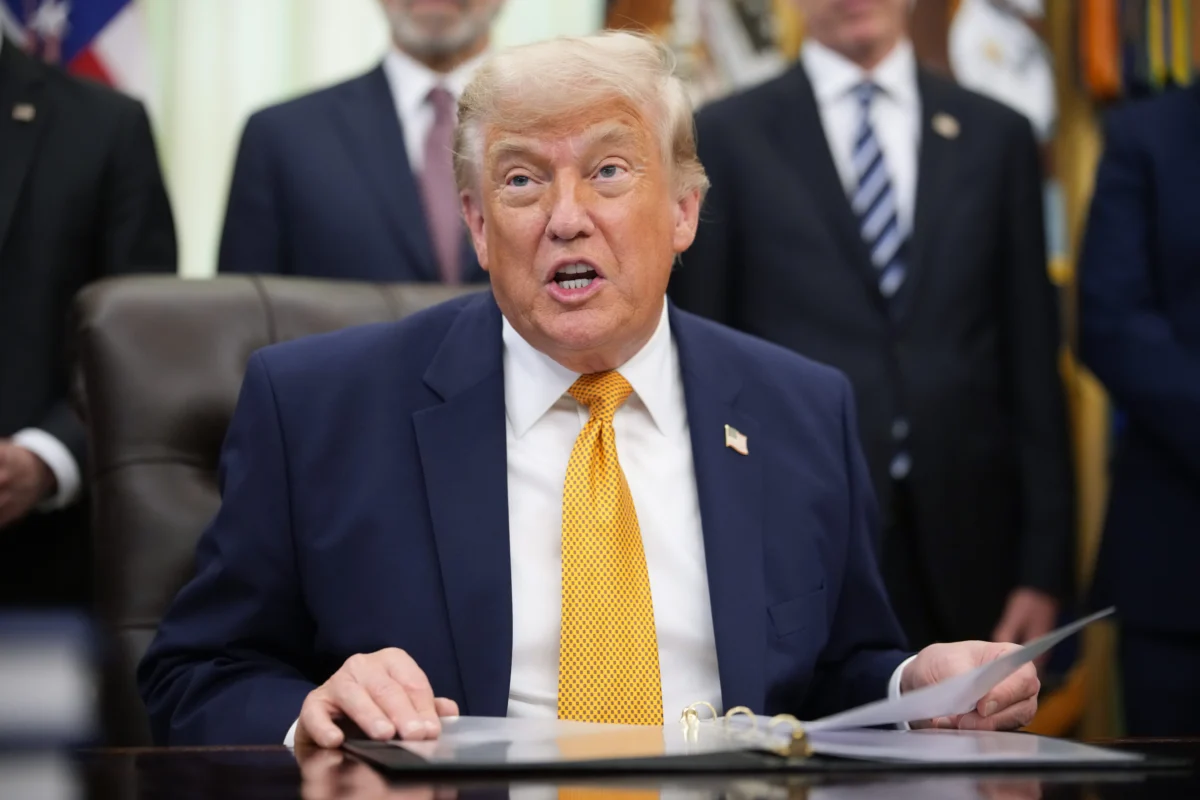
President Donald Trump on Wednesday ignited a firestorm of controversy and threw Capitol Hill into disarray by abruptly canceling the scheduled signing of a landmark bipartisan housing bill, a measure widely celebrated by leaders from both political parties as a significant legislative achievement. The eleventh-hour decision, announced via a post on his Truth Social platform, linked the bill’s fate to the passage of his proposed "SAVE America Act," which he unilaterally declared a "National Emergency." This unexpected move sent shockwaves through Congress, exposing deep fissures within the Republican Party and drawing sharp criticism from Democrats who accused the former president of indifference to the pressing economic challenges faced by American families.
The housing package, a rare beacon of bipartisan cooperation in a sharply divided Congress, had garnered overwhelming support in both the House and Senate. It was designed to address the nation’s escalating housing crisis by increasing supply, enhancing affordability, and imposing limits on the purchase of single-family homes by private equity firms. Congressional Republican leaders, including House Speaker Mike Johnson (R-La.) and Senate Majority Leader John Thune (R-S.D.), had initially hailed the bill’s passage as a major victory, eagerly anticipating a signing ceremony in Statuary Hall at noon ET on Wednesday. This event was meant to be a moment of unity, showcasing legislative effectiveness ahead of the crucial 2026 midterm elections, where affordability and cost-of-living issues are projected to be decisive factors.
The SAVE America Act: Trump’s Non-Negotiable Demand
Trump’s cancellation, however, transformed a planned celebration into a political spectacle. Just over an hour before he was due to appear, he posted on Truth Social: "Today’s Housing News Conference and Signing is hereby cancelled until such time as we pass the desperately needed SAVE AMERICA ACT, which I consider to be a National Emergency. Thank you for your attention to this matter!" This declaration underscored his unwavering focus on the SAVE America Act, a controversial election measure that has become a cornerstone of his political agenda.
The SAVE America Act aims to curtail noncitizen voting in U.S. elections and mandate nationwide voter identification laws. While the premise of noncitizen voting is a recurring theme in conservative rhetoric, existing federal law already prohibits noncitizens from voting in federal elections, and documented instances of widespread noncitizen participation are exceedingly rare. A 2014 study by Jesse T. Richman, Gulshan Chattha, and David C. Earnest, though contested, suggested a minimal percentage, if any, of noncitizens participating. More recent analyses by the Brennan Center for Justice and other non-partisan groups have consistently found no evidence of widespread noncitizen voting that would materially impact election outcomes. Nevertheless, the bill, which passed the House in February largely along party lines, resonates strongly with Trump’s base and is broadly popular among Republicans who cite election integrity concerns.
However, the path for the SAVE America Act in the Senate is fraught with insurmountable obstacles. Without substantial Democratic support, the legislation cannot overcome the 60-vote threshold required to bypass the Senate’s filibuster rule, a procedural maneuver that allows a minority of senators to block a vote on a bill. Democrats and numerous voting rights advocates vehemently oppose the measure, arguing that it addresses a non-existent problem and could disenfranchise eligible voters, particularly minorities, the elderly, and low-income individuals who may struggle to obtain or present specific forms of identification.
A Day of Discord and Tense Encounters on Capitol Hill
The dramatic cancellation set the stage for a contentious day on Capitol Hill, particularly for congressional Republicans caught between their legislative priorities and the demands of their party’s de facto leader. Trump’s visit to the Capitol was multifaceted, including a planned lunch with Senate Republicans that the housing bill signing was meant to precede. Notably, this meeting was arranged at the invitation of Senator Rick Scott (R-Fla.), rather than the customary invitation from Senate Minority Leader Thune and other GOP leadership, signaling a potential shift in internal party dynamics and loyalty.
The luncheon itself quickly devolved into a heated exchange. Senator Bill Cassidy (R-La.), who recently lost his GOP primary after Trump endorsed his opponent, reportedly confronted the former president over an Iran memorandum of understanding. Cassidy, a vocal critic of the agreement, reportedly "yelled" at Trump, according to an MS NOW report citing a person familiar with the encounter. "I’m not going to be bullied when I feel like I’m asking a question the American people need to know. And so at that point it began to escalate," Cassidy later told reporters, confirming the tension. Other Republican senators offered varying descriptions of the exchange: Senator Ted Cruz (R-Texas) characterized it as a "spirited discussion," while Senator Jim Justice (R-W.V.) described it as "not super combative, but very passionate," ultimately ending respectfully.
Emerging from the meeting, Trump offered his characteristic assessment to reporters: "I think we had a really great meeting. We like our leader… I don’t like a few people, but that’s OK. I think you know who they are." This thinly veiled jab at his Republican detractors underscored the deep divisions within the party, with Trump continuing to exert a powerful, and at times disruptive, influence over its legislative agenda and internal cohesion.
Housing Uncertainty and Legislative Gridlock

In the wake of the cancellation, the path forward for the bipartisan housing package remained shrouded in uncertainty. Senator John Husted (R-Ohio), a staunch supporter of the bill, conceded that its future was "not really discussed" during the meeting with Trump. With a 10-day window for the president to sign or veto legislation, Congress faces immense pressure to either persuade Trump or find an alternative solution, all while the SAVE America Act remains mired in legislative deadlock.
Senate Majority Leader Thune, expressing his disappointment, reiterated the bill’s importance: "It’s a great piece of legislation that increases the supply of housing and the availability of credit to afford homes, so it’s an affordability issue, and eventually I hope he finds a way to sign it." His sentiment was echoed by House Speaker Johnson, who, despite his earlier enthusiasm for the housing bill, pivoted to defending Trump’s focus. Johnson suggested that the only viable path to passing the SAVE America Act would be through budget reconciliation, a complex congressional process that allows certain spending and budgetary measures to bypass the Senate filibuster and pass with a simple majority.
However, the applicability of reconciliation to the SAVE America Act is highly questionable. The Byrd Rule, a key provision governing reconciliation, prevents the inclusion of "extraneous" provisions that do not directly impact the federal budget. Election law, a policy matter rather than a purely fiscal one, is unlikely to qualify under these strict rules. Even if it were deemed eligible, the reconciliation process itself is lengthy, arduous, and typically reserved for major budgetary legislation, making it an improbable vehicle for a controversial election bill with a rapidly approaching deadline. "He’s laser focused on SAVE America Act, as most common-sense Americans are," Johnson said. "The only path, I think, to get that done… you have to put it on a reconciliation bill."
Representative French Hill (R-Ark.), who chairs the House Financial Services Committee and played a leading role in crafting the housing bill, offered a pragmatic but resigned perspective: "Trump picked the day, and now he’s chosen to change the day. So we’ll let him do that, and we’ll see what he decides to do." His statement reflected the exasperation felt by many Republicans who had invested significant political capital in a bill now held hostage.
A Pattern of Executive Intervention and Legislative Derailment
Wednesday’s events were not an isolated incident but rather the latest in a series of instances where Trump has leveraged his influence to derail congressional Republican priorities at the eleventh hour, specifically to push for the SAVE America Act. Just last week, Trump took to Truth Social to direct Jay Clayton, his permanent nominee for Director of National Intelligence (DNI), to skip a scheduled Senate confirmation hearing. Senate Republicans had been working to fast-track Clayton’s nomination to prevent Bill Pulte, the head of the Federal Housing Finance Agency (FHFA), from assuming the acting DNI role. Pulte’s controversial tenure at FHFA, marked by willingness to attack Trump’s opponents, had drawn opposition from Democrats and even some Republicans.
Trump’s intervention in the DNI nomination also complicated negotiations for an extension of Section 702 of the Foreign Intelligence Surveillance Act (FISA), a critical foreign surveillance provision that lapsed earlier this month. Democrats vowed to oppose any extension as long as Pulte remained in the DNI role. On June 17, Trump publicly linked FISA’s fate to the SAVE America Act, stating, "to add a slight bit of intrigue but, for the Good of the Nation, and the People of our Country, I will not approve FISA without THE SAVE AMERICA ACT going along with it." This pattern demonstrates Trump’s consistent strategy of using key legislative deadlines and appointments as bargaining chips to advance his specific agenda, often to the frustration of his own party’s leadership.
Broader Implications and Political Fallout
The former president’s actions have not only angered some congressional Republicans but have also provided potent ammunition for Democrats, who swiftly capitalized on the situation to criticize his priorities. Senator Elizabeth Warren (D-Mass.), who co-led the housing bill in the Senate, appeared on CNBC’s "Squawk on the Street," lambasting Trump’s decision. "This just doesn’t make any sense, other than whatever it is he wants to do is a complete indifference to the cost squeeze on American families and to genuine efforts to do something about it," Warren asserted. "He could be over here trying to claim a victory lap. And instead he’s saying, no, no, he doesn’t want anything to do it. It’s because he really doesn’t care about American families."
This incident underscores the enduring power of Trump within the Republican Party, even out of office. His ability to unilaterally derail bipartisan legislation, override the wishes of his own party’s leadership, and command their subsequent defense highlights a unique dynamic in contemporary American politics. For the GOP, it presents a delicate balancing act: demonstrating legislative competence and addressing pressing national issues while appeasing a powerful figure who holds significant sway over their base.
For the nation, the cancellation of the housing bill signing represents a setback for addressing a critical economic challenge. The housing affordability crisis has deepened across the United States, with median home prices and rental costs continuing to climb, outpacing wage growth. According to data from the National Association of Realtors, the median existing-home sales price in April 2026 was up significantly year-over-year, exacerbating an already dire situation for many Americans. The bipartisan bill offered a glimmer of hope for tangible relief, and its shelving leaves millions of families grappling with the financial burden of housing.
The episode also raises broader questions about the functionality of American governance and the prospects for bipartisan cooperation. In an era of intense political polarization, achieving consensus on significant issues is already a monumental task. When such hard-won agreements can be overturned by a single individual’s demand for unrelated legislation, it further erodes trust in the legislative process and the ability of elected officials to deliver solutions for their constituents. As Congress navigates the coming days, the fate of the housing bill and the contentious SAVE America Act will serve as a stark reminder of the complex and often unpredictable interplay between executive influence, party loyalty, and the pursuit of legislative priorities in a deeply divided political landscape.
