

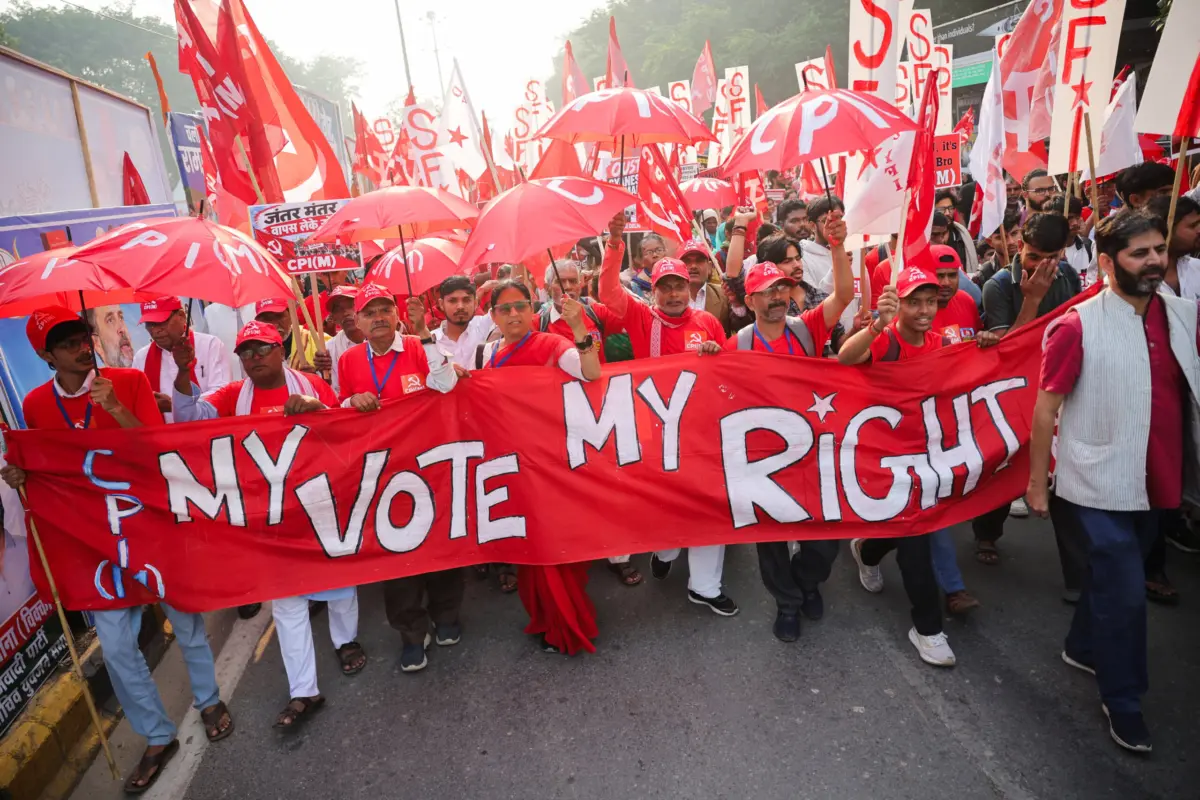
Thousands of demonstrators converged on New Delhi, India’s capital, on Sunday, November 1st, demanding the immediate resignation of Chief Election Commissioner (CEC) Gyanesh Kumar. The massive protest, spearheaded by Rahul Gandhi of the Indian National Congress, represents the latest and most significant escalation in a month-long series of demonstrations. Opposition parties allege that recent revisions to India’s crucial voter lists have been systematically manipulated to favour Prime Minister Narendra Modi’s ruling Bharatiya Janata Party (BJP), thereby undermining the integrity of the electoral process ahead of the 2029 general election.
The Heart of the Allegation: Disenfranchisement on a Grand Scale
At the core of the opposition’s grievances is the claim that over 130 million names have been removed from the electoral rolls, a figure that, if accurate, represents a staggering scale of potential disenfranchisement. Opposition leaders contend that this deletion process has disproportionately targeted India’s Muslim population and other minority communities, demographics traditionally less inclined to support the Hindu nationalist agenda of the BJP. The implications of such a widespread purge, particularly if skewed along communal lines, are profound for the world’s largest democracy, raising serious questions about fairness, representation, and the foundational principles of electoral equality.
Rahul Gandhi, addressing the throngs of supporters, lambasted the Election Commission of India (ECI), accusing it of compromising its constitutional independence and acting as an extension of the ruling party. "The very pillars of our democracy are under attack," Gandhi declared, "and the Election Commission, meant to be the impartial guardian of our polls, has become an instrument of political manipulation. We will not stand by silently as millions of our citizens are stripped of their fundamental right to vote." Other prominent figures from the Indian National Congress and allied parties within the INDIA (Indian National Developmental Inclusive Alliance) bloc echoed these sentiments, calling the alleged deletions a "pre-poll rigging" strategy designed to consolidate the BJP’s power base.
The Role of the Election Commission of India: A Constitutional Guardian Under Scrutiny
The Election Commission of India is a permanent and independent constitutional body established to ensure free and fair elections in the country. Comprising a Chief Election Commissioner and two Election Commissioners, its mandate includes superintendence, direction, and control of the preparation of electoral rolls for, and the conduct of, all elections to Parliament and to the Legislature of every State, and of elections to the offices of President and Vice-President. The ECI is designed to be an autonomous body, insulated from executive interference, a crucial aspect of India’s democratic framework.
Electoral roll revision is a routine, albeit critical, exercise undertaken periodically by the ECI. Its purpose is to update voter lists by adding new eligible voters, deleting names of deceased individuals or those who have moved, and correcting errors. This process is essential for maintaining accurate and current voter data. Typically, this involves door-to-door verification, public notices for claims and objections, and a transparent grievance redressal mechanism. However, the sheer scale of the alleged deletions this time, coupled with the specific targeting claims, has cast a long shadow over the ECI’s impartiality.
Chronology of Escalating Tensions
The simmering discontent over the electoral roll revisions began to boil over approximately a month ago, culminating in Sunday’s large-scale protest.
- Late 2025: The ECI initiates its annual special summary revision of electoral rolls across various states, setting specific timelines for draft publication, claims, objections, and final publication.
- Early October 2026: Opposition parties, particularly the Congress, begin to raise concerns informally about an unusually high number of deletions reported by their local cadres during the draft roll verification phase. Initial reports from ground workers suggest a disproportionate impact on areas with significant minority populations.
- Mid-October 2026: The Indian National Congress formally writes to the ECI, citing specific instances and statistical anomalies in certain constituencies where large blocks of names, predominantly from minority communities, appear to have been deleted. They demand a transparent audit and a halt to the finalisation of the revised rolls.
- Late October 2026: Localised protests erupt in several states, including Uttar Pradesh, Bihar, Maharashtra, and Karnataka, as aggrieved citizens discover their names missing from the draft electoral rolls. These demonstrations, though smaller in scale, underscore the growing public frustration.
- November 1, 2026 (Sunday): The culmination of these grievances sees thousands march through New Delhi. The protest, led by Rahul Gandhi, specifically targets Chief Election Commissioner Gyanesh Kumar, demanding his resignation and calling for a comprehensive, independent investigation into the alleged irregularities. This marks a significant escalation from localised concerns to a national political showdown.
Supporting Data and Alleged Patterns
While the ECI has not confirmed the "over 130 million names" figure, opposition leaders cite data gathered from their party workers and local election observers. They allege that the deletions often occur under vague categories such as "shifted" or "duplicate entries" without adequate verification. For instance, in several urban constituencies, entire apartment buildings or slum areas, known strongholds of minority voters, have reportedly seen a significant reduction in registered voters.
India’s Muslim population constitutes approximately 14-15% of the total population, numbering around 200 million individuals. Their voting patterns have historically been diverse but often coalesce against parties perceived as discriminatory. The allegation that their names are being targeted is highly incendiary, invoking memories of past electoral disputes and fueling fears of institutional bias. Opposition figures have presented anecdotal evidence and some statistical analyses (derived from comparing previous electoral rolls with draft new ones) to support their claim that the deletions are not random but follow a discernible pattern aimed at reducing the vote share of specific demographic groups.
Official Responses and Counter-Arguments
The Election Commission of India has vehemently denied any allegations of favouritism or bias. In a series of statements, the ECI has reiterated its commitment to upholding the sanctity of the electoral process. An ECI spokesperson clarified that the revision process adheres strictly to established legal procedures and guidelines, including multiple stages of verification. "The Election Commission operates with utmost transparency and impartiality," a statement read. "Voters whose names may have been wrongly deleted due to clerical errors or other legitimate reasons are encouraged to re-register. The process for re-registration is straightforward, involving the submission of Form 6 at designated centres or through the online portal, and due diligence will be exercised to ensure all eligible citizens are on the rolls." The ECI has also highlighted the rigorous training provided to its field staff and the public awareness campaigns conducted to inform citizens about the revision process.
The Bharatiya Janata Party (BJP) has strongly condemned the opposition’s protests, accusing them of undermining democratic institutions and spreading baseless rumours. Senior BJP leaders have dismissed the allegations as a desperate attempt by a "disillusioned opposition" to discredit the ECI and create an atmosphere of distrust ahead of future elections. "The opposition, especially the Congress, is habitual of questioning every institution when they anticipate electoral defeat," stated a prominent BJP spokesperson. "The Election Commission is a constitutional body that functions independently. These allegations are nothing but an attack on the integrity of our democratic processes and an insult to the dedicated officials working to ensure free and fair elections. The voter list revision is a legitimate, transparent, and necessary exercise, and politicising it is irresponsible and dangerous." The BJP maintains that the opposition’s claims are designed to sow communal discord and garner sympathy, rather than being based on any factual evidence of wrongdoing.
Broader Impact and Implications
The ongoing controversy carries significant implications for India’s democratic health and its political landscape.
- Erosion of Public Trust: Allegations of electoral manipulation, particularly those involving the disenfranchisement of specific communities, can severely erode public trust in democratic institutions. The ECI’s credibility, once largely unimpeachable, faces a significant challenge, potentially leading to cynicism among voters and a weakening of faith in the electoral outcomes.
- Political Polarisation: The dispute further deepens the already intense political polarisation in India. The opposition’s narrative of an ECI compromised by the ruling party fuels a sense of grievance among their supporters, while the BJP’s counter-narrative frames the opposition as anti-national and destructive to democratic norms. This adversarial dynamic could make consensus-building and constructive political discourse increasingly difficult.
- Impact on the 2029 General Election: Although the next general election is still several years away, the battle over electoral rolls is a crucial preliminary skirmish. If a significant number of voters are indeed disenfranchised, it could materially alter the electoral calculus. The opposition aims to rally its base and highlight what it perceives as an existential threat to their voting rights, while the BJP seeks to dismiss these concerns as partisan propaganda. The controversy sets a contentious tone for the years leading up to the national polls.
- Social Cohesion: The specific targeting of Muslim and other minority voters, if proven, could exacerbate communal tensions. In a country with a history of communal strife, such allegations risk further dividing society along religious and ethnic lines, undermining social cohesion and the secular fabric of the nation.
- Constitutional Precedent: The controversy raises fundamental questions about the independence of constitutional bodies in India. If the ECI is perceived as having succumbed to political pressure, it could set a dangerous precedent, potentially emboldening future governments to exert undue influence over other independent institutions, thereby weakening the checks and balances essential for a robust democracy.
- International Scrutiny: As the world’s largest democracy, developments in India’s electoral processes are closely watched by international observers, human rights organisations, and other democratic nations. Allegations of large-scale voter disenfranchisement and institutional bias could tarnish India’s global image as a vibrant and fair democracy.
The protest in New Delhi highlights a critical juncture for Indian democracy. The integrity of the electoral roll, the impartiality of the Election Commission, and the fundamental right to vote are not merely administrative details but the very bedrock upon which democratic governance stands. As the political temperature continues to rise, the demand for transparency and accountability from the Election Commission will only grow louder, with implications that will resonate far beyond the immediate political skirmishes, shaping the future trajectory of India’s democratic journey. The resolution of this dispute will be a defining moment for India’s commitment to free and fair elections.
