

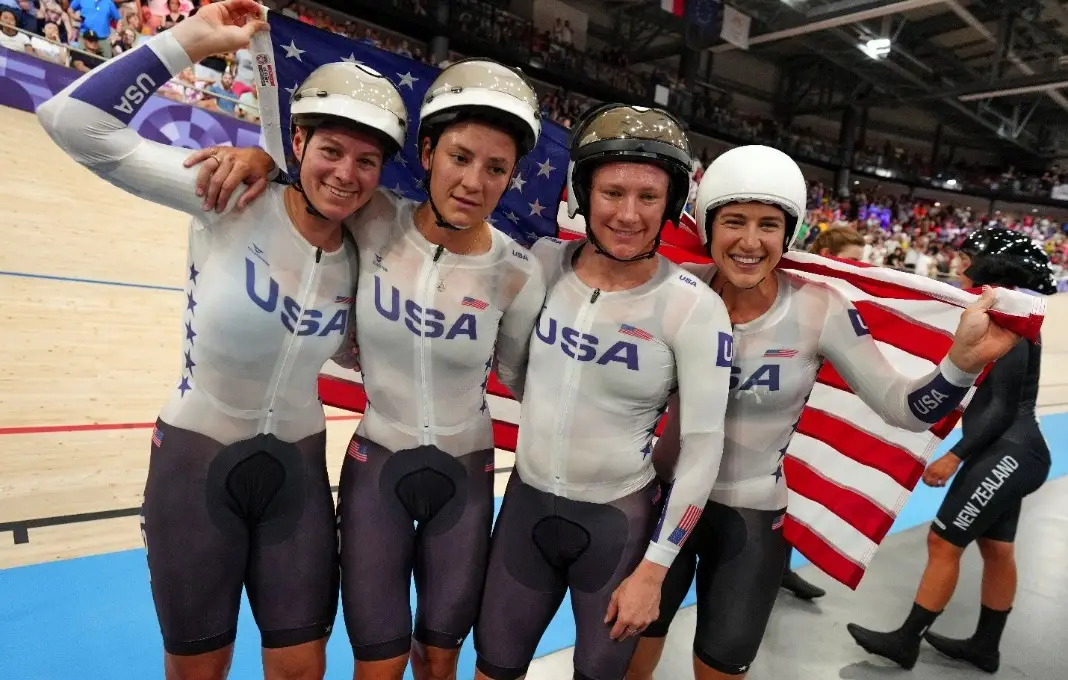
Kristen Faulkner, a name synonymous with grit and unprecedented success on the cycling circuit, offers a profound blueprint for team dynamics that transcends the velodrome and resonates deeply within the corporate world. Her remarkable journey, marked by two Olympic gold medals in both road and track cycling at the 2024 Paris Olympics, a Harvard education, and a burgeoning venture capital career, defies conventional athletic timelines. Faulkner’s ascent, which began in her mid-twenties, highlights not just individual talent but a meticulously crafted approach to teamwork, communication, and collective achievement under extreme pressure. This narrative explores the transferable principles of Faulkner’s success, demonstrating how businesses can foster environments that mirror the synergy and resilience of elite cycling teams.
The Unconventional Path to Olympic Glory
Faulkner’s trajectory is a testament to intentionality and a radical reframing of team performance. Unlike many athletes who dedicate their youth to a single sport, Faulkner embarked on her cycling career later in life, leveraging her sharp intellect and analytical skills honed at Harvard. Her recent triumphs in Paris, securing gold in both the demanding individual road race and the technically intricate team pursuit, underscore a strategic, rather than purely instinctual, mastery of her sport. This unconventional path provides a unique vantage point for extracting lessons applicable to any collaborative endeavor, particularly those operating under intense scrutiny and demanding rapid decision-making.
Communication as the Lifeblood of Team Pursuit
The core of Faulkner’s philosophy on high-performing teams lies in the power of communication, particularly within the crucible of competition. "There’s basically two important things," Faulkner stated in a recent discussion, "The first is communication, like over-communicate with the entire time. You cannot sit there and feel something is wrong and not say it out loud." This principle is critical in team pursuit, a discipline where riders cycle in formation, taking turns at the front to break the wind for their teammates. The pace is relentless, and even minor hesitations or unspoken concerns can have cascading negative effects.
While the visual spectacle of professional cycling can appear serene, the reality for the athletes is a constant, unfiltered exchange of vital information. This "brutal honesty," as it can be termed, is diametrically opposed to the often-hesitant communication prevalent in many business environments. Faulkner elaborates, "If the person in front of you is starting to slow down, you have to tell them to get off the front. You can’t hold anything back in the moment." This directness, devoid of ego or fear of reprisal, is what enables the team to function as a cohesive unit, making split-second adjustments to maintain optimal speed and efficiency.
The implications for businesses are substantial. In a corporate setting, employees may withhold critical feedback or concerns, fearing they might appear incompetent, disrupt workflow, or displease superiors. This often leads to missed opportunities, suboptimal outcomes, and a general erosion of team efficiency. As Simon Sinek, a renowned leadership expert, aptly describes communication as the "lubricant" of teamwork, it is the essential element that prevents friction, breaks down silos, and fosters an environment where individuals feel safe to voice concerns, admit errors, and seek assistance. The ability to provide and receive direct, immediate feedback is not a sign of weakness but a hallmark of a strong, adaptable team.
The Death of Ego: Prioritizing Collective Output
Complementing the necessity of open communication is the absolute imperative of shedding ego. Faulkner articulated this with striking clarity: "There can be no ego at all." In team pursuit cycling, this translates into a profound understanding of one’s current capacity and its impact on the collective. If a rider feels strong, they don’t push ahead to showcase their individual prowess; instead, they extend their time at the front, absorbing more of the wind resistance for the benefit of the team. Conversely, if a rider is struggling, they signal their need to rotate off the front earlier, preventing them from becoming a bottleneck and potentially jeopardizing the entire team’s performance.
This contrasts sharply with many corporate cultures that often glorify individual heroism and exceptional performance, sometimes to the detriment of the overall system. The "rockstar" employee who consistently exceeds targets but operates in isolation or inadvertently creates additional burdens for colleagues is a common, albeit often detrimental, archetype. Cycling, by contrast, elevates self-awareness and sacrifice for the greater good. The ultimate measure of success is not the individual’s peak performance but the team’s collective output and speed.
The business lesson derived from this is the critical need to cultivate environments that reward self-awareness and strategic contribution to the team’s success, rather than solely individual accolades. Leaders must actively promote a culture where stepping back to support a struggling teammate or taking on a less glamorous role is recognized as a strength, not a deficiency. This fosters a sense of shared responsibility and ensures that the entire system benefits from the collective effort.
Building Trust Through Consistent, Observable Behavior
Trust, in Faulkner’s paradigm, is not an abstract concept built on hierarchical authority or good intentions. It is a tangible outcome of consistent, observable behavior. She explained that a rider who consistently pushes to the point of slowing down can erode trust within the team. This suggests that while individual excellence is valued, it must be exercised within the context of team sustainability.
Conversely, consistent performance that demonstrates self-awareness builds immense trust. "If someone always hits their numbers, I start to feel like, wow, this person is really self-aware," Faulkner noted. This implies that high-performing teams are not necessarily composed of flawless individuals but of members who possess a keen understanding of their capabilities and limitations, and who act accordingly to support the team’s objectives.
The challenge arises when a high performer’s actions, though driven by a desire to excel, inadvertently create obstacles for others. This is not a critique of excellence itself, but of a potential misalignment between individual ambition and team cohesion. James Clear, author of the bestseller Atomic Habits, echoes this sentiment, emphasizing that sustained high performance stems from well-designed habits and routines that enable consistent contribution without disrupting the surrounding system. Positive Intelligence, an organization focused on mental fitness, frames this as mutual accountability, where team members hold each other responsible not only for results but also for the manner in which those results are achieved. In such environments, accountability is a shared responsibility, not solely the burden of leadership.
The business takeaway here is that trust is cultivated when individuals consistently act in the best interest of the team, demonstrating reliability and an understanding of their role within the collective. This is far more impactful than sporadic bursts of individual brilliance that may not align with the team’s overall strategy or capacity.
Direct, Objective, and Constant Feedback Loops
Faulkner’s approach to feedback is characterized by its directness, objectivity, and relentless frequency. She emphasizes, "The best way to give feedback is to never make assumptions about intent." Instead of questioning a teammate’s motivations, the focus remains squarely on observable facts: what happened, what was experienced, and what needs to be adjusted. This aligns with principles promoted by organizations like Fearless Culture, which advocates for clarifying questions that transform raw feedback into actionable insights.
The importance of clarity in communication cannot be overstated. Faulkner stated, "I think if you beat around the bush, then things can get a little confusing… the clearest ‘this is what happened’ is the best." This direct, unambiguous approach minimizes misinterpretation and ensures that the feedback delivered is readily understood and can be acted upon.
Furthermore, feedback in elite cycling is not a periodic event but an ongoing process. After every training session or race segment, a review takes place, often supported by data and video analysis. This immediacy ensures that lessons are learned and applied in real-time, fostering a culture of continuous improvement. An article published on Medium highlights that constructive feedback, when delivered consistently and effectively, not only corrects errors but also strengthens performance, engagement, growth, and trust within a team.
Faulkner noted the interesting phenomenon that occurs with frequent feedback: "The more common feedback is, the more numb people get to the emotional effects of it." This suggests that when feedback becomes a normalized part of the team dynamic, its emotional impact diminishes, transforming it from a potentially sensitive interaction into a purely functional tool for enhancement.
For businesses, this translates to the necessity of establishing rapid feedback loops. Feedback should be objective, frequent, and delivered in an environment that feels safe and conducive to learning. The ultimate goal is not the pursuit of perfection in a single instance, but the acceleration of the learning process and the continuous refinement of team performance.
The Power of Micro-Awareness in High-Performance Teams
In the absence of dashboards and real-time metrics that might be common in a business setting, elite cyclists rely on a sophisticated form of "micro-awareness." Faulkner described this as the ability to read subtle cues, such as cadence, body movement, and shifts in pace. "If the cadence is starting to slow down, it means the person on the front is going too slow," she explained. Similarly, "If the person in front of you is wobbling, maybe they need to get off sooner." This constant sensing and adjusting allows the team to maintain optimal cohesion and efficiency.
This principle is directly transferable to the business world. Subtle signals—a shift in posture, a delayed response, a fleeting expression of hesitation—can often reveal unspoken concerns or disengagement before they escalate into significant problems. Mindful Insights refers to these cues as "unspoken truths," capable of surfacing frustration, doubt, or a lack of buy-in before they manifest as larger issues.
Businesses often fall into the trap of waiting for formal reports, metrics, or escalations, by which time it is frequently too late to intervene effectively. The situational awareness demonstrated by Faulkner and her cycling teammates allows for in-the-moment course correction.
The business lesson here is to train teams to recognize and interpret these subtle signals early on. This requires fostering an environment that encourages keen observation, not just passive analysis. By developing this heightened sense of awareness, teams can proactively address potential issues, fostering a more agile and responsive organizational culture.
Final Reflections for Business Leaders: The Systemic Advantage
Reflecting on Faulkner’s insights, it becomes clear that the exceptional performance of elite athletes is not merely a product of individual prowess but the result of deliberately constructing teams around fundamental principles. These principles, honed under the intense pressure where milliseconds can determine victory or defeat, offer a powerful framework for business leaders:
- Over-communication under pressure: Fostering an environment where open, honest, and frequent communication is not just encouraged but expected, especially during challenging periods.
- Ego dissolution: Cultivating a team culture where the collective good consistently supersedes individual ambition, and where strategic self-awareness and contribution are paramount.
- Trust through consistent action: Building a foundation of trust based on reliable, observable behaviors that consistently serve the team’s best interests, rather than solely on individual performance metrics.
- Objective and frequent feedback: Implementing robust feedback mechanisms that are direct, data-driven, and regularly integrated into the team’s workflow to accelerate learning and adaptation.
- Micro-awareness and situational intelligence: Training team members to perceive and respond to subtle, non-verbal cues that can signal underlying issues or opportunities before they become critical.
These principles are not theoretical constructs for Faulkner; they are the daily practice that underpins her success. While the stakes in business may differ in nature from those on the cycling track, the underlying principles of high-performance teamwork remain remarkably consistent. The most effective teams do not simply collaborate; they possess an intuitive understanding of when to lead, when to support, and when to yield. They operate as a unified system, adapting dynamically, holding each other accountable, and pursuing continuous improvement. Ultimately, high performance in any domain is not solely about individual brilliance but about the collective power of the pull, and the team’s capacity to share that load effectively. The legacy of athletes like Kristen Faulkner serves as an invaluable guide, illustrating that true victory is often a shared journey, powered by a well-oiled, communicative, and ego-free collective.
