


The headlines have been breathless, painting a picture of a $2.02 trillion private credit market in freefall. Some outlets suggest we are on the precipice of systemic collapse, while others forecast a slow-motion replay of the 2008 financial crisis. A closer examination of the data, however, reveals a more nuanced reality, one where legitimate concerns are being conflated into a single, misleading crisis narrative. This conflation of three distinct conversations—redemptions, defaults, and structural issues—risks doing real damage to market understanding and eroding trust in an asset class that, by most credible measures, is functioning as intended.
Separating the Signal from the Noise: Three Conversations, One Misleading Narrative
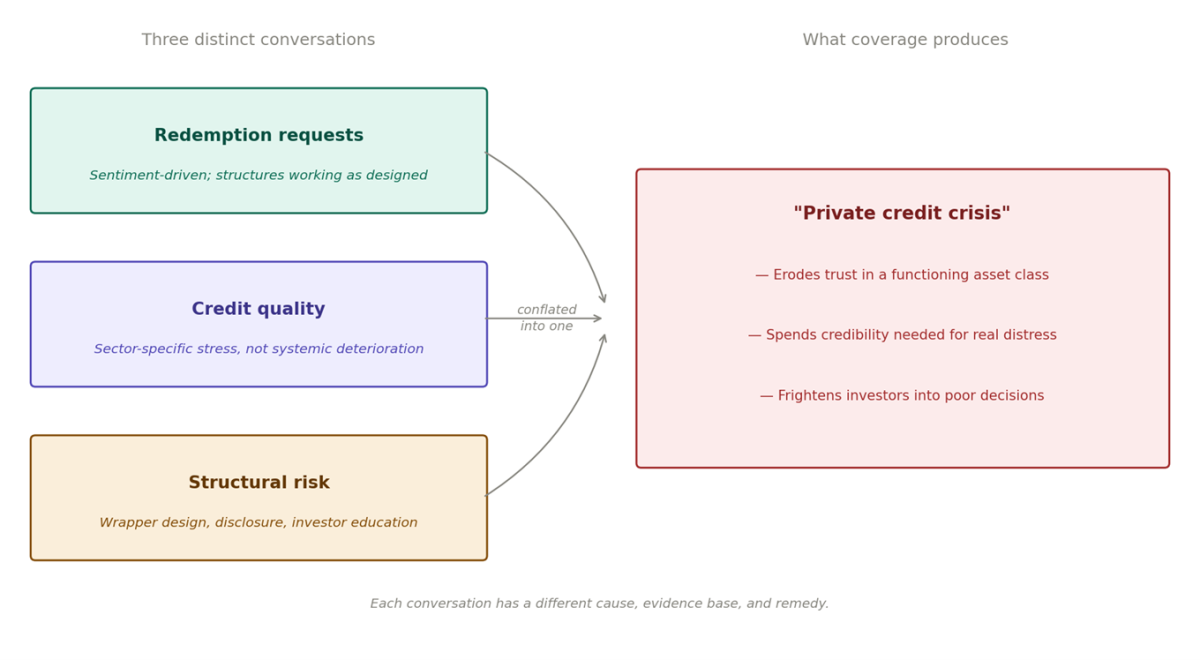
The current media storm around private credit stems from a conflation of several distinct issues. Understanding these issues separately is crucial to avoid a generalized panic and to accurately assess the health of the market.
- Redemption Requests: A surge in requests from retail investors in non-traded Business Development Companies (BDCs) and semi-liquid vehicles has led to the implementation of quarterly caps and the locking of capital. This has been widely interpreted as evidence of a collapsing asset class.
- Credit Quality: Concerns about the underlying creditworthiness of borrowers, particularly within the software and technology sectors, are rising due to the disruptive potential of Artificial Intelligence (AI).
- Structural Issues: The design and marketing of "semi-liquid" investment vehicles, intended for retail investors seeking access to private market premiums, are being scrutinized for their ability to manage investor liquidity expectations against the inherent illiquidity of private credit assets.
Conflating these three distinct elements into a single crisis story does significant damage to market understanding. It erodes trust in an asset class that, by most credible measures, is performing as designed and expends valuable analytical credibility that the industry will need when genuine systemic problems eventually arise.
The Nuances of Redemption Requests: Sentiment vs. Deterioration
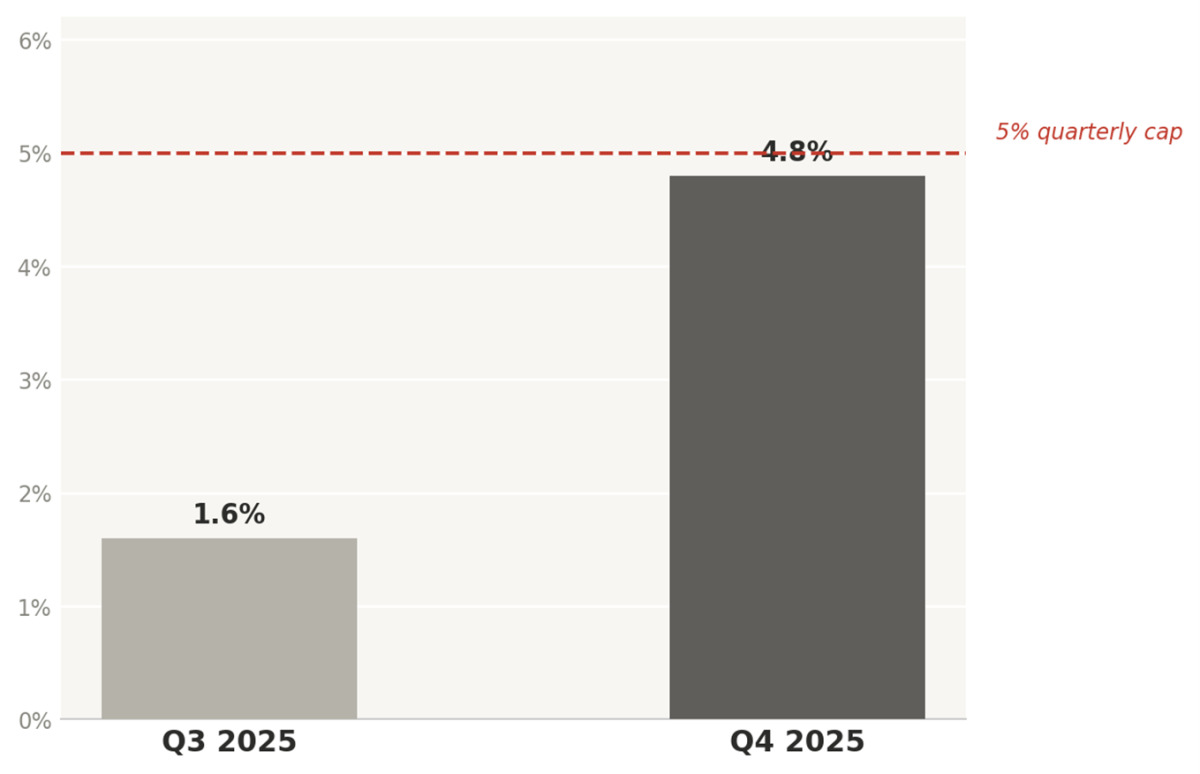
The narrative around redemptions has been particularly sensationalized. It is important to distinguish between actual redemptions (capital returned to investors) and redemption requests (the volume of investors seeking to exit). In non-traded BDCs and semi-liquid vehicles, actual redemptions are fixed and capped at 5% of Net Asset Value (NAV) by design, a feature intended to protect the integrity of the loan book and the returns for remaining investors.
In Q4 2025, average redemption requests for perpetually non-traded BDCs rose to 4.8% of NAV, a significant increase from 1.6% in Q3 2025. Five BDCs funded tenders above the standard 5% quarterly cap, triggering alarmist headlines. However, this surge in requests is primarily a signal of investor sentiment rather than a broad-based judgment on private credit portfolio quality. Fitch Ratings attributes these requests largely to investor concerns about AI disruption risk for software companies, leading to elevated redemption requests and slower inflows. This sentiment-driven behavior, while concerning from a narrative perspective, does not automatically equate to credit deterioration across the entire private credit market.

The structural safeguards within these vehicles—specifically the quarterly cap—are functioning precisely as designed. They are not "gates" imposed in a moment of crisis but pre-existing features meant to buffer the loan portfolio from sudden, large-scale outflows. A manager honoring the 5% cap is not an anomaly; it is the intended operation of the product. The massive oversubscription to these redemption requests, however, highlights a critical underlying issue: the long-term nature of these vehicles and whether their fundamental illiquidity was adequately understood by the investors who purchased them.
Financial data supports this distinction. Liquidity and asset coverage cushions appear sufficient to absorb spikes in elevated redemptions. Fitch notes that sustained tenders above 5% could pressure credit profiles, but this is not their base case. The average debt-to-equity ratio for perpetually non-traded BDCs stood at a robust 0.71x, significantly lower than the 1.13x for other rated BDCs. Asset coverage cushions averaged 38.6%, well above the 22% average for Fitch-rated public and private BDCs. These are not the balance sheet metrics of a sector in imminent crisis.
In fact, Fitch identifies a potential structural silver lining: if fundraising remains weak, the competitive pressure that has compressed spreads and weighed on BDC earnings could ease, signaling a rebalancing rather than a crisis. Moody’s noted a shift from inflows to outflows in Q1 2026 for perpetually non-traded BDCs, and that publicly traded BDCs have maximized leverage, leaving less room for error.
The Software Sector and the AI Conundrum
A significant contributor to the current "mess" is the concentration of software companies within BDC portfolios. Moody’s found that software represents approximately 25% of BDC portfolios on a median basis, flagging AI as a developing credit risk. However, their own analysis offers a balanced perspective, stating, "Asset quality metrics have so far remained largely benign, and software loan maturities do not increase more meaningfully until 2028-2029, suggesting AI risk will be a sentiment and monitoring issue in the near term rather than an immediate ratings driver."
The deep dive into the software sector reveals how private credit became so intertwined with this area. Software-as-a-Service (SaaS) companies have long been favored by private credit lenders due to their predictable recurring revenue, sticky customer bases, high margins, and scalability. Outstanding loans to SaaS firms surged from approximately $8 billion in 2015 to over $500 billion, or 19% of total direct loans, by the end of 2025. A third of private credit funds had extended loans to the SaaS sector by this point. This trend was amplified by direct lenders capturing a growing share of large leveraged buyout (LBO) financing, rising from 34% in 2022 to a record 54% in 2023, according to PitchBook LCD. This marked a sharp reversal from the pre-pandemic period when approximately 80% of buyouts were financed through syndicated loan markets, with software being a dominant sector.
The proximate trigger for the recent wave of redemption requests was Anthropic’s unveiling of new agentic AI tools capable of performing complex professional tasks that many SaaS companies currently monetize. This sparked a sell-off in software data provider shares and raised concerns that AI could fundamentally weaken traditional SaaS business models. Within weeks of these AI product launches, investors sought to withdraw over $10 billion from private credit funds, driven by fears of over-exposure to software companies perceived as vulnerable.
The deeper issue here is not necessarily the software exposure itself, but the opacity surrounding it. Private credit loans are typically held at par, and borrowers do not publicly disclose earnings. Deteriorations in a borrower’s business model may not surface in stated valuations until a covenant breach or maturity event forces disclosure, by which point options for resolution are significantly narrowed.
Stress Indicators and the Erosion of Transparency
While the headline default rate in private credit remains low, stress indicators are present and warrant careful examination. As of Q4 2025, 6.4% of private credit loans carried "bad PIK" (Payment-in-Kind) interest—interest deferred mid-loan due to liquidity strain rather than structured in at origination. This is nearly triple the 2021 levels. Lincoln International treats this as a shadow default rate, placing implied distress closer to 6% against a headline rate of around 2%.
Furthermore, approximately 70% of private credit issuance is now "covenant-lite," meaning the early warning systems that once flagged borrower stress before a missed payment are largely absent. This creates a market where investors may not know if loans should have been marked down, and in the absence of transparency, the rational move for a retail investor with a quarterly redemption window is to exit before the true financial picture becomes clear.
Blue Owl: A Case Study in Wrapper and Disclosure Failures
Blue Owl became a highly visible casualty of the redemption request wave, with investors seeking to withdraw 40.7% of shares from its technology-focused vehicles and 21.9% from its credit income funds. These requests were largely driven by sentiment and fears surrounding the software sector, rather than by any meaningful deterioration in the underlying loan portfolios, which had delivered returns in line with the Cliffwater Direct Lending Index since inception, with non-accruals at just 0.6%.
The company attempted to resolve a liquidity mismatch by merging OBDC II into its publicly traded BDC. However, the proposed terms would have imposed roughly a 20% haircut on investors due to OBDC II’s discount to NAV, triggering a class-action lawsuit and significant media attention. Allegations included the firm having repeatedly assured investors there was no "meaningful pressure" on redemptions while withdrawals were accelerating.
The timing proved deeply unfortunate. The merger was terminated, redemption mechanics were restructured to eliminate quarterly tender offers entirely, and Moody’s revised its outlook to negative. Crucially, Moody’s simultaneously noted that asset quality remained solid, confirming that the failure lay with the investment wrapper and disclosure, not the underlying credit assets. Investors were not redeeming because the assets were failing, but because they were frightened—partly by negative coverage that was now citing their redemption requests as proof of crisis—and because the "semi-liquid" nature of their investments had been misrepresented as being more accessible than the quarterly cap mechanics permitted.

This situation raises a more profound question about investor psychology and the role of intermediaries. Investor sentiment is shaped by conversations with GPs, advisors, and other agents. When redemption requests massively oversubscribe a 5% quarterly cap in a vehicle designed for long-term illiquidity, it prompts a critical examination of whether the vehicle’s fundamental nature was mis-sold, misunderstood, or simply ignored as speculative fervor took hold.
The industry’s language itself may be inadequate. The term "semi-liquid" implies a degree of accessibility that the underlying mechanics may not support. More fundamentally, the question arises: are structures that offer periodic withdrawal capabilities from inherently illiquid assets truly feasible at the scale the industry has pursued? While retail investors deserve access to private market premiums—where much of capital formation and new economy innovation occurs—excluding them entirely presents its own challenges. However, until the messaging, structures, and investor education are genuinely fit for purpose, it is difficult to argue that these products are serving investors or the broader system well. The industry may need to revisit wrapper design before further expansion into the retail channel is warranted. This is primarily a distribution, education, and wrapper problem, but not yet a credit problem.
Credit Quality: Pockets of Stress and Sector-Specific Challenges
Credit quality represents a separate, albeit interconnected, conversation that deserves honest assessment on its own terms. There are indeed meaningful pockets of stress. Software and tech exposure, estimated at around 26% of direct lending portfolios, is under pressure as AI disruption poses real questions about SaaS business models underwritten for a world of predictable recurring revenue.
Highly leveraged healthcare roll-ups and smaller middle-market borrowers, priced for an era of cheap money, are also showing strain. The prevalence of covenant-lite structures, which became standard during the inflow frenzy of 2021-2024, offers less protection than lenders may have assumed.
Morgan Stanley has warned that direct lending default rates, currently running at approximately 5.6%, could reach 8%—well above the 2-2.5% historical average. While this is a significant increase and warrants close monitoring, Morgan Stanley’s own analysts have characterized an 8% spike as "significant but not systemic." KBRA’s rated BDC universe showed no rating changes or negative outlook revisions through Q3 2025, though selective downgrades followed in Q4. The stress is real and concentrated, particularly within specific sectors, but it does not represent a broad-based deterioration across the entire $2 trillion market.
This distinction is critical. Concentrated credit stress in software and leveraged healthcare is primarily a manager selection and underwriting discipline issue, not an inherent problem with private credit itself. While AI disruption risk is genuine, it does not uniformly impact all private loans; its effects are more sector-specific, albeit within an increasingly interconnected financial system.
Systemic Risk: Beyond the 2008 Parallel
Comparisons to the Global Financial Crisis (GFC) are frequently invoked whenever complex financial structures exhibit stress. While understandable given the memory of past crises, such comparisons are often inaccurate and misleading. Private credit is structurally different from the 2008 system. There are no depositors to run, no repo lines to freeze, and no overnight funding markets to seize up. The feedback loop that made subprime mortgages systemic—losses embedded in bank balance sheets backstopped by government-insured deposits—does not exist in the same form.
However, this does not imply zero systemic risk. The contagion channels are different but still present. Mark-to-model valuation can lead to deterioration building invisibly until it manifests. The increasing entanglement of insurance companies, which fund a growing share of private credit, means losses could ultimately impact the retirement savings of policyholders unaware of their exposure. These are real risks, though distinct from those of 2008.
A wrinkle that has received less attention is the AI ecosystem’s own circular dependencies, which bear a resemblance to the pre-2008 financial system. Major AI players like Microsoft are embedded with OpenAI, Google and Amazon with Anthropic, and Nvidia underpins virtually every model in production. Mapping these relationships reveals less of a competitive technology sector and more of a single, interconnected organism. This mirrors the counterparty exposure diagrams seen in 2007, where the question shifted from "who has the risk?" to "who doesn’t?" If a significant node in this ecosystem stumbles, private credit portfolios exposed to SaaS companies whose revenue relies on its stability would undoubtedly feel the impact. The diversification many investors believe they possess may be more theoretical than real. The goal here is to inform rather than incite new waves of hysteria, but it is crucial to learn from the past to avoid repeating the same mistakes.
The Perils of Conflation: Distinguishing Wrapper, Sector, and Systemic Risk
The media narrative has compressed the complex chain of causation between redemption requests, credit quality, and potential systemic issues into a single, alarming story. This compression has significant consequences. When every instance of a redemption gate is framed as a systemic crisis, and every gated fund becomes evidence of a collapsing asset class, the media loses its ability to signal true distress when it genuinely occurs.
Private credit may not be in a crisis, but it is certainly undergoing a recalibration. This recalibration involves real stress in specific sectors, genuine structural questions about the design of semi-liquid wrappers, and real risks that demand rigorous oversight and honest analysis. What it does not deserve is the kind of breathless conflation that makes it impossible to distinguish between a wrapper problem, a sector problem, and a systemic one.
The distinction is analytically important, but it also marks the difference between informed markets and frightened ones. As CAIA’s latest report, "The World Rewired," highlights, understanding these broader shifts in the investment landscape is crucial for navigating the complexities of modern finance.
