

For entrepreneurs who have dedicated years to meticulously building their businesses, the decision to delegate significant responsibility to a professional management team marks a pivotal moment. This transition often necessitates a fundamental reevaluation of executive compensation, a crucial aspect that can profoundly impact a company’s ability to scale and thrive. Founders, accustomed to modest personal salaries that reflect an early-stage financial reality, may find themselves confronted with the stark reality that attracting experienced presidents, CFOs, or COOs requires compensation packages that significantly exceed their own earnings and past pay scales. Even a seasoned CEO, who might already benefit from substantial equity incentives, will likely recognize the strategic imperative to offer higher remuneration to secure executives possessing indispensable capabilities for future growth.
New research from Chief Executive Group, detailed in their 2026-2027 CEO & Senior Executive Compensation Report, offers critical insights into the evolving landscape of senior leadership compensation within private companies. The report underscores a clear correlation between company size and the remuneration required to attract and retain top executive talent, revealing a sharp upward trajectory in compensation as businesses expand their revenue streams and operational complexity.
Unpacking the Data: Compensation Benchmarks for Private Company Leadership
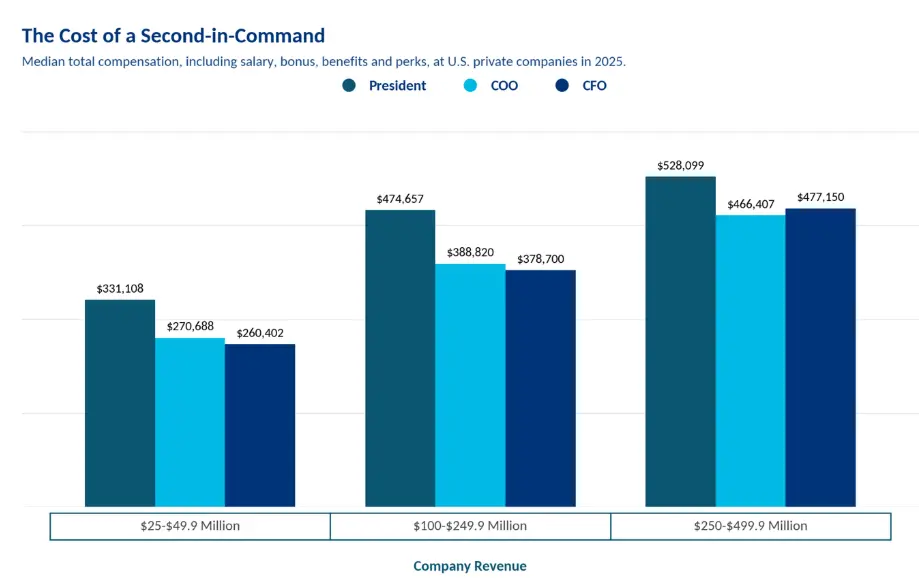
The comprehensive findings from the Chief Executive Group’s report paint a detailed picture of executive pay in the private sector. In 2025, the median total compensation for presidents of U.S. private companies reached $354,608. Chief Operating Officers (COOs) earned a median of $282,940, while Chief Financial Officers (CFOs) reported a median compensation of $272,434. While these national medians provide a valuable baseline, a deeper dive into revenue tiers reveals the nuanced compensation structures that accompany escalating business scale.
Compensation Tiers by Company Revenue (2025 Median Total Compensation):
-
$25 million – $49.9 million in Annual Revenue:
- Presidents: $331,108
- COOs: $270,688
- CFOs: $260,402
-
$100 million – $249.9 million in Annual Revenue:
- Presidents: $474,657
- COOs: $388,820
- CFOs: $378,700
-
$250 million – $499.9 million in Annual Revenue:
- Presidents: $528,099
- COOs: $466,407
- CFOs: $477,150
These figures represent the totality of compensation, encompassing base salary, performance-based bonuses, equity awards, benefits, and other perquisites. It is crucial to recognize that these are median figures, serving as a midpoint rather than an upper limit. The report further highlights that top-quartile compensation can significantly exceed these medians. For instance, among CFOs at companies generating between $100 million and $249.9 million in revenue, top-quartile total compensation soared to $596,198, a substantial premium over the $378,700 median. This data strongly suggests that business owners and CEOs planning to recruit senior executives should budget based on the upper range of compensation, acknowledging that half of the market for comparable talent already commands figures above the median.
The Strategic Imperative: Beyond Affordability to Capability Valuation
The challenge for business leaders is not merely about the financial capacity to meet higher cash compensation demands for new executives. It is fundamentally about identifying the precise capabilities a business requires to ascend to the next level and accurately valuing those competencies in the competitive talent market. Often, strategic foresight dictates the recruitment of key executives from larger organizations, where compensation structures are typically more robust, precisely to imbue the growing company with the necessary expertise and operational discipline.
Consider a company poised for expansion into new domestic or international markets. Such a strategic move necessitates a president with a proven track record of managing larger, more intricate organizational structures. Similarly, a founder contemplating an eventual sale of the business or actively seeking outside investment will require a CFO possessing deep expertise in financial structuring, regulatory compliance, complex transactions, and capital raising. For a rapidly expanding manufacturing firm, the need for an operations leader capable of instilling greater rigor in production processes and optimizing supply chain efficiency becomes paramount. Each of these critical roles presents a distinct compensation challenge, requiring a tailored approach that reflects the specific demands and strategic importance of the position.
The Chief Executive Group’s research further illuminates that compensation is not a monolithic construct. It varies significantly based on industry sector, ownership structure, and overall profitability. For example, private equity-backed companies frequently offer more aggressive and competitive compensation packages, particularly through enhanced bonus structures and equity incentives, compared to many other privately held enterprises. This dynamic creates a heightened competitive environment for founders seeking to attract the same caliber of talent. Consequently, it becomes imperative for leaders to look beyond base salary and explore multifaceted reward strategies, including performance bonuses, long-term incentive plans, and other mechanisms designed to align executive rewards with the creation of enterprise value.
Rethinking Executive Compensation: A Founder’s Perspective Shift
A fundamental distinction often exists between a founder’s financial stake and that of a hired senior executive. Founders typically possess a significant, often majority, ownership stake in the business they have built. This equity represents a substantial portion of their long-term financial return, extending far beyond their immediate salary and short-term compensation. When comparing compensation packages, this ownership disparity is critical. A hired senior executive, lacking equivalent equity participation, will evaluate an opportunity through a different financial lens. Their assessment will likely weigh the salary, bonuses, and benefits more heavily, as these represent their primary avenues for financial reward from the organization.
There is no one-size-fits-all formula for determining the appropriate remuneration for a second-in-command or any senior executive. Furthermore, simply offering a higher salary does not automatically guarantee superior leadership or guaranteed success. However, as chief executives chart the course for their company’s next phase of growth, their own compensation may serve as an inappropriate benchmark for establishing the pay scales of the executives they need to recruit.
The more pertinent and strategically sound question to ask is: What do comparable companies pay for the specific capabilities and experience that are critical for our business’s advancement? And crucially, how can compensation be structured to effectively incentivize and reward the achievement of defined business outcomes? The Chief Executive Group’s 2026-2027 CEO & Senior Executive Compensation Report provides a granular level of detail, offering valuable benchmarks for presidents, COOs, CFOs, and other senior executives, segmented by company size, industry, ownership structure, and performance metrics. This comprehensive data empowers leaders to make informed decisions, ensuring that their compensation strategies are not only competitive but also strategically aligned with their growth objectives and the long-term value creation for their enterprises.
Broader Implications: The Talent War for Growth
The findings from the Chief Executive Group’s report arrive at a critical juncture for many private companies. As the economic landscape continues to evolve, with an increasing emphasis on innovation, efficiency, and market expansion, the demand for highly skilled and experienced senior leadership remains intense. Private companies, often operating with leaner structures than their public counterparts, face a unique challenge in competing for this talent. They must not only match the financial incentives offered by larger corporations and private equity firms but also articulate a compelling vision and culture that resonates with ambitious executives.
The data suggests a clear trend: as companies mature and increase their revenue, the stakes for executive compensation rise proportionally. This is not simply an inflationary pressure; it reflects the increasing complexity of managing larger organizations, navigating more intricate regulatory environments, and executing more ambitious strategic initiatives. The ability to attract a president with experience in global market entry, a CFO adept at managing complex financial instruments and investor relations, or a COO skilled in optimizing multi-site operations is directly tied to the compensation offered.
Implications for Business Strategy:
- Strategic Budgeting: Companies must move beyond reactive salary adjustments and proactively incorporate executive compensation into their long-term strategic and financial planning. This includes forecasting future talent needs and budgeting accordingly.
- Value-Based Compensation: The research reinforces the need for a shift towards value-based compensation models. Instead of solely focusing on base salary, companies should increasingly tie compensation to measurable outcomes, such as revenue growth, profitability improvements, market share expansion, and successful product launches. Equity incentives, when structured appropriately, can be particularly effective in aligning executive interests with long-term shareholder value.
- Industry and Ownership Nuances: The report’s emphasis on variations by industry and ownership structure highlights the importance of targeted research. A compensation strategy that works in the technology sector might be insufficient in manufacturing, and compensation norms can differ significantly between family-owned businesses and those backed by venture capital.
- Talent Acquisition as a Competitive Advantage: In an increasingly competitive business environment, the ability to attract and retain top executive talent can be a significant competitive differentiator. Companies that invest wisely in their leadership teams are better positioned to innovate, adapt, and outperform their rivals.
The Chief Executive Group’s report serves as a vital resource for private company leaders. By providing robust, data-driven insights into executive compensation trends, it empowers them to make more informed decisions. The transition from founder-led to professionally managed teams is a journey that demands strategic financial planning, a deep understanding of market dynamics, and a commitment to valuing the critical capabilities that drive sustainable growth and long-term success. The question is no longer if top talent comes at a cost, but rather, how to strategically invest in that talent to unlock a company’s full potential.
