

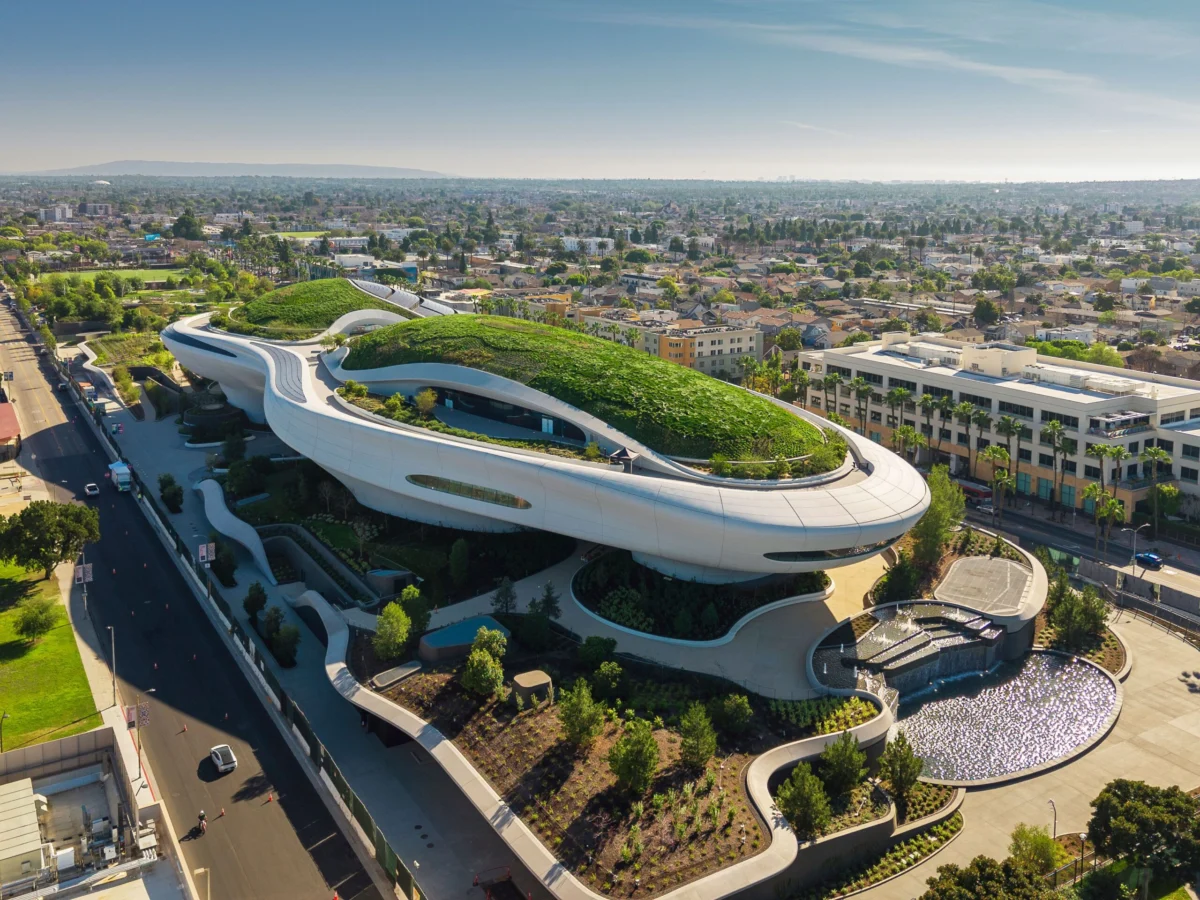
The skyline of South Los Angeles has been irrevocably altered by the arrival of a structure that appears to have descended from the cosmos rather than being constructed by human hands. Perched on an 11-acre campus within the historic Exposition Park, the Lucas Museum of Narrative Art stands as a testament to the radical vision of filmmaker George Lucas and his wife, Mellody Hobson. Designed by Chinese architect Ma Yansong of MAD Architects, in collaboration with executive architect Michael Siegel of Stantec and landscape architect Mia Lehrer of Studio-MLA, the museum is an instant landmark that defies traditional architectural conventions. Clad in over 1,500 individually crafted panels of curved fiberglass-reinforced polymer, the building’s sinuous, biomorphic forms create an illusion of weightlessness, with dramatic cantilevers that allow the massive 300,000-square-foot structure to hover delicately above the ground.
A Vision for Democratic Art
The core mission of the Lucas Museum of Narrative Art is to celebrate the power of visual storytelling, a medium that George Lucas argues is the most fundamental form of human communication. By focusing on "narrative art," the institution seeks to bridge the gap between "high culture" and the popular arts that have long been excluded from traditional museum sanctums. Lucas defines narrative art as a lineage that stretches back thousands of years, from prehistoric cave paintings to the complex digital world-building of modern cinema.

Mellody Hobson, the museum’s co-founder and a prominent business leader, emphasizes that the institution is designed to foster emotional rather than purely intellectual connections. The goal is to create a democratic, non-exclusionary space where visitors—particularly young people from the surrounding Los Angeles communities—can see themselves reflected in the stories told on the walls. By elevating illustrators, comic book artists, and digital creators to the same status as classical masters, the museum challenges the 19th-century "ghettoization" of popular media and seeks to inspire a new generation of creators.
Architectural Innovation and Biomorphic Design
Ma Yansong’s design for the museum is a tour de force of contemporary engineering. The five-story building utilizes a "shanshui" philosophy—a traditional Chinese concept that seeks to integrate the man-made environment with the natural world. This is reflected in the building’s organic, flowing lines which avoid right angles in favor of curves that mimic the movement of water or clouds. The exterior’s fiberglass-reinforced polymer (FRP) panels were selected for their ability to be molded into complex, three-dimensional shapes while maintaining structural integrity and weather resistance.
The ground-level experience is designed to be as inviting as the galleries themselves. The building acts as a massive canopy, providing shade and shelter for a covered plaza. At the center of this plaza is a dramatic elliptical oculus, a massive opening that frames the sky and allows natural light to pour into the heart of the site. This integration of indoor and outdoor space is a hallmark of the project, ensuring that the museum feels like a natural extension of Exposition Park rather than a fortress of culture.

Inside, the attention to detail is exhaustive. From the radiused edges of the elevator cabs to the custom-designed kiosks in the gift shop, every element has been curated to maintain the "organic" feel of the architecture. The interior vaulted spaces and curved corridors are intended to guide visitors through a seamless flow of ideas and moods, echoing the way a story unfolds in a film or a novel.
The Journey to Exposition Park: A Chronology
The path to the museum’s opening on September 22 has been a decade-long journey marked by geographic shifts and significant investment. The project’s timeline reflects the complexity of bringing a billion-dollar private cultural institution to life in a major metropolitan area:
- 2014: George Lucas initially proposes the museum for a site in the Presidio of San Francisco. After facing opposition from local groups regarding the design and location, the search expands to other cities.
- 2015: A proposal is made to build the museum on the lakefront in Chicago. Despite support from city officials, legal challenges from park preservationists lead Lucas to abandon the Chicago site in 2016.
- 2017: Lucas announces that the museum will be built in Los Angeles, specifically in Exposition Park. The city’s rich history with the film industry and its diverse population are cited as key factors in the decision.
- 2018: Construction officially breaks ground. The project is estimated to cost over $1 billion, funded entirely by Lucas and Hobson, making it one of the largest philanthropic gifts in the history of the United States.
- 2019–2023: The complex construction process proceeds, involving the installation of the specialized FRP panels and the development of the extensive underground parking and support facilities.
- 2024: The museum nears completion, with the focus shifting to the installation of the inaugural exhibitions and the finalization of the 11-acre park.
A Collection Without Boundaries
The museum’s collection is as eclectic as its architecture. It houses approximately 100,000 pieces that span the history of visual narrative. This includes a vast array of traditional fine art, such as paintings by Norman Rockwell and N.C. Wyeth, who are often cited as the premier narrative illustrators of the 20th century. However, the collection also dives deep into the world of cinema and popular culture.

Visitors will encounter original storyboards, costumes, and props from legendary films, including a model of the Millennium Falcon from the Star Wars franchise. These are juxtaposed with ultra-high-tech reproductions of historical monuments like Trajan’s Column and the Sistine Chapel ceiling. By placing a comic strip by R. Crumb in the same context as a Renaissance masterpiece, the museum forces a conversation about how stories are told and why certain narratives endure across generations.
Landscape and Community Integration
The 11-acre campus designed by Studio-MLA is far more than just a setting for the building; it is a functional park designed to serve the local community. Landscape architect Mia Lehrer has created a series of "land forms" that rise and fold around the architecture, referencing the diverse geography of California, including foothills, canyons, and meadows.
The park features:

- An Amphitheater: A dedicated space for outdoor performances, film screenings, and community gatherings.
- Hanging Gardens: Lush greenery integrated into the building’s upper levels, contributing to the site’s ecological health and thermal regulation.
- Sculpture Gardens: A curated outdoor gallery featuring monumental works, including characters from the Star Wars universe and icons of American history like Rosie the Riveter.
- Renewable Systems: A rain fountain that serves as a renewable cooling mechanism for the building, alongside solar arrays integrated into the roof design.
Lehrer’s design emphasizes accessibility, providing new green space in a part of Los Angeles that has historically been underserved by public parks. The museum’s mission of "popular engagement" is thus reflected in its physical footprint, offering a "democratic" space that is open to the public regardless of whether they purchase a gallery ticket.
Economic and Cultural Implications
The opening of the Lucas Museum of Narrative Art is expected to have a profound impact on the regional economy and the global art world. With its location in Exposition Park—already home to the California Science Center, the Natural History Museum of Los Angeles County, and the BMO Stadium—the museum completes a cultural corridor that rivals any in the world.
Economic analysts suggest that the museum will draw millions of visitors annually, boosting local tourism and supporting hundreds of permanent jobs in education, curation, and hospitality. Furthermore, the museum’s focus on digital arts and filmmaking aligns with Los Angeles’s status as the entertainment capital of the world, providing a permanent home for the study and celebration of the crafts that drive the city’s primary industry.

Critically, the museum represents a shift in the philanthropic landscape. By funding the project entirely through private means, Lucas and Hobson have maintained total creative control over the institution’s mission. While some art critics have questioned the "populist" nature of the collection, many urban planners and community leaders have praised the project for its investment in South Los Angeles and its commitment to making art accessible to all.
Conclusion: Creating Wonder
As the Lucas Museum of Narrative Art prepares for its public debut, it stands as a bold experiment in cultural democratization. By combining cutting-edge architecture with a collection that spans the high-brow and the popular, the institution seeks to redefine what a museum can be in the 21st century.
For George Lucas, the project is the culmination of a lifelong fascination with the mechanics of storytelling. For Los Angeles, it is a new architectural icon and a significant addition to its cultural infrastructure. In the words of Mellody Hobson, the museum is designed to feel like "the inside of George’s brain"—a place where stories flow seamlessly from one to another, designed with the singular prime directive to "create wonder." Whether through the sight of a futuristic "spaceship" landing in Exposition Park or the emotional resonance of a familiar image, the museum invites the world to see art not as a distant, intellectual pursuit, but as a living, breathing part of the human experience.
