


Hiroshi Okuda, the former chairman and president of Toyota Motor Corporation who passed away on August 8 at the age of 93, leaves behind a legacy defined by radical transformation, ruthless pragmatism, and a fundamental shift in the global automotive landscape. As the first executive from outside the founding Toyoda family to lead the company in nearly three decades, Okuda is credited with rescuing the Japanese manufacturer from a period of dangerous complacency and steering it toward the technological innovation that resulted in the world’s first mass-produced hybrid vehicle, the Prius. His tenure was marked by a willingness to break traditional Japanese corporate taboos, prioritizing global expansion and technological disruption over the safety of the status quo.
The Ascension of a Maverick: Breaking the Toyoda Family Monopoly
Hiroshi Okuda joined Toyota in 1955, but his path to the top was anything but conventional. In a corporate culture that historically prioritized the lineage of the founding Toyoda family, Okuda was an outlier. His rise to the presidency in 1995 came during a period of significant internal and external turmoil for the company. At the time, Toyota’s domestic market share in Japan was slipping, and the company was perceived as a slow-moving giant that had become overly reliant on its reputation for "lean manufacturing" without having a clear vision for the 21st century.
The transition of power occurred under sudden circumstances. Tatsuro Toyoda, the son of company founder Kiichiro Toyoda, was forced to step down after being hospitalized for health complications, widely reported as a stroke, following the 1995 Tokyo Motor Show. This vacancy allowed Okuda to step in, ending a 28-year streak of family leadership. Okuda brought with him a reputation for being a "tough-as-nails" financier and an operational expert who was not afraid of confrontation—a trait that earned him both respect and friction within the conservative ranks of Toyota’s leadership.
The Philippine Crucible: A Legend Born in Adversity
Much of Okuda’s legendary grit can be traced back to his time in the Philippines during the 1970s. Following the declaration of Martial Law under Ferdinand Marcos, Okuda was sent to Manila to oversee Toyota’s partnership with Delta Motors Corp. Within the company, this assignment was viewed by some as a demotion or a "banishment" resulting from an altercation Okuda had with a superior in Japan.
His primary role in the Philippines was reportedly that of a debt collector and operational fixer. Urban legends surrounding his tenure suggest that Okuda once crossed mountain ranges to negotiate directly with leftist rebels who opposed the establishment of a Toyota factory. While historical records place the primary factory in the Parañaque district of Metro Manila, the mythos of the "mountain-crossing executive" underscored his reputation for being a leader who would go to any lengths to secure the company’s interests. This period in the Philippines provided him with a global perspective and a financial hardness that he would later use to dismantle Toyota’s insular domestic culture.
Waking the Sleeping Giant: The War on Complacency
When Okuda took the helm in 1995, he inherited a company that was financially stable but strategically stagnant. He famously observed that Toyota was "suffering from a big-company disease," where seniority-based promotions and a focus on incremental improvements were stifling innovation.
Okuda’s reforms were swift and, by Japanese standards, revolutionary. He took the following steps to modernize the company:
- Dismantling Seniority: He overhauled the promotion system, allowing younger, high-performing managers to leapfrog older executives, a move that shattered the traditional "salaryman" hierarchy.
- Global Expansion: He accelerated the construction of manufacturing plants in the United States, Europe, and China. Under his leadership, Toyota transitioned from being a Japanese exporter to a truly multinational corporation that built cars where it sold them.
- Domestic Rationalization: In a move that sent shockwaves through the Japanese economy, Okuda closed several domestic plants to optimize efficiency. In a country where "lifetime employment" was a sacred social contract, this was viewed as a radical departure from tradition.
The Prius Ultimatum: A Race Against Time and Tradition
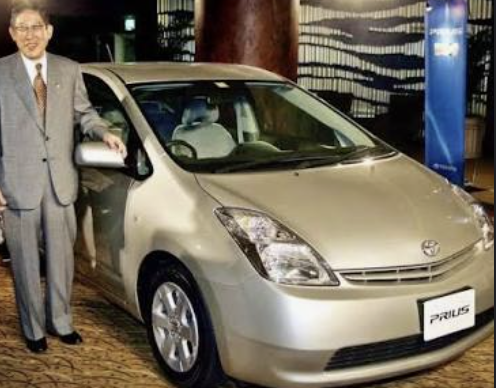
Perhaps the most significant achievement of the Okuda era was the birth of the Toyota Prius. In the mid-1990s, an internal team known as "G21" (Global 21st Century) was tasked with developing a car that would address the environmental concerns of the coming millennium. The team proposed a hybrid-electric powertrain, but the technical challenges were immense. Most engineers within Toyota viewed the project as a costly distraction from the profitable V8 and SUV markets dominated by American rivals.
The G21 team originally estimated that a production-ready hybrid could be launched by 1998. Okuda, recognizing the symbolic and strategic importance of the project, rejected this timeline. He demanded that the car be ready for the Tokyo Motor Show in October 1997 and for full production by December of that same year.
The timing was not arbitrary. Okuda knew that the Kyoto Climate Conference (COP3) was scheduled for December 1997. He wanted Toyota to debut the Prius on the world stage at the exact moment global leaders were signing the Kyoto Protocol, the first international treaty to set legally binding targets for greenhouse gas emissions. By forcing the launch a year early, Okuda ensured that Toyota would be synonymous with the environmental movement.
The engineering pressure was unprecedented. The team had to finalize the nickel-metal hydride (NiMH) battery systems and the complex power-split device while the car was essentially still in the prototype phase. When the Prius launched in 1997, it was the first mass-produced hybrid in the world, achieving fuel economy nearly double that of conventional cars in its class.
The Parallel Bet: The 1996 RAV4 EV
While the Prius became the face of Toyota’s green revolution, Okuda also greenlit a more obscure but equally important project: the RAV4 EV. Launched in Japan in September 1996 and in the U.S. in 1997, the RAV4 EV was a pure battery-electric vehicle (BEV).
Unlike the experimental General Motors EV1, the RAV4 EV was a practical four-seat SUV. It utilized advanced NiMH batteries that provided a range of 120 to 200 kilometers (75 to 125 miles) on a single charge. Although only about 1,900 units were produced between 1997 and 2003, the vehicle proved that Toyota possessed the technical capability to build functional electric cars long before the modern EV boom.

Okuda’s decision to prioritize the hybrid Prius over the battery-electric RAV4 EV was a masterclass in strategic pragmatism. He recognized that in the late 1990s, the lack of charging infrastructure and the high cost of batteries made BEVs a niche product. The Prius, however, required no change in consumer behavior, making it the perfect "bridge" technology for the masses.
Chronology of the Okuda Era
- 1955: Hiroshi Okuda joins Toyota Motor Corporation.
- 1970s: Okuda serves in the Philippines, managing relations with Delta Motors Corp during the Martial Law era.
- 1982: Appointed to the Board of Directors.
- 1995: Becomes President of Toyota after Tatsuro Toyoda steps down.
- 1996: Launch of the RAV4 EV in Japan.
- 1997: Launch of the first-generation Prius (XW10) in Japan, coinciding with the Kyoto Protocol.
- 1999: Okuda steps down as President to become Chairman of the Board.
- 2002-2006: Serves as Chairman of the Japan Business Federation (Keidanren), the country’s most powerful lobby.
- 2009: Retires from the Toyota board, becoming an honorary advisor.
Supporting Data: The Impact of Okuda’s Leadership
Under Okuda’s influence (both as President and Chairman), Toyota’s growth was astronomical.
- Market Dominance: In 1995, Toyota’s global sales stood at approximately 4.5 million vehicles. By the time his influence peaked in the mid-2000s, the company was closing in on 9 million units, eventually overtaking General Motors as the world’s largest automaker in 2008.
- Hybrid Success: Since the 1997 launch, Toyota has sold over 20 million hybrid vehicles globally. The technology Okuda championed now accounts for nearly 30% of Toyota’s total global sales.
- Financial Fortitude: During the Asian Financial Crisis of 1997, Okuda’s aggressive cost-cutting and global diversification allowed Toyota to remain profitable while many of its domestic competitors, such as Nissan and Mazda, required foreign bailouts or alliances.
A Legacy of Friction: The 10 Million Sales Target and the 2010 Recalls
Okuda’s legacy is not without its critics. His relentless drive for scale, encapsulated in his "Global 20" vision—aiming for 15% to 20% of the global market and 10 million annual sales—pushed the company’s resources to their limits.
Analysts suggest that this rapid expansion strained Toyota’s legendary quality control systems. This culminated in the 2009–2011 recall crisis, where millions of vehicles were recalled for issues related to "unintended acceleration." The crisis forced Toyota’s first annual loss in decades and led to a congressional hearing in the United States. Akio Toyoda, who took over as president in 2009, famously pivoted the company back toward "the joy of driving" and slowed growth to prioritize quality, essentially spending years undoing the side effects of Okuda’s aggressive expansion.
Final Analysis and Global Impact
Hiroshi Okuda was the catalyst that transformed Toyota from a provincial Japanese manufacturer into a dominant global sovereign. His willingness to challenge the founding family and the "way things have always been done" provided the friction necessary for innovation to occur.
The industry’s current shift toward electrification is a direct descendant of the "G21" project Okuda forced into existence. By proving that consumers would buy electrified powertrains, he created the market conditions that allowed companies like Tesla and BYD to eventually emerge.
Okuda’s passing marks the end of an era for the "Japanese Miracle" of corporate leadership. He was a man who understood that in a rapidly changing world, the greatest risk is not failure, but the refusal to adapt. His legacy remains visible on every road in the world, embodied in the quiet hum of a hybrid engine—a technology that exists today because one man refused to wait until 1998.
