

For entrepreneurs who have dedicated years to meticulously building their businesses, the decision to transition leadership by bringing in professional management can mark a pivotal moment. This shift often necessitates a fundamental reevaluation of executive compensation strategies, a challenge that can prove particularly acute for founders accustomed to leaner personal salaries. As companies mature and aspire to new heights, the investment required to attract and retain top-tier executive talent can significantly exceed historical pay scales, prompting a critical examination of what specialized expertise truly costs.
New research from Chief Executive Group underscores this evolving landscape, offering a comprehensive look at senior executive remuneration within U.S. private companies. The 2026-2027 CEO & Senior Executive Compensation Report reveals a clear correlation between company size and the compensation packages offered to key leadership roles, such as presidents, Chief Operating Officers (COOs), and Chief Financial Officers (CFOs). This data provides crucial benchmarks for private company leaders navigating the complexities of talent acquisition and retention in an increasingly competitive market.
The Escalating Demand for Senior Leadership Talent
The core of this compensation challenge lies in the inherent value that experienced executives bring to a growing enterprise. Founders, often deeply embedded in the operational fabric of their companies, may find themselves needing to delegate responsibilities to individuals with proven track records in scaling operations, managing complex financial structures, or driving strategic growth. The compensation required to lure such individuals often surpasses the founder’s own remuneration, even for seasoned CEOs who may have a significant equity stake. This disparity highlights a common hurdle: aligning the founder’s perception of value with the market reality of executive talent.
The Chief Executive Group’s report, released in late 2026, analyzes compensation data from the 2025 fiscal year, providing a timely snapshot of current market trends. The findings indicate that the median total compensation for presidents of U.S. private companies reached $354,608 in 2025. COOs and CFOs, while commanding slightly lower figures, still represent substantial investments, with median total compensation at $282,940 and $272,434, respectively. These national medians, however, serve as a starting point, with actual compensation often dictated by a nuanced interplay of company size, industry, and specific functional requirements.
Benchmarking Executive Pay: Size Matters
The research meticulously breaks down compensation figures based on annual revenue, illustrating a dramatic escalation in executive pay as companies ascend the growth ladder.
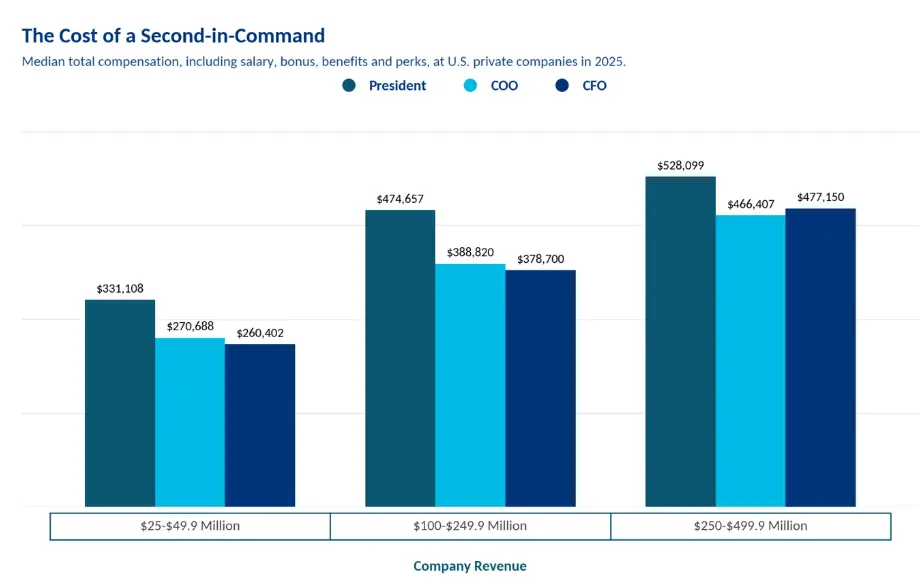
For private companies generating between $25 million and $49.9 million in annual revenue, the median total compensation for presidents stood at $331,108 in 2025. COOs and CFOs in this revenue bracket earned median figures of $270,688 and $260,402, respectively. While these numbers represent significant investments, they are dwarfed by the compensation packages at larger enterprises.
As companies grow to encompass revenues between $100 million and $249.9 million, the figures for senior leadership experience a notable surge. Presidents in this tier saw median total compensation rise to $474,657. COOs were compensated at a median of $388,820, and CFOs at $378,700. This upward trajectory continues unabated for even larger entities.
At the upper echelon of private companies, those with annual revenues ranging from $250 million to $499.9 million, median compensation for presidents reached an impressive $528,099. COOs in this segment earned a median of $466,407, and CFOs commanded $477,150. These figures underscore the substantial financial commitment required to secure leadership talent capable of navigating and driving the growth of large, complex private organizations.
It is crucial to note that these figures represent median total compensation. This comprehensive compensation package includes not only base salary but also bonuses, equity awards, benefits, and other perquisites. However, even these median figures can be misleading when considering the upper echelons of talent. The report highlights that for CFOs at companies with $100 million to $249.9 million in revenue, top-quartile total compensation can soar to $596,198, a figure substantially exceeding the $378,700 median. This implies that companies seeking executives with exceptional experience or specialized capabilities must often look beyond the midpoint of market compensation and be prepared to offer packages that place them in the top 25% of earners. As a consequence, business owners planning critical hires are advised to budget against the higher end of the compensation range, recognizing that half the market is already compensating at or above the median.
The Strategic Imperative of Executive Talent Acquisition
The challenge for private company leaders extends beyond simply being able to afford higher cash compensation. The fundamental question revolves around identifying the specific capabilities a business requires for its next phase of growth and then determining the market value of those capabilities. In many instances, strategic prudence dictates hiring key executives who have prior experience in larger, more established organizations, where compensation structures are typically more robust. This influx of seasoned talent can bring invaluable insights and proven methodologies that accelerate a company’s own growth trajectory.
For example, a company embarking on an expansion into new international markets might require a president with a demonstrated history of managing larger, more intricate organizational structures and navigating diverse regulatory environments. Similarly, a founder preparing for a potential sale or seeking significant outside investment will likely need a CFO possessing deep expertise in financial structuring, complex reporting requirements, transactional processes, and capital raising strategies. A rapidly expanding manufacturing firm, on the other hand, might prioritize an operations leader capable of instilling greater discipline in production processes and optimizing intricate supply chains. Each of these specialized roles presents a unique compensation puzzle, demanding a tailored approach that reflects the critical nature of their contributions.
Beyond Salary: A Multifaceted Compensation Landscape
The Chief Executive Group’s research also sheds light on the significant variations in compensation based on industry, ownership structure, and profitability. Private equity-backed companies, for instance, are often recognized for offering more competitive and performance-driven compensation packages compared to many other privately held businesses. This is particularly evident in their utilization of performance bonuses and substantial equity incentives, designed to align executive interests directly with value creation for the firm.
For founders vying for the same pool of top talent, this dynamic suggests a need to look beyond base salary. Creative compensation structures that incorporate performance bonuses tied to key growth metrics, long-term incentives that reward sustained value creation, and other innovative mechanisms for recognizing and rewarding executives who contribute to building enterprise value become paramount. The ability to offer a compelling total rewards package, encompassing both financial and non-financial elements, can be a critical differentiator in attracting and retaining high-caliber leaders.
Rethinking the Founder’s Compensation Benchmark
A key distinction that often influences compensation discussions is the founder’s inherent ownership stake in the business. Founders typically possess a meaningful equity position, which represents a significant portion of their overall financial return from building the company. The salary and other short-term compensation elements a founder takes home may only represent one facet of their financial reward.
Hired senior executives, particularly those without an equivalent ownership stake, will often evaluate an opportunity through a different financial lens. Their primary return will likely stem from their salary, bonuses, and any equity or long-term incentive awards they receive. Consequently, a direct comparison of a founder’s personal paycheck to a potential executive’s salary can be an inadequate and even misleading benchmark.
There is no single, universally applicable formula for determining the appropriate compensation for a second-in-command. Furthermore, simply offering a higher salary does not automatically guarantee superior leadership or a better return on investment. The true measure of executive compensation lies in its ability to attract and retain individuals who possess the specific capabilities needed to drive the company’s strategic objectives and deliver measurable results.
The Future of Executive Compensation in Private Companies
As chief executives contemplate the next chapter of their company’s growth, relying solely on their own compensation as a reference point for hiring new executives is likely to be an insufficient strategy. A more effective approach involves understanding what comparable companies are paying for similar capabilities and structuring compensation packages around the anticipated outcomes and performance targets of the business. This forward-looking perspective, informed by robust market data, is essential for building a leadership team capable of navigating the complexities of expansion and achieving sustained success.
The 2026-2027 CEO & Senior Executive Compensation Report from Chief Executive Group serves as an invaluable resource for private company leaders. It provides detailed, data-driven benchmarks for presidents, COOs, CFOs, and other senior executives, segmented by company size, industry, ownership structure, and performance metrics. By leveraging such insights, founders and CEOs can make more informed decisions about executive compensation, ensuring they are not only competitive in attracting top talent but also strategically aligned with their company’s long-term growth ambitions. The report’s comprehensive nature aims to demystify executive pay within the private sector, empowering leaders to invest wisely in the human capital that will drive their enterprises forward. The findings offer a clear mandate: investing in experienced leadership is not merely an expense, but a critical strategic imperative for companies aspiring to reach their full potential in an ever-evolving business landscape.
