

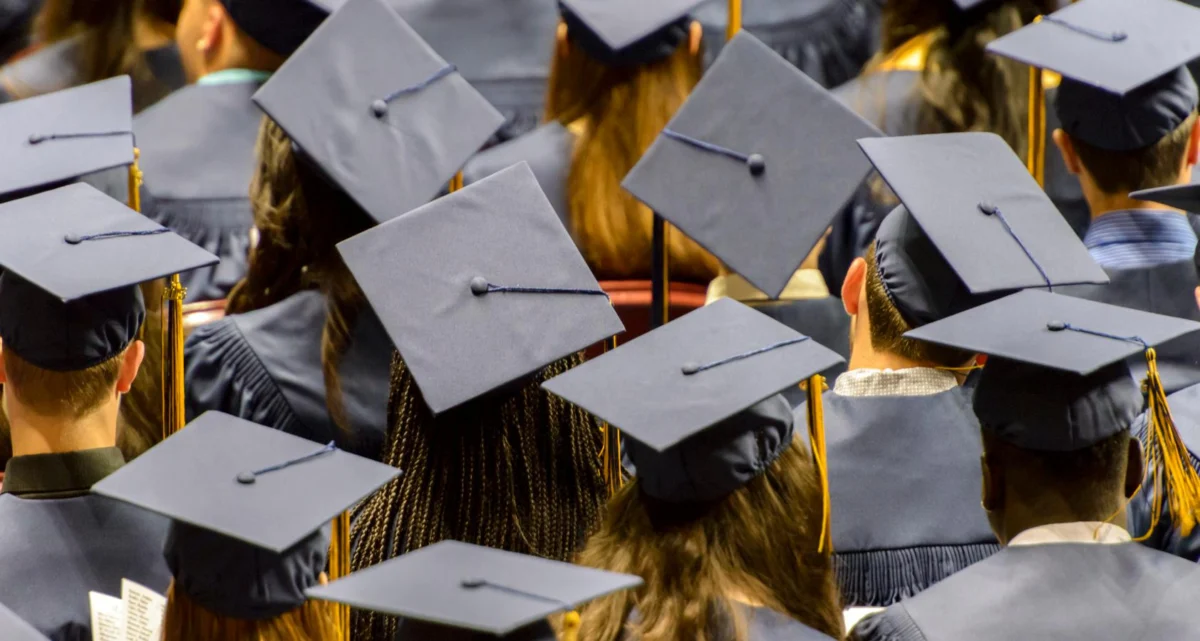
The traditional commencement speech is often designed to be a bridge between the ivory tower of academia and the pragmatic realities of the professional world, typically filled with platitudes about "following one’s passion" and "changing the world." However, the 2024 commencement season has revealed a burgeoning friction between corporate optimism and student anxiety, particularly regarding the rapid ascent of generative artificial intelligence. Across the United States, prominent figures from the technology and business sectors have found that the mere mention of AI—once a buzzword for progress—now serves as a catalyst for vocal dissent among graduating classes.
At the University of Central Florida (UCF), the tension reached a boiling point during a ceremony for the College of Arts and Humanities. Gloria Caulfield, an executive at Tavistock Development Company, took the stage to offer what was likely intended as a forward-looking address. Acknowledging that the graduates were entering a world defined by "profound change," Caulfield attempted to frame the rise of artificial intelligence as a historic milestone.
"The rise of artificial intelligence is the next industrial revolution," Caulfield declared. The response from the audience was immediate and overwhelming. Rather than the expected polite applause, a wave of boos erupted from the sea of caps and gowns. The heckling grew in volume, forcing Caulfield to pause. Visibly surprised, she turned to the faculty members seated behind her and asked, "What happened?"
The incident at UCF was not an isolated event of local frustration but rather part of a growing national trend where the promise of technological "disruption" is being met with skepticism by the very demographic expected to lead it. For many graduates, particularly those in the arts and humanities, AI is not viewed as a tool for empowerment but as a direct threat to their career viability and the intrinsic value of human creativity.
A Growing Pattern of Resistance
The phenomenon repeated itself days later at the University of Arizona, where former Google CEO Eric Schmidt faced an even more contentious reception. Schmidt’s appearance was already mired in controversy prior to his arrival on campus. Student organizations and activist groups had called for his removal as the commencement speaker, citing a lawsuit involving allegations of sexual assault brought forward by a former business partner—allegations that Schmidt has categorically denied.
When Schmidt finally took the podium, he was met with persistent booing that began even before he started his address. However, the vitriol intensified when the topic turned to technology. Schmidt, a long-time proponent of the "techno-optimist" worldview, urged the graduates to embrace the current era of innovation. "You will help shape artificial intelligence," he told the crowd.
As the boos continued, Schmidt attempted to talk over the noise, employing a metaphor famously used by Sheryl Sandberg: "When someone offers you a seat on the rocket ship, you do not ask which seat, you just get on." He insisted that graduates could now "assemble a team of AI agents" to handle tasks they could never accomplish alone. The rhetoric, which might have been met with awe a decade ago, appeared to fall flat with a generation that has witnessed the volatile nature of the tech industry, including mass layoffs and the ethical quagmires of social media.
The Economic Context of Student Pessimism
To understand why AI has become a "third rail" at graduation ceremonies, one must look at the broader economic landscape facing the Class of 2024. These students are entering the workforce at a time of significant transition and uncertainty. A recent Gallup poll highlights a dramatic shift in sentiment: only 43% of Americans aged 15 to 34 currently believe it is a good time to find a job in their local area. This represents a staggering decline from 2022, when 75% of the same demographic expressed optimism about the labor market.
This "vibecession"—a term coined to describe a disconnect between positive macroeconomic indicators and a negative public perception of the economy—is particularly acute for new graduates. While the national unemployment rate remains low, the specific sectors that traditionally absorb college graduates, such as tech, media, and professional services, have undergone significant contractions. Since the start of 2023, the tech industry alone has seen hundreds of thousands of job cuts as companies "pivot" toward AI-driven efficiency.
For a student who has spent four years and tens of thousands of dollars on a degree in graphic design, journalism, or computer science, the narrative of an "AI revolution" sounds less like a rocket ship and more like a replacement strategy. Brian Merchant, a prominent tech critic and author, suggested that for many young people, AI has become "the cruel new face of hyper-scaling capitalism." Merchant argued that the hostility is a rational response to a technology that is often marketed as a way to automate away the very entry-level roles that graduates rely on to begin their careers.
The Anomaly of the Technical Elite
While the reception for AI has been chilly at many general ceremonies, there are notable exceptions. Jensen Huang, the CEO of Nvidia—the company whose chips provide the literal backbone for the AI boom—spoke at Carnegie Mellon University’s commencement to a much warmer reception. Huang told the graduates that AI had "reinvented computing" and that they were entering the field at the most exciting time in history.
The difference in reaction can be attributed to the specific audience. Carnegie Mellon is one of the world’s premier institutions for robotics and computer science. For these graduates, AI is the industry that will provide their high-paying salaries and research grants. They are the architects of the technology, not the people whose jobs are being targeted for automation. This divide suggests a growing "AI class gap," where those who build and own the tools see a future of infinite growth, while those who use or are displaced by the tools see a future of precariousness.
A Timeline of the 2024 Commencement Tension
The friction observed in May 2024 is the culmination of several years of rapid technological shifts and social unrest:
- Late 2022: The public release of ChatGPT brings generative AI into the mainstream, sparking immediate debates in academia about cheating and the future of the essay.
- Early 2023: Major tech firms (Google, Meta, Microsoft) announce massive layoffs while simultaneously announcing multi-billion dollar investments in AI.
- Late 2023: The Hollywood strikes (WGA and SAG-AFTRA) bring the threat of AI displacement to the forefront of national conversation, ending with historic protections for human creators.
- Spring 2024: Gallup reports a record low in job market optimism among young adults.
- May 2024: Commencement season begins. Students at UCF, University of Arizona, and other institutions use the ceremony as a platform to voice their displeasure with AI-centric corporate messaging.
The "Resilience" Narrative and the Inherited Mess
The recurring theme of "resilience" in this year’s speeches serves as a tacit acknowledgement from the older generation that the world they are handing off is fractured. Even Eric Schmidt, amidst the booing, conceded that there is "a fear in your generation that the future has already been written, that the machines are coming, that the jobs are evaporating, that the climate is breaking, and that you are inheriting a mess that you did not create."
However, the disconnect remains in the proposed solutions. While speakers like Caulfield and Schmidt suggest that the answer lies in "embracing the machine" or "getting on the rocket ship," graduates appear to be looking for a more human-centric approach. Alexander Rose Tyson, a UCF graduate, told reporters that the booing wasn’t a coordinated political stunt but a "collective" realization that the corporate platitudes being offered were out of touch with the reality of their lives.
For the College of Arts and Humanities graduates at UCF, the frustration was compounded by what they perceived as a lack of respect for their specific fields. One student noted that before Caulfield even mentioned AI, she had already lost the audience by offering generic praise for executives like Jeff Bezos—figures who are often viewed by humanities students as symbols of the "gig economy" and the erosion of worker rights.
Implications for the Future of Tech and Society
The backlash at these commencement ceremonies serves as a warning for the tech industry and corporate leaders. For the past two decades, "innovation" was a universally positive term. Today, it is increasingly scrutinized for its social costs. If the next generation of workers—the "AI natives"—is fundamentally skeptical of the technology, the path to widespread adoption and integration may be much more litigious and socially disruptive than Silicon Valley anticipates.
The events of May 2024 suggest that the "Industrial Revolution" metaphor used by Gloria Caulfield was more accurate than she intended. The original Industrial Revolution was defined not just by the steam engine, but by the Luddites and the labor movements that rose in response to the dehumanization of work. As the Class of 2024 steps off the stage and into the office (or the remote workstation), they carry with them a clear message: they are not interested in being passengers on a rocket ship that doesn’t have a place for their humanity.
