

The residential development industry is currently navigating a complex intersection where traditional construction wisdom meets the rapid evolution of consumer psychology and technological integration. As the housing market faces fluctuating interest rates and shifting demographic demands, the role of sales leadership has expanded beyond simple inventory management to encompass deep market analysis and behavioral forecasting. In the high-stakes environment of upscale New Jersey townhome communities, the difference between a project’s financial success and its stagnation often rests on the ability to distinguish between what potential buyers admire in a digital gallery and what they are prepared to finance at the closing table.
The Shift from Developer-Led to Consumer-Influenced Design
Historically, real estate developers relied on established design programs—sets of finishes and layouts that had proven successful in previous cycles. For years, dark wood flooring and traditional cabinetry served as the industry standard for luxury. However, the rise of visual social media platforms such as Pinterest and Instagram has fundamentally altered the buyer’s journey. Today’s prospective homeowners arrive at model homes with curated digital portfolios, often featuring high-end finishes from properties that far exceed their actual purchasing power.
This democratization of design inspiration has created a unique challenge for builders: the "Pinterest Gap." Developers must now find ways to replicate the aesthetic of multi-million-dollar estates within a budget that maintains the profitability of mid-market and upscale townhome developments. A notable case study in this shift occurred in a New Jersey development where a move toward light, whitewashed wood flooring—initially met with skepticism by ownership—became the community’s most successful upgrade. This change was not merely a matter of aesthetic preference but a strategic response to real-time buyer feedback that preceded broader market trends.
The Chronology of Modern Real Estate Sales Strategy
The lifecycle of a new construction project has become increasingly front-loaded, requiring significant intellectual investment before the first shovel hits the ground. The process typically follows a rigorous timeline:
- Pre-Development Analysis: Market research teams identify gaps in local inventory and analyze the demographic profile of the target buyer.
- Product Positioning: Decisions regarding model home merchandising and option programs are finalized. This stage now involves reconciling "aspirational" design with "attainable" pricing.
- Community Launch: The initial phase where marketing strategies are tested against actual foot traffic. This is the critical window for identifying buyer objections.
- The Post-Launch Pivot: As the community matures, sales leadership must interpret sales data to adjust pricing, incentives, or design options in response to competitor activity or economic shifts.
Throughout this chronology, the most significant hurdle is often the transition from the "admiration phase" to the "purchase phase." Industry experts note that traffic without meaningful buyer intelligence creates a false sense of momentum. A model home may receive universal acclaim for its interior design, but if the features showcased do not translate into signed contracts or profitable upgrades, the design is considered a failure from a development standpoint.
Supporting Data: The Impact of Upgrades and Market Trends
Recent data from the National Association of Home Builders (NAHB) suggests that the "options and upgrades" segment of a new home sale can account for 10% to 20% of the total purchase price in upscale markets. In New Jersey, where the median price for new construction remains significantly higher than the national average, the selection of these upgrades is a primary driver of developer margins.
According to recent market indices, homeowner interest in remodeling and specific aesthetic upgrades saw a slight stall in late 2024, yet the demand for "move-in ready" homes with modern, light-filled aesthetics remains high. This suggests that while buyers are more cautious about self-funded renovations, they are willing to pay a premium for a builder-completed home that meets their specific stylistic requirements.
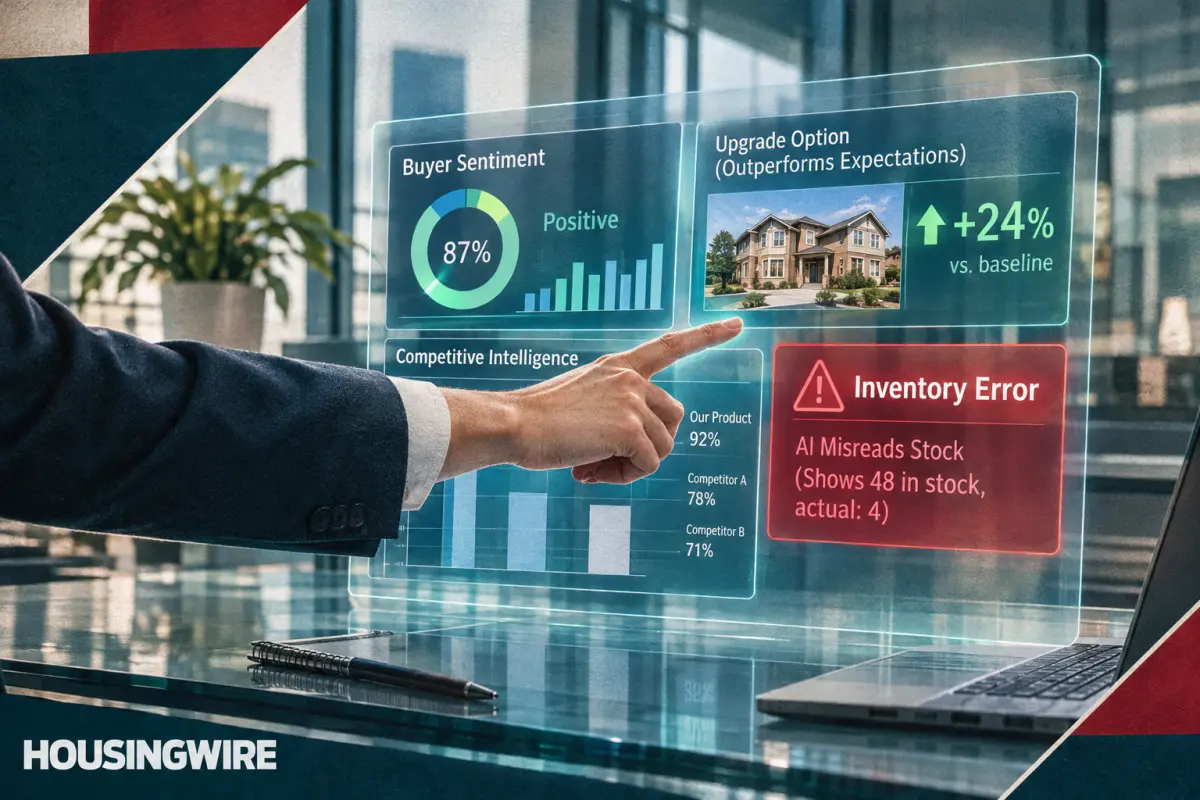
The integration of Artificial Intelligence (AI) into this data landscape has provided developers with new tools for sentiment analysis. AI platforms can now aggregate thousands of buyer comments from CRM systems, identifying recurring objections—such as the lack of a first-floor bedroom suite or dissatisfaction with standard kitchen finishes—much faster than manual reporting.
The Limitations of Technology and the Risk of Incomplete Data
While AI has revolutionized data organization, the industry is beginning to identify significant risks associated with over-reliance on automated insights. A primary concern is the accuracy of AI-generated market reports. In several documented instances, AI tools designed to track competitor inventory have failed to account for "pocket listings" or homes that are under contract but not yet closed.
For example, an AI analysis might report that a competing development has only six homes remaining, when in reality, dozens of units remain in the pipeline but are not currently reflected in public-facing digital listings. Making pricing adjustments or feasibility decisions based on such incomplete data can lead to catastrophic financial miscalculations.
Furthermore, marketing metrics such as "cinematic walkthrough views" or "social media engagement" can be misleading. While high-quality photography and video tours are essential for attracting attention, they do not provide information on whether the audience is financially qualified. Industry veterans compare this phenomenon to travel programming: many people enjoy watching the presentation without any intention or ability to book the trip.
Official Responses and Professional Analysis
Sales leadership at firms like High Point Development and various New Jersey-based brokerages emphasizes that technology should be viewed as a supplement to, rather than a replacement for, human judgment. The consensus among top-tier brokers is that "judgment" is the ability to recognize when data is incomplete or when a "polished" answer is factually incorrect.
"A report doesn’t make a decision; a person does," states Anita Kazmierczak, a veteran of the New Jersey real estate market with two decades of experience in onsite new-construction sales. Her analysis suggests that the most effective sales leaders are those who can work within a development budget while simultaneously acting as a bridge between the buyer’s desires and the owner’s financial requirements.
This sentiment is echoed across the industry. Developers are increasingly looking for sales professionals who can:
- Interpret buyer objections to distinguish between "negotiating tactics" and "fundamental product flaws."
- Verify inventory and competitor positioning through physical site visits rather than relying solely on digital scrapers.
- Recommend difficult course corrections, such as price reductions or incentive shifts, before market conditions worsen.
Broader Impact and Future Implications
The long-term success of the residential construction industry will likely depend on a hybrid model of "High Tech and High Touch." As AI continues to evolve, it will become better at predicting macro-trends, but the micro-trends—the specific reasons why a family chooses one townhome over another—remain rooted in human emotion and local nuance.
The current economic climate, characterized by appraisal challenges and financing complications, further underscores the need for experienced leadership. When an appraisal comes in lower than the contract price due to a lack of comparable sales, or when buyer confidence wavers due to external economic factors, technology offers little recourse. In these moments, the ability to diagnose the problem, weigh the financial consequences, and defend a course of action to ownership is the true measure of sales leadership.
Ultimately, the goal of any developer is to create a community that is both aesthetically desirable and financially viable. Achieving this balance requires a deep understanding of the "qualified buyer"—the individual who not only likes the whitewashed floors or the first-floor suite but has the financial capacity and the genuine intent to purchase. As the industry moves forward, the most successful developers will be those who use technology to see what buyers are looking at, but use human judgment to understand what they will actually buy.
