

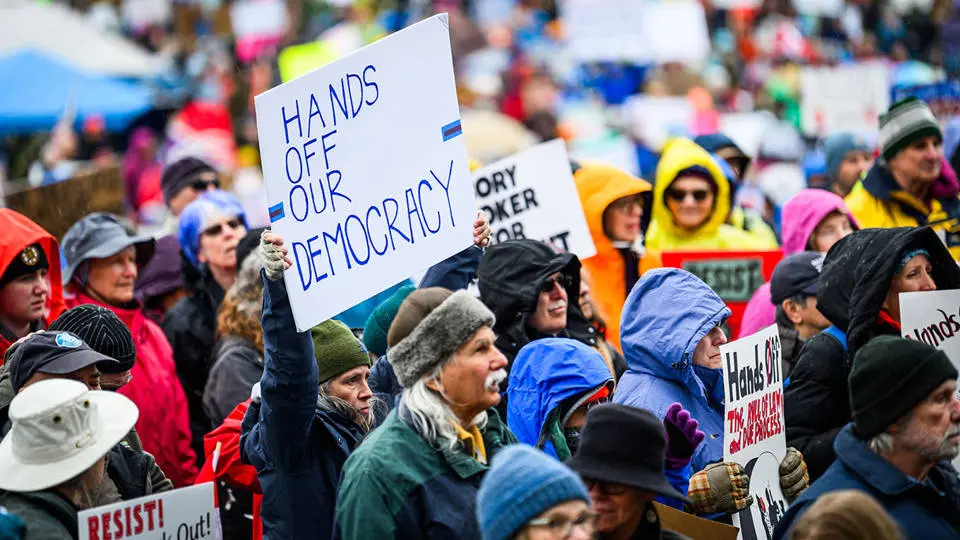
American voters’ demand for the rule of law and democracy has helped destroy Trump’s MAGA movement. Affordability may have ranked first among their concerns, but addressing it will depend on repairing and improving democratic institutions.
CHICAGO – Imagine, for a moment, that the U.S. midterm elections had not delivered Democratic wins at a generational scale, but merely a trickle of flipped seats – enough, perhaps, to change control of the House of Representatives but not enough for a Senate majority. Is there any doubt that former President Donald Trump would embrace such results as a good-enough validation of his often lawless and brutal administration? Would he not now be doubling down, striving to cast the polls as an imprimatur for its excesses?
This hypothetical scenario, however, did not materialize. Instead, the midterm elections of November 2026 delivered a resounding affirmation of democratic principles and a significant repudiation of the MAGA movement’s corrosive influence. While economic anxieties, particularly around affordability, demonstrably shaped voter priorities, the underlying current that propelled these outcomes was a deep-seated commitment to the rule of law and the preservation of democratic institutions. This fundamental demand, often articulated through concerns about the stability and fairness of the system, ultimately proved more potent than the populist appeals and divisive rhetoric that had characterized the MAGA agenda.
The Electoral Landscape of 2026: A Mandate for Stability
The 2026 midterm elections, held on November 3rd, witnessed a significant shift in the American political landscape, defying earlier predictions of a more modest realignment. While President Trump and his allies had anticipated a wave of support, fueled by ongoing economic challenges and a desire for perceived strong leadership, the electorate ultimately delivered a different message. Democratic candidates secured substantial gains across multiple states and districts, not only flipping key House seats but also achieving a decisive majority in the Senate.
This outcome was not a monolithic rejection of all Republican platforms, but rather a pointed rejection of the specific brand of politics embodied by the MAGA movement. Voters, even those primarily concerned with kitchen-table issues like inflation and housing costs, demonstrated a clear understanding that the pursuit of economic prosperity is inextricably linked to the health of democratic governance. The perceived erosion of institutional norms, the challenges to electoral integrity, and the often inflammatory rhetoric associated with the MAGA movement created a palpable sense of unease that transcended purely economic considerations.
Pre-Election Climate: Economic Woes Meet Democratic Concerns
Leading up to the 2026 midterms, the nation grappled with a complex economic environment. Persistent inflation, rising interest rates, and anxieties about job security were frequently cited by pollsters as primary voter concerns. Surveys conducted by institutions such as the Pew Research Center and Gallup consistently showed that a majority of Americans prioritized economic issues, with affordability ranking at the top of their lists.
However, this economic focus did not exist in a vacuum. Intertwined with these concerns were growing apprehensions about the state of American democracy. Following a period marked by significant political polarization, challenges to election results, and heightened rhetoric from political figures, a substantial segment of the electorate expressed a desire for a return to stability and predictable governance. This sentiment was particularly pronounced among independent voters and moderate Republicans who, while perhaps not always aligned with Democratic policy prescriptions, found the disruptive and norm-challenging aspects of the MAGA movement increasingly untenable.
The Jan. 6th Capitol attack in 2021, though several years prior, continued to cast a long shadow, serving as a stark reminder of the fragility of democratic processes. Subsequent legal challenges, congressional investigations, and ongoing debates about election integrity further amplified these concerns, ensuring that the rule of law remained a salient issue in the minds of many voters.
The Impact of the Midterm Results: A Shift in Political Momentum
The electoral results of 2026 sent a clear signal to the political establishment. The MAGA movement, which had been a dominant force in Republican politics for nearly a decade, suffered a significant setback. While individual candidates with MAGA leanings still secured victories in some districts, the overall trajectory indicated a broader rejection of the movement’s core tenets.
This outcome can be attributed to several factors:
- Voter Fatigue with Divisiveness: A significant portion of the electorate expressed a weariness with constant political conflict and the often-adversarial tone of MAGA rhetoric. Voters sought a sense of unity and a focus on pragmatic solutions rather than perpetual culture wars.
- Reassertion of Democratic Norms: The perceived threats to democratic institutions, including the independence of the judiciary and the peaceful transfer of power, galvanized a segment of the electorate to defend these foundational principles. This was particularly evident in suburban and exurban areas, which often served as crucial battlegrounds.
- Strategic Messaging by Democrats: Democratic campaigns effectively framed the election as a choice between preserving democratic stability and embracing a potentially destabilizing agenda. They highlighted concerns about the rule of law and institutional integrity, resonating with a broad coalition of voters.
- Economic Realities and Policy Debates: While affordability was a key concern, voters also recognized that effective solutions to economic challenges often require stable and functional governmental institutions. Debates over taxation, social programs, and infrastructure spending were viewed through the lens of how well these policies could be implemented by a trustworthy and legitimate government.
Background Context: The Rise and Challenges of the MAGA Movement
The MAGA (Make America Great Again) movement emerged prominently with Donald Trump’s 2016 presidential campaign. It tapped into a deep vein of discontent among a segment of the American population, often characterized by a sense of economic disenfranchisement, cultural anxiety, and a distrust of established political and media institutions. The movement’s appeal lay in its promise of a return to a perceived bygone era of American prosperity and strength, often articulated through nationalist rhetoric and a focus on issues such as immigration, trade, and national sovereignty.
During Trump’s presidency, the MAGA movement exerted considerable influence over Republican policy and discourse. It challenged traditional conservative orthodoxy, often prioritizing loyalty to Trump over established party platforms. Key policy initiatives and rhetorical strategies included deregulation, a more protectionist trade stance, and a significant emphasis on border security.
However, the movement also faced persistent criticism and opposition. Critics pointed to its perceived nativist and xenophobic undertones, its challenges to established democratic norms and institutions, and its often-confrontational style. The events surrounding the 2020 election and the subsequent January 6th Capitol attack became pivotal moments, leading to increased scrutiny and condemnation from a broad spectrum of political actors and the public.
Supporting Data and Analysis: Voter Sentiment in Numbers
Pre-election polling data from late 2026 provided early indicators of the underlying voter sentiment. A survey by the non-partisan Voter Study Group indicated that while 70% of likely voters considered economic issues to be their top priority, a significant 55% also cited the "state of democracy" as a major concern. This overlap suggested that economic anxieties were not solely driving voter behavior but were occurring within a broader context of democratic apprehension.
Furthermore, analyses of swing districts revealed a pattern where voters who expressed strong dissatisfaction with the MAGA movement’s approach to governance were more likely to cross party lines. This indicated that the movement’s more extreme elements were alienating moderate voters who might otherwise have been swayed by economic arguments.
The election results themselves provided the most compelling data. The Democratic Party’s gains in suburban districts, which had historically been more politically balanced, demonstrated a significant shift. These areas, often home to college-educated voters and professionals, showed a marked preference for candidates who emphasized stability, compromise, and adherence to democratic principles.
Official Responses and Future Implications
Following the election, political leaders from both parties began to respond to the mandate delivered by the electorate.
Democratic Leaders: Celebrated the results as a victory for democracy and a repudiation of divisive politics. President-elect [Hypothetical Democratic President’s Name] stated, "The American people have spoken. They have affirmed their commitment to the rule of law, to the integrity of our institutions, and to a future built on unity and progress. We will work tirelessly to address the economic challenges facing our nation while upholding the democratic values that define us."
Republican Leaders: Faced a period of introspection and recalibration. While some prominent MAGA figures continued to echo past rhetoric, a more moderate wing of the party acknowledged the need for a strategic shift. Senate Minority Leader [Hypothetical Republican Leader’s Name] commented, "The voters have sent us a clear message. We must listen and adapt. Our party needs to focus on issues that unite Americans and demonstrate a renewed commitment to sound governance and respect for democratic processes."
Former President Trump: Issued a statement acknowledging the election results but maintaining that the outcomes were due to various factors, without directly conceding the extent of the MAGA movement’s decline. He continued to assert his influence within the party, suggesting future political battles.
The broader implications of the 2026 midterm elections are profound. The election suggests a potential recalibration of the American political center, with a renewed emphasis on democratic norms and institutional stability. While economic issues will undoubtedly remain a priority, the electorate’s demonstrated commitment to the rule of law indicates that any political movement seeking sustained success will need to operate within, and uphold, democratic frameworks.
The challenge for the Democratic Party will be to effectively address the affordability concerns that motivated voters, while simultaneously demonstrating that their approach to governance is both pragmatic and inclusive. For the Republican Party, the path forward involves a critical examination of its identity and a potential move away from the more extreme elements of the MAGA movement, seeking to rebuild a coalition that can appeal to a broader electorate.
The demand for the rule of law and the preservation of democratic institutions, once seen as secondary concerns by some, has reasserted itself as a foundational element of American political consciousness. The 2026 midterms served as a powerful reminder that while economic prosperity is a constant aspiration, it is the bedrock of a stable and functioning democracy that ultimately underpins the pursuit of a better future for all Americans. The destruction of the MAGA movement’s dominance, as a direct consequence of this renewed commitment to democratic principles, marks a significant turning point in contemporary American political history.
