

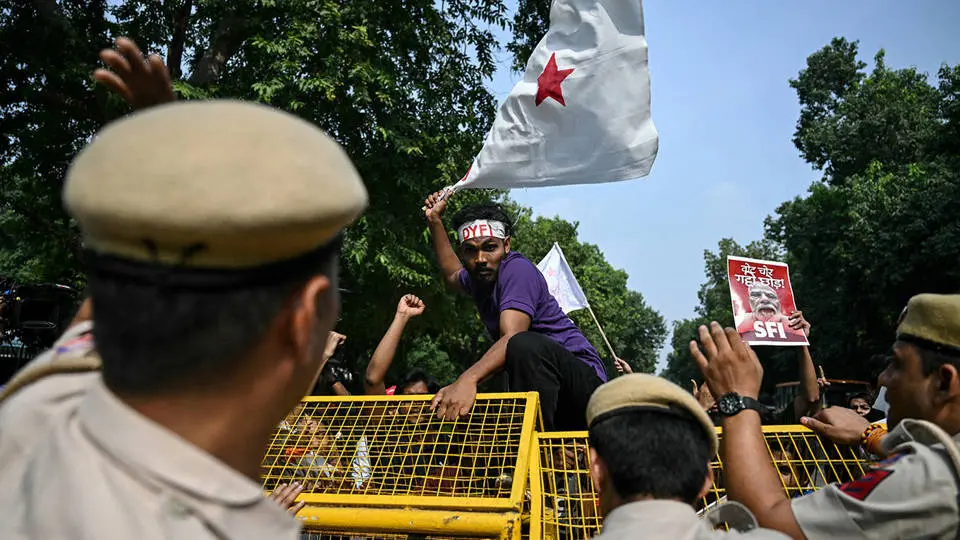
NEW DELHI – November 5, 2026 – India is grappling with a deepening political crisis following a controversial "special intensive revision" of electoral rolls that has reportedly removed 130 million voters, sparking widespread protests, particularly among the nation’s youth. The Election Commission of India (ECI) finds itself under intense scrutiny as the opposition, bolstered by a resurgent youth movement, demands accountability for what critics are calling mass disenfranchisement.
The current turmoil follows a summer of significant social unrest. In June and July, a nationwide youth-led movement advocating for comprehensive education reform dominated headlines and public discourse. This movement, initially fueled by widespread dissatisfaction with the existing educational framework and perceived government inaction, gained considerable momentum. Notably, it received tacit support from the Congress party, led by Rahul Gandhi, which has been seeking to capitalize on public discontent to reassert its political relevance. The pressure exerted by the protests was so substantial that the ruling Bharatiya Janata Party (BJP) government, under Prime Minister Narendra Modi, was compelled to offer concessions. The most significant of these was the resignation of Union Education Minister Dharmendra Pradhan in late August, a move widely seen as an attempt to de-escalate the situation and placate public anger.
However, the resolution of the education reform protests appears to have merely redirected the focus of public discontent. The electorate’s attention has now shifted decisively to the integrity of India’s democratic process, specifically the electoral system itself. The sheer scale of the voter deletion has ignited a firestorm, raising fundamental questions about the fairness and transparency of India’s elections.
The Unfolding Crisis: A Timeline of Disenfranchisement
The controversy began to surface in early September, following preliminary reports from regional election offices about an unusually high number of deletions from the voter lists. These reports, initially dismissed as administrative anomalies, soon coalesced into a nationwide concern.
- Late August – Early September 2026: Reports of significant voter deletions begin to emerge from various states, particularly those with large youth populations and a history of electoral contestation. Initial figures suggest a higher-than-usual attrition rate.
- Mid-September 2026: The Election Commission of India officially announces a "special intensive revision" of electoral rolls, citing the need to "cleanse" the voter database and ensure accuracy. The stated objective is to remove deceased individuals, those who have permanently shifted residence, and duplicate entries.
- Late September – Early October 2026: Independent researchers and civil society organizations begin to publish analyses of the revised rolls, raising alarm bells. These studies indicate that the deletions disproportionately affect young voters and marginalized communities. The figure of 130 million deleted voters begins to circulate widely.
- Mid-October 2026: Youth organizations, student unions, and civil society groups announce plans for nationwide protests. The narrative shifts from administrative correction to deliberate disenfranchisement.
- Late October – Early November 2026: Large-scale protests erupt in major cities, including New Delhi, Mumbai, Kolkata, and Bengaluru. Protesters chant slogans demanding the reinstatement of their voting rights and an investigation into the ECI’s actions. The Congress party and other opposition parties officially lend their support to the movement.
- November 3, 2026: The Election Commission of India issues a statement defending the revision process, reiterating that it was conducted in accordance with established legal procedures and aimed at enhancing electoral integrity. They attribute the high numbers to a comprehensive data-matching exercise.
- November 5, 2026: The protests continue unabated, with demonstrators vowing to escalate their actions if their demands are not met. The political opposition signals its intent to raise the issue in Parliament, threatening a deadlock.
The Scale of the Problem: Data and Discrepancies
The figure of 130 million voters removed from the rolls is staggering, representing a significant portion of India’s electorate. While India’s total electorate is estimated to be around 900 million, a deletion of this magnitude suggests a systemic issue rather than routine administrative housekeeping.
- Pre-Revision Electorate: Before the intensive revision, India’s electoral rolls were estimated to contain approximately 930 million registered voters.
- Post-Revision Electorate: Following the revision, the number has reportedly fallen to around 800 million, a reduction of roughly 14%.
- Demographic Impact: Preliminary analyses by groups like the Centre for the Study of Developing Societies (CSDS) suggest that approximately 60% of the deleted voters are between the ages of 18 and 35. This is a critical demographic, as young voters are often seen as a key indicator of future political trends and have been a focus of political parties seeking to expand their base.
- Geographic Concentration: Reports indicate that states with high youth populations and a history of political activism, such as Uttar Pradesh, Bihar, and Maharashtra, have witnessed a disproportionately higher number of deletions.
The Election Commission’s rationale for the revision cites the need to remove duplicates, deceased voters, and those who have moved. However, critics argue that the scale of the deletions, particularly among young and potentially mobile populations, suggests a flawed methodology or, at worst, a deliberate attempt to manipulate the electorate. The process typically involves physical verification and notifications to voters whose eligibility is in question. The speed and scope of this "special intensive revision" have led many to question whether these due process safeguards were adequately implemented.
Reactions and Repercussions: A United Front Against Disenfranchisement
The protests have seen an unprecedented convergence of various social and political forces. The youth movement, having successfully lobbied for education reform, has found a powerful new cause. Their energy and organizational capacity have been augmented by the support of established political entities.
Rahul Gandhi, a prominent leader of the Congress party, has been a vocal critic of the ECI’s actions. "This is not just an administrative error; it is an assault on democracy," Gandhi stated at a recent rally in Delhi. "The BJP government, fearing the voice of the people, is attempting to silence millions through this electoral manipulation. We stand with every young Indian whose right to vote has been snatched away."
The Congress party has vowed to make the electoral roll issue a central plank of its parliamentary agenda. Other opposition parties, including the Trinamool Congress, the Aam Aadmi Party, and various regional outfits, have also expressed solidarity with the protesters and condemned the ECI’s actions. This broad-based opposition presents a significant challenge to the ruling BJP.
Civil society organizations have been at the forefront of documenting the alleged irregularities. "We have received numerous testimonies from individuals who have been struck off the rolls despite being eligible and having voted in previous elections," said Priya Sharma, a spokesperson for the National Election Watch Foundation. "The ECI must provide a transparent and verifiable account of how these deletions were carried out and offer a swift mechanism for reinstatement."
The Election Commission’s Defense and the Path Forward
The Election Commission of India, in its official statement, has maintained that the revision process was conducted with utmost transparency and adherence to the Representation of the People Act, 1951. A senior ECI official, speaking on condition of anonymity, stated, "The revision was a comprehensive exercise to update the electoral roll, which is a continuous process. We have employed advanced data analytics and cross-referencing mechanisms to ensure accuracy. Any eligible voter who has been mistakenly removed can apply for re-enrolment, and their applications will be processed expeditiously."
However, the ECI’s assurances have done little to quell the rising tide of public anger and suspicion. The sheer magnitude of the deletions, coupled with the timing – just over a year before the next general election is scheduled – has fueled concerns about potential political motivations.
The immediate future hinges on the ECI’s willingness to address the concerns raised by the protesters and the opposition. Key demands include:
- A Full and Transparent Audit: An independent audit of the entire revision process to identify any procedural flaws or instances of bias.
- Immediate Reinstatement: A swift and efficient process to reinstate all eligible voters who were erroneously removed, without requiring them to undergo the full re-enrolment process if they can prove their previous eligibility.
- Accountability: An explanation from the Election Commission regarding the specific reasons for such a large-scale deletion and accountability for any lapses.
- Reforms: A commitment to electoral roll management reforms that ensure greater transparency and citizen participation in the future.
Broader Implications for Indian Democracy
The current electoral crisis has far-reaching implications for the health and stability of Indian democracy. If the perception of the ECI as an impartial arbiter of elections is eroded, it could have devastating consequences.
- Erosion of Trust: The trust deficit between citizens and electoral bodies is a serious threat. If a significant portion of the electorate believes their vote is not guaranteed, their engagement with the democratic process could wane, leading to lower turnout and increased cynicism.
- Political Polarization: The issue is already highly politicized. The opposition is leveraging it to mobilize support against the ruling party, potentially exacerbating existing political divisions.
- Legal and Constitutional Challenges: The ECI’s actions could face legal challenges, potentially leading to prolonged court battles that could further destabilize the political landscape.
- International Scrutiny: India’s democratic credentials are often held up as an example for developing nations. A crisis of this magnitude could attract unwanted international attention and raise questions about the robustness of its electoral system.
The coming weeks will be critical. The Election Commission must demonstrate a commitment to transparency and inclusivity to restore public confidence. The political opposition, while using the issue to its advantage, also bears a responsibility to ensure the focus remains on democratic principles rather than partisan gains. The millions of young Indians who have taken to the streets are demanding nothing less than the assurance that their voice, and their vote, truly matters in the world’s largest democracy. The resolution of this crisis will be a significant test of India’s democratic resilience.
