

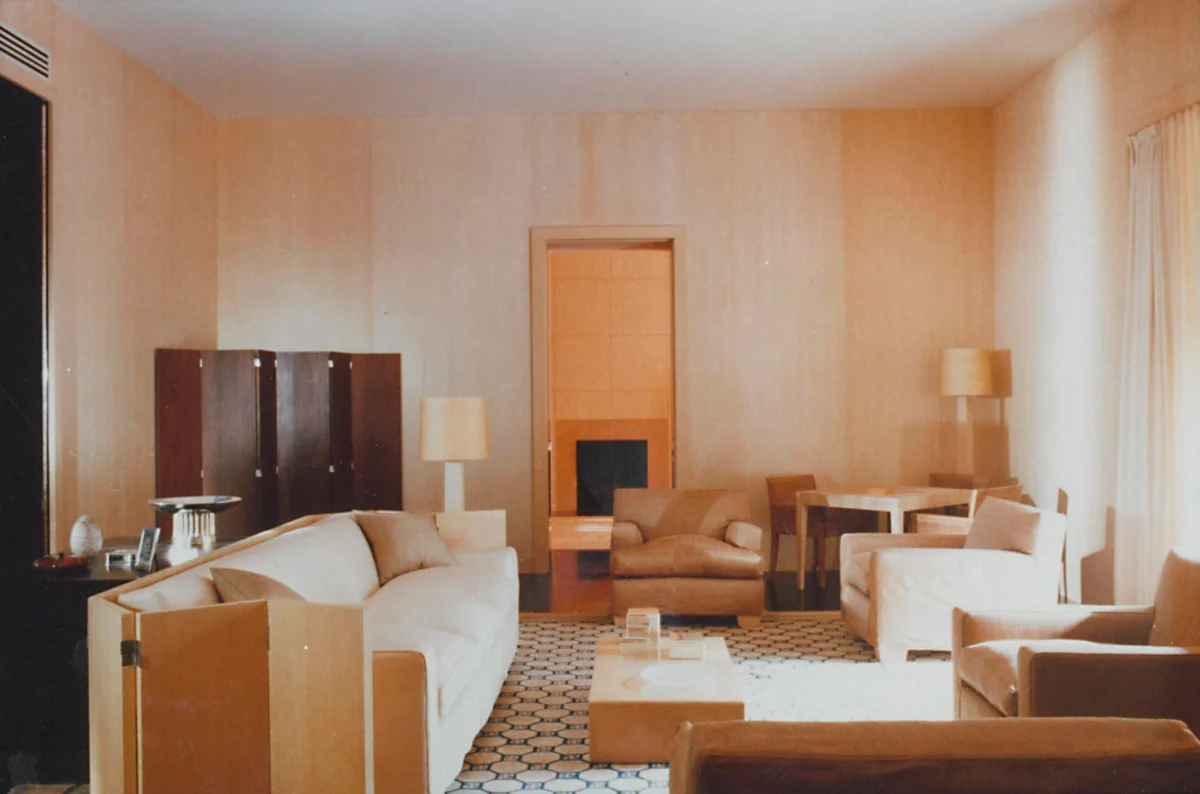
When the celebrated French poet and playwright Jean Cocteau visited the Left Bank apartment of Jean-Michel Frank in the early 1920s, his reaction was as sharp as it was memorable. Upon surveying the Parisian decorator’s living quarters, Cocteau remarked to his companions, “This fellow is charming. Very charming, really. What a shame he’s been burglarized.” This playful critique was not directed at a lack of hospitality, but rather at the jarring, radical emptiness of Frank’s home. The space was stripped of the heavy moldings, ornate artworks, and cluttered furniture that defined the era’s bourgeois tastes. It was a look that the novelist François Mauriac would later famously describe as the “strange luxury of nothingness.”
Jean-Michel Frank, a figure who would become the "It" decorator of the interwar period, was not merely removing items; he was redefining the very concept of luxury. His work represented a pivotal shift in interior design, moving away from the excessive ornamentation of the 19th century toward a refined, cerebral minimalism. Central to this aesthetic was a piece of furniture that has since become an icon of 20th-century design: the upholstered back armchair. Conceived in 1923, this chair serves as a masterclass in the power of restraint, proving that a design can be nearly invisible and yet remain profoundly influential for over a century.
The Architect of Absence: Jean-Michel Frank’s Design Philosophy
Jean-Michel Frank’s rise to prominence in the 1920s and 30s coincided with a period of intense artistic experimentation in Paris. While the Art Deco movement was characterized by exotic woods, lacquers, and intricate patterns, Frank pursued a different path. He sought a "purity of line" that bordered on the monastic. His philosophy was rooted in the idea that a room should provide a sense of calm and clarity, achieved through the careful selection of high-quality materials and the elimination of the unnecessary.
Born in 1895 into a wealthy family, Frank’s life was marked by both immense privilege and profound tragedy, including the loss of his brothers in World War I and the suicide of his father. Some design historians suggest that his preference for stark, minimalist spaces was a psychological response to a world he found chaotic and overwhelming. By stripping a room to its essentials, he created a controlled, serene environment.
Frank’s approach was often a radical interpretation of classical forms. His work is frequently cited as an extreme evolution of the Louis XVI style, which had seen a resurgence in the early 20th century. Where Louis XVI furniture utilized straight lines and neoclassical symmetry to replace the rococo curves of the previous era, Frank took those lines to their logical conclusion, removing all decorative carvings and gilt until only the geometric essence remained.

Anatomy of a Classic: The 1923 Upholstered Back Armchair
The upholstered back armchair, designed in 1923, stands as one of Frank’s earliest and most enduring contributions to the decorative arts. Produced by his primary collaborator, the master cabinetmaker Adolphe Chanaux, the chair is defined by its "blocky" silhouette. It features a low-slung, sturdy frame with distinctive beveled feet that give the piece a subtle lift without compromising its grounded appearance.
The brilliance of the design lies in its versatility. While the form is rigid and geometric, the choice of upholstery transforms its character. Frank originally utilized a range of luxurious yet tactile materials, including oak for the frame and sheaths of shearling, leather, or heavy wool. In the salons of the Parisian elite, these chairs were often covered in vellum or straw marquetry—a technique Frank popularized, which used humble materials to create a surface of shimmering, sophisticated texture.
Despite its solid construction, the chair possesses a "chameleon-like" quality. In a crowded room, it recedes into the background; in a minimalist space, its proportions become a focal point of architectural balance. It is this ability to "practically disappear" that has made it a favorite among collectors and designers who value subtlety over spectacle.
A Legacy of High-Profile Commissions
The success of the upholstered back armchair was bolstered by its presence in some of the most influential interiors of the 20th century. Frank was the decorator of choice for a daring, cosmopolitan clientele that included both European aristocrats and American industrial scions.
One of his most significant commissions was for the Paris salon of Charles and Marie-Laure de Noailles. The Noailles were legendary patrons of the avant-garde, supporting artists like Salvador Dalí and filmmakers like Luis Buñuel. For their home, Frank created an environment that was both a gallery for modern art and a testament to his minimalist vision. The upholstered back armchair provided the necessary comfort for intellectual discourse without distracting from the couple’s radical art collection.
Across the Atlantic, the chair found its way into the San Francisco penthouse of Charles Templeton Crocker, an American scion and prominent figure in the California social scene. Circa 1929, Frank’s designs for Crocker demonstrated that the "luxury of nothingness" had global appeal, transcending the borders of Parisian high society to influence the burgeoning modernism of the United States.

The Chronology of Rebirth: Ecart and the Putman Legacy
The continued availability and relevance of Jean-Michel Frank’s work are largely due to the efforts of Andrée Putman, the "grande dame" of French design. In 1978, Putman founded Ecart International with the specific mission of reissuing forgotten furniture designs from the 1920s and 30s. At the time, Frank’s work had fallen somewhat out of fashion, overshadowed by the mid-century modern movement and the flamboyant styles of the 1960s.
Putman recognized that Frank’s pieces were not merely historical artifacts but essential tools for contemporary living. By re-releasing the upholstered back armchair and other Frank staples, Ecart allowed a new generation of designers to incorporate his "strange luxury" into modern projects.
In 2024, the torch was passed to the acclaimed AD100 interior designer Pierre Yovanovitch, who acquired Ecart. Yovanovitch, known for his own masterful blend of high art and refined furniture, has expressed a deep reverence for Frank’s "sharp" style. According to Yovanovitch, the enduring appeal of the chair lies in its lack of a specific "period" look. “The style is so sharp—at the end there’s actually no style, which is what makes it so timeless,” Yovanovitch noted. This month, Ecart’s new Paris gallery is set to showcase a suite of important Frank designs, placing the 1923 armchair at the center of the exhibition. Yovanovitch reports that the piece continues to captivate passersby: “Every time we put one in the window people stop, come in, and say, ‘What is that?’”
Contemporary Perspectives: The "GOAT" of Chairs
The professional interior design community remains enamored with the upholstered back armchair, citing its perfect marriage of form and function. Neal Beckstedt, a prominent AD100 designer, recently integrated a pair of the chairs into his Sag Harbor beach house. His approach demonstrates the chair’s adaptability; rather than the formal vellum or leather of the 1920s, Beckstedt wrapped the pieces in a casual blue linen.
“On a comfort scale of 1 to 10, it’s a 20,” Beckstedt remarked, emphasizing that the chair’s blocky appearance belies an ergonomic excellence. “Perfect proportions; perfect comfort—it’s the GOAT [Greatest of All Time] of chairs.”
This sentiment is echoed by market data. Original Jean-Michel Frank pieces are among the most sought-after items at major auction houses like Sotheby’s and Christie’s. In recent years, authentic Frank furniture has seen a significant appreciation in value, with individual chairs often fetching six-figure sums. The market’s appetite for Frank reflects a broader trend toward "quiet luxury"—a preference for items that signal status through craftsmanship and history rather than logos or ostentatious display.

Broader Impact and Implications for Modern Design
The legacy of Jean-Michel Frank and his 1923 armchair extends far beyond the confines of luxury penthouses. His work laid the groundwork for the minimalist movements that would follow in the latter half of the 20th century. The idea that a space can be "luxurious" through the absence of clutter is now a fundamental tenet of modern architecture and interior design.
Furthermore, the collaboration between Frank and Chanaux established a model for the designer-craftsman relationship that remains the gold standard in the high-end furniture industry. The emphasis on material honesty—letting the grain of the oak or the texture of the shearling speak for itself—prefigured the sustainable and "natural" design trends prevalent today.
As Ecart prepares its new showcase in Paris, the upholstered back armchair stands as a reminder that true design excellence does not shout for attention. In a world increasingly saturated with visual noise, the "strange luxury of nothingness" offers a compelling alternative. Jean-Michel Frank’s "burglarized" apartment was not a place of loss, but a place of profound discovery—a discovery that continues to resonate in the homes of the 21st century. Through the stewardship of designers like Yovanovitch and the enduring praise of practitioners like Beckstedt, the 1923 armchair remains a cornerstone of the decorative arts, proving that the most powerful statement a designer can make is often found in what they choose to leave out.
