

In the traditional landscape of real estate investment, high capital requirements have long functioned as a significant barrier to entry, often preventing retail investors from achieving the level of diversification necessary to mitigate systemic risk. For decades, the standard path toward property ownership—whether through direct acquisition or participation in private equity syndications—demanded minimum outlays ranging from $50,000 to $100,000 per deal. This concentration of capital into a limited number of assets creates a high-stakes environment where the failure of a single property can jeopardize an entire portfolio. However, a shifting paradigm in the industry, characterized by the rise of co-investing clubs and fractional ownership, is allowing investors to apply the principles of modern portfolio theory to real estate, spreading risk across a broader "returns bell curve."
The fundamental challenge of high-minimum investments is the inherent lack of variety they impose on a portfolio. An investor with $200,000 in liquidity might only be able to participate in two or three major deals if the entry point is $75,000 per asset. In contrast, by utilizing co-investing structures that allow for contributions as low as $2,500 to $5,000, that same capital can be distributed across 40 to 80 different projects. This approach transforms real estate from a series of "all-or-nothing" bets into a statistical exercise in averaging, mirroring the methodology used by institutional stock market investors.
The Statistical Reality of the Returns Bell Curve
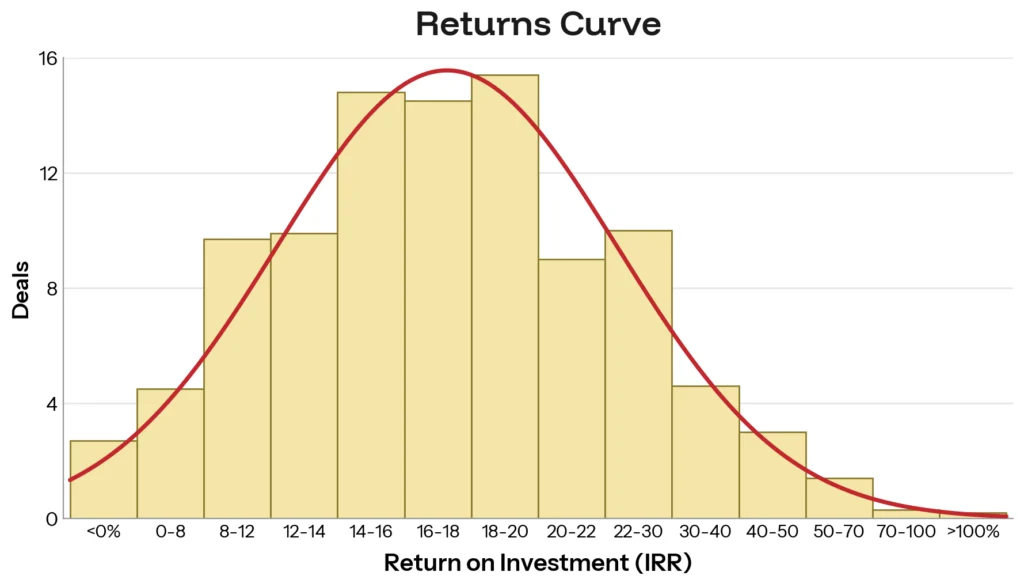
Investment performance is rarely uniform; rather, it typically follows a normal distribution, or a bell curve. In any sufficiently large portfolio of private real estate deals, a small percentage of assets will significantly underperform, a small percentage will provide "home run" returns, and the vast majority will cluster around the mean.
Data from long-term passive real estate portfolios suggests that even with rigorous due diligence, external factors—such as localized economic downturns, interest rate fluctuations, or management failures—can lead to underperformance. For instance, in a tracked sample of 54 passive investments, approximately 7% (four deals) were reported to have underperformed significantly. However, when these losses are contextualized within a diversified portfolio, the impact is minimized. The average annual return for such a diversified group of private real estate holdings often hovers around 16.39%, inclusive of both realized gains from completed cycles and projected returns from ongoing operations.
This statistical smoothing is a hallmark of successful risk management. By reducing the per-deal investment size, the psychological and financial burden of a "sideways" deal is mitigated. The objective is not to achieve a perfect record of success across all assets—an impossible feat in any market—but to ensure that the aggregate performance of the portfolio remains robust, driven by the law of averages.
Diversification Across Multiple Strategic Axes
True diversification in real estate requires more than just owning multiple properties; it necessitates exposure across several distinct axes: asset class, geography, capital structure, and time.
Property Type and Asset Class
The real estate market is not a monolith. Different sectors respond differently to economic stimuli. For example, while multifamily housing often remains resilient during economic contractions due to the fundamental need for shelter, industrial real estate has seen a surge driven by the growth of e-commerce and logistics. A sophisticated portfolio might include interests in thousands of multifamily units, but it should also balance those with exposure to retail centers, raw land developments, mobile home parks, single-family rental (SFR) portfolios, and hospitality assets.
Geographic Distribution
Economic health can vary wildly from one municipality to another. By spreading investments across various states and even international borders (such as Canada), investors protect themselves against localized regulatory changes, natural disasters, or regional industry collapses. This geographic spread ensures that a downturn in the Sun Belt, for instance, might be offset by stability or growth in the Midwest or the Pacific Northwest.
Equity vs. Debt Positions
Risk can further be managed by diversifying the position in the capital stack. While equity investments offer higher upside through profit-sharing and appreciation, debt investments—such as secured notes—provide fixed income and a higher level of security. Recent market data shows that private notes, often secured by real property at conservative Loan-to-Value (LTV) ratios of 55% or lower, can yield fixed interest rates of 14% to 15%. These debt positions provide a "floor" to the portfolio, ensuring cash flow even when equity markets are volatile.

Time Horizons and Liquidity
One of the primary criticisms of real estate is its illiquidity. Most syndications require a commitment of five to seven years. However, by staggering investments over time, an investor can create a "ladder" of exits. Short-term debt instruments with 12-month terms can be paired with long-term value-add equity plays. This ensures a steady stream of returning capital, preventing a situation where all liquidity is locked away simultaneously.
Tax Efficiency and the "Lazy 1031 Exchange"
A significant advantage of the diversified, high-frequency investment model is the ability to optimize tax liabilities. Real estate is unique in its ability to generate paper losses through depreciation—often ranging from 65% to 80% of the invested capital in the first year through cost segregation and bonus depreciation.
Investors can utilize a strategy colloquially known as the "Lazy 1031 Exchange." In a traditional 1031 exchange, an investor must reinvest proceeds from a sale into a "like-kind" property within strict timeframes to defer capital gains taxes. In a diversified passive portfolio, the same effect is achieved by timing. As older investments go "full cycle" and trigger taxable gains, the investor places capital into new deals within the same calendar year. The high depreciation write-offs from the new investments help offset the gains from the old ones, effectively shielding the investor’s wealth from immediate taxation and allowing for the compounding of returns.
Comparative Analysis: Real Estate vs. Traditional Markets
To understand the value of a diversified real estate strategy, one must compare it to the broader financial markets. The S&P 500 is often cited as the benchmark for wealth creation, with an average annual return of approximately 10% over the long term. However, the stock market is prone to high volatility; in any given year, a significant portion of the companies within the index may lose money.
Real estate, particularly when accessed through private partnerships, often displays a low correlation with the stock market. Unlike Real Estate Investment Trusts (REITs), which are traded on public exchanges and often move in tandem with broader market sentiment, private equity real estate is valued based on the underlying asset’s performance and local market conditions.
Furthermore, real estate serves as a more effective substitute for bonds in a modern portfolio. Traditionally, bonds were used to provide income, reduce volatility, and offer recession resilience. However, in inflationary environments, the fixed returns of bonds are often eroded, and their market value drops when interest rates rise—as seen during the aggressive rate hikes of 2022 and 2023. Real estate provides the same income and stability benefits but includes an inherent inflation hedge, as property values and rents typically rise alongside consumer prices.
Implications for the Modern Investor
The transition from active property management to a diversified passive model represents a significant shift in the philosophy of wealth building. For many years, the "millionaire next door" was an active landlord who managed a handful of local properties. While effective, this model is labor-intensive and carries high concentrated risk.
The democratization of real estate through co-investing clubs and lower-minimum syndications allows for a "slow-and-steady" approach known as dollar-cost averaging. By investing a set amount every month into new deals, investors remove the emotional component of "timing the market." This disciplined approach focuses on "time in the market," ensuring that the investor captures the growth of the asset class while being protected by a wide net of diversified holdings.
Ultimately, the goal of spreading risk across the returns bell curve is to achieve financial freedom without the "sleepless nights" associated with high-stakes, concentrated bets. As the industry continues to evolve, the ability to build a sophisticated, institutional-grade real estate portfolio with relatively small incremental investments is likely to become the preferred path for the next generation of wealth seekers. By embracing the law of averages and diversifying across every possible axis, investors can secure above-average returns while insulating themselves from the inevitable outliers of the market.
