

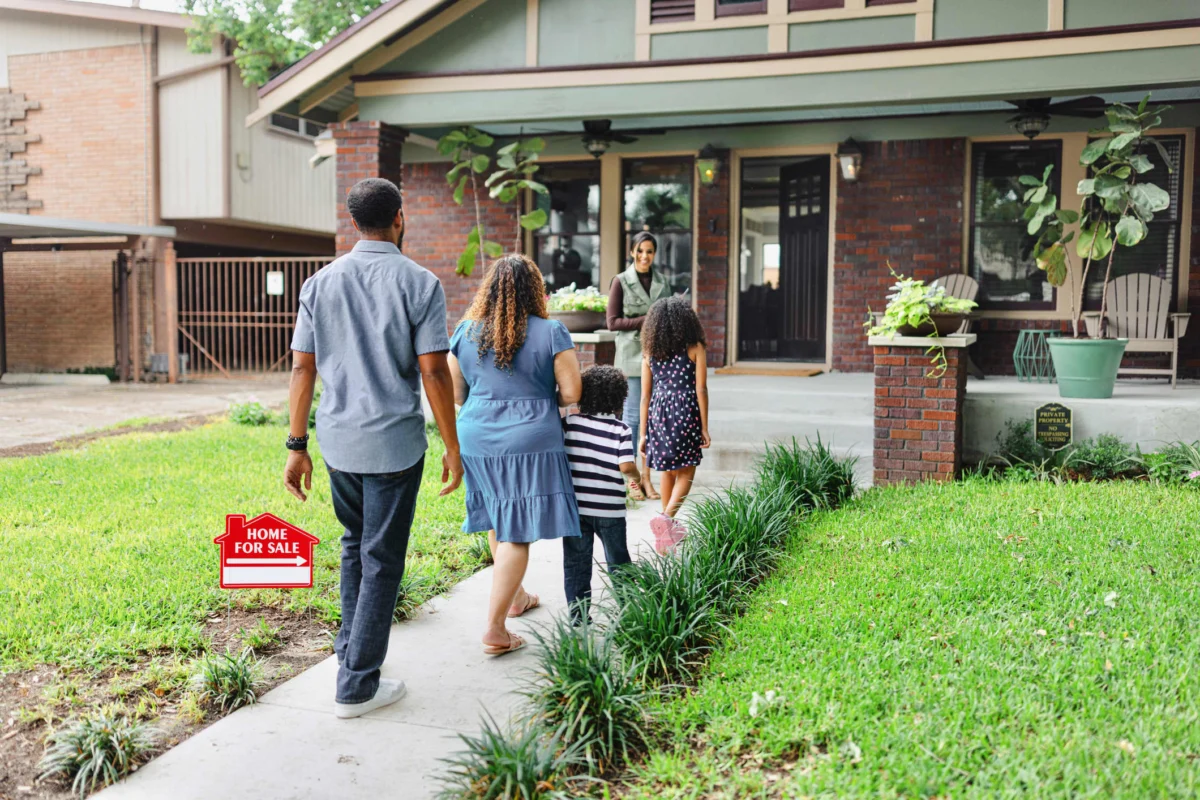
The United States housing market is exhibiting a stark divergence, with an increasing availability of lower-priced starter homes failing to translate into affordability for prospective buyers, while the luxury segment continues to thrive. This emerging "K-shaped" recovery in real estate underscores broader economic inequalities, with high mortgage rates, persistent inflation, and escalating everyday costs forming formidable barriers for first-time homeowners.
Recent data from real estate firm Zillow paints a challenging picture for those seeking entry into homeownership. In May, sales of starter homes – defined as properties within the lowest-priced third of the market – experienced a 5.4% year-over-year decline. This downturn occurred despite a 4.5% increase in their availability, indicating a significant disconnect between supply and effective demand. The typical value of a starter home nationally reached $202,000 in May, marking a 2.3% rise from the same month in 2025. While this growth rate is modest compared to the peaks of the pandemic-era boom, it continues to outpace wage growth for many potential buyers.
"Starter-home buyers have more choices, more price cuts, and less competition, which would typically signal a more favorable market," observed Kara Ng, a senior economist for Zillow and author of the report. "However, the unfortunate reason for that advantage is that starter-home buyers are either unwilling or unable to purchase a home. Even with subdued rent growth, inflation is eating into other parts of household budgets, making it harder to save for a down payment." This statement encapsulates the core dilemma: a theoretical improvement in inventory is nullified by an erosion of purchasing power.
The Ascent of the Luxury Segment
In stark contrast, the upper echelons of the housing market are experiencing robust growth. Sales of luxury homes – those representing the top 5% of values, typically worth about $1.9 million nationally – surged by 6.2% year-over-year in May, according to the same Zillow report. This segment’s resilience is largely attributed to factors inaccessible to the average starter-home buyer. High-net-worth individuals, often beneficiaries of a strong stock market, possess greater liquidity and less reliance on traditional mortgage financing.
"The pattern mirrors a broader economic divide," Ng noted in her report, "with stock market gains supporting demand at the high end while rising everyday costs weigh on potential starter-home buyers." This phenomenon reflects the ongoing "K-shaped economy," a term frequently employed by economists to describe the widening gap between higher-income households, who continue to experience robust wealth accumulation and spending, and lower- and middle-income consumers, who are increasingly burdened by the persistent cost of living crisis. While some economists have prematurely declared the "death" of the K-shaped recovery, the housing market’s current trajectory suggests its continued, and perhaps deepening, influence.
Mortgage Rates: The Unyielding Barrier
One of the most significant impediments to widespread homeownership remains elevated mortgage rates. While the frenetic pace of home price growth has moderated from the double-digit annual increases witnessed during the pandemic housing boom, the median price of an existing home still hit an all-time high of $440,600 in June, according to the National Association of Realtors (NAR). This figure represents a staggering 49.2% increase since June 2020 and a 1.8% rise from a year earlier, highlighting the entrenched nature of high property values.
Compounding this challenge are interest rates that have largely remained elevated. As of Wednesday, the average interest rate on a 30-year fixed-rate mortgage stood at 6.75%, according to Mortgage News Daily. These rates had briefly dipped below 6% in late February, offering a glimmer of hope, but geopolitical tensions, notably the onset of the Iran War, and the accompanying specter of rekindled inflation, swiftly pushed them higher. The Federal Reserve’s sustained efforts to combat inflation through monetary tightening have also played a pivotal role, anchoring interest rates at levels not seen consistently in over a decade.
"Buyers are also up against these nearly 7% mortgage rates currently, and can’t afford to buy at these high rates and high prices," explained Daryl Fairweather, chief economist for real estate company Redfin. The mathematical impact of these rates on monthly payments is substantial. For instance, a 6.75% rate on a $202,000 mortgage – the typical value of a starter home – translates to a monthly payment of approximately $1,310 for principal and interest alone, according to Bankrate’s mortgage calculator. If rates were to drop to 5%, that payment would fall to $1,084, and at 3% (a rate not seen since the pandemic lows), it would be a more manageable $852. This difference of hundreds of dollars per month can be the deciding factor for budget-constrained families.
"Hypothetically, if mortgage rates were to drop to, say, 5%, that would make buying a home much more affordable," Fairweather suggested. "You would see instantaneously an increase in sales and more people buying and then more people selling. But I think it’s pretty far-fetched at this point to rely on that happening. Interest rates are looking like they will be higher for longer." This sentiment reflects a growing consensus among economists that the era of ultra-low interest rates is unlikely to return in the near future, prolonging the affordability crisis for many.

Beyond Mortgage Rates: The Full Cost of Homeownership
The financial burden of homeownership extends far beyond the principal and interest of a mortgage. Property taxes and homeowner’s insurance, often bundled into a homebuyer’s monthly escrow payment, have also seen significant increases. According to Cotality, a property data and analytics firm, these costs have risen substantially since 2019, adding further strain to household budgets. In some regions, particularly those prone to natural disasters or experiencing rapid appreciation, insurance premiums have skyrocketed or become entirely unavailable through traditional channels, forcing homeowners into state-backed or more expensive options. These escalating ancillary costs contribute to a higher effective monthly payment, further eroding affordability even if home prices or mortgage rates were to stabilize.
The Enduring Supply-Demand Imbalance
While the immediate challenges for starter-home buyers stem from affordability, the underlying structural issue of a chronic housing shortage continues to exert upward pressure on prices across all segments. As of 2025, the U.S. faced a deficit of over 4 million homes, according to Realtor.com research. This gap is a legacy of underbuilding following the 2008 financial crisis, compounded by rising material and labor costs, restrictive zoning regulations, and supply chain disruptions during the pandemic.
Historically, the U.S. has built an average of 1.5 million homes per year to keep pace with population growth and demand. However, for many years post-2008, construction lagged significantly behind this benchmark. Even with recent increases in housing starts, the accumulated deficit will take years, if not decades, to resolve. This persistent shortage ensures that even if demand cools due to high rates, a fundamental lack of inventory will prevent significant price corrections in many desirable areas.
Policy Responses and Their Potential Impact
Acknowledging the severity of the housing crisis, policymakers have begun to enact measures aimed at increasing supply and improving access to financing. The bipartisan 21st Century ROAD to Housing Act, which became law in July, is one such legislative effort. This comprehensive act combines dozens of measures designed to encourage home construction, expand access to financing for a broader range of buyers, and restrict purchases by large institutional investors, who are often blamed for exacerbating competition and driving up prices in certain markets.
The act aims to streamline regulatory processes, provide incentives for developers to build more affordable housing units, and potentially expand down payment assistance programs. However, experts caution that the benefits of such legislation will likely take considerable time to materialize. Given the scale of the housing shortage and the inherent complexities of construction and urban planning, a rapid reversal of the current trends is improbable. The effectiveness of the act will also depend on its implementation at the state and local levels, where many zoning and permitting decisions are made.
Generational Trade-offs and Future Outlook
The current housing market dynamics present significant dilemmas, particularly for younger generations attempting to establish financial stability. "One of the dilemmas for young people is that they kind of have to choose: Do they want to live somewhere that has the best job opportunities, or do they want to live where homeownership will be much easier to access at a younger age, but they might not earn as much over their lifetime because of that choice," Fairweather articulated. This trade-off between economic opportunity and affordable living underscores a deepening generational divide, impacting career trajectories, family formation, and long-term wealth accumulation.
For those unable to afford homeownership, the alternative is often renting, where prices have also seen substantial increases in recent years, albeit with some recent moderation. This means that saving for a down payment becomes even more challenging, creating a vicious cycle of delayed homeownership or perpetual renting. The broader implications of this K-shaped housing market extend to economic mobility, social equity, and regional development, potentially exacerbating wealth disparities and concentrating economic power in fewer hands.
Looking ahead, the trajectory of the housing market will largely depend on the interplay of several key factors: the Federal Reserve’s monetary policy and its impact on mortgage rates, the rate of inflation and its effect on household budgets, and the effectiveness of legislative efforts to boost housing supply. While the market may see continued moderation in price growth for existing homes, a significant decrease in prices appears unlikely given the persistent supply deficit. For starter-home buyers, the path to homeownership remains steep, requiring a combination of economic stability, disciplined saving, and potentially, a more favorable turn in the broader economic environment than is currently anticipated.
