

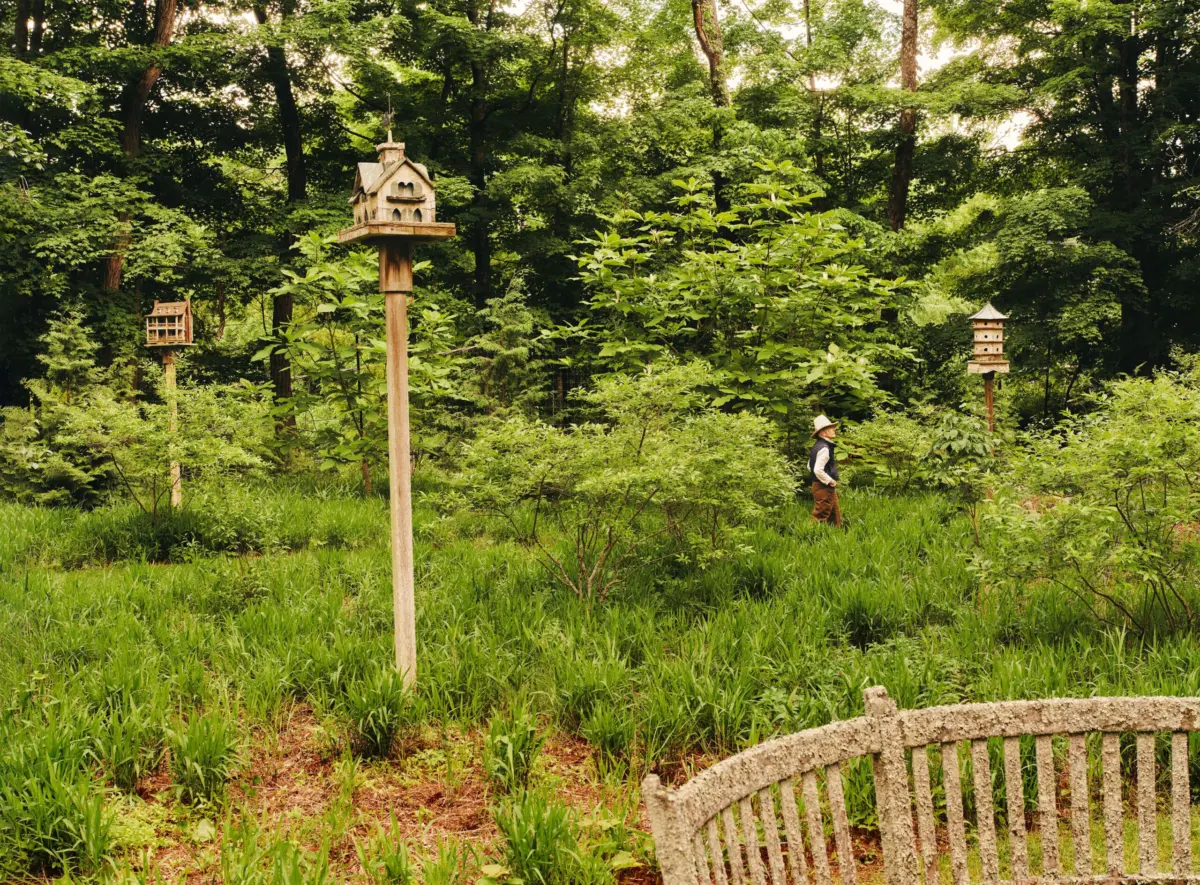
In the quiet enclave of Falls Village, Connecticut, at the edge of a storied country garden belonging to AD100 Hall of Fame interior designer Bunny Williams, exists a unique architectural phenomenon. It is a settlement comprising 17 distinct structures, each elevated on its own post and finished with meticulous detail. The collection includes a church with a sensible tin roof, a thatched cottage, a pagoda, a red general store flying a miniature flag, and a Russian dacha-style residence with shutters and a weather vane. Despite their architectural complexity, these buildings are not intended for human habitation; they form an avian hamlet, a miniature town assembled over decades through a blend of serendipitous discovery and intentional landscape design.

The collection serves as a testament to the intersection of American folk art, historical preservation, and horticultural stewardship. Williams, along with her husband, the noted antiques dealer John Rosselli, spent years scouring fields and fairs to stock their influential New York City shop, Treillage. During these excursions, birdhouses frequently caught Williams’s eye. What began as a pair of curiosities eventually grew into a significant collection that sat in the hayloft of her barn for years before being integrated into the landscape. This integration was not the result of a master plan but rather an organic evolution, mirroring the way real-world towns grow through incremental additions.
A Chronology of Landscape Transformation
The transition of these objects from storage to the garden required a deliberate effort to reclaim a long-overlooked point of land on the Williams estate. This process was spearheaded by Williams and her head gardener, Robert Reimer. The project began with the removal of invasive plant species to liberate a stand of existing apple trees, which now serve as the backdrop for the miniature village.

To ensure the area was conducive to wildlife, the team planted bird-friendly scrub plants, oat grass, and fruit-bearing pawpaw trees. The installation of the birdhouses themselves was a feat of engineering and design. Williams commissioned uniform, tall posts to ensure the houses were positioned high enough to be viewed from below, creating a sense of stature. To protect the potential residents from predators, each post was wrapped with a metal band, a functional deterrent designed to prevent squirrels from climbing the structures.
This transformation highlights a shift from purely aesthetic gardening to ecological restoration. By selecting plant species that provide both cover and sustenance, Williams created a sanctuary that functions as both a gallery of folk art and a viable habitat for local bird populations.

The Golden Age of Avian Architecture: 1890–1930
While Williams’s collection was assembled based on visual appeal and "humor" rather than pedigree, research into the provenance of such objects reveals a significant chapter in American social history. According to Jacob Torkelson, an architectural historian and researcher at the University of Pennsylvania’s Stuart Weitzman School of Design, the period between 1890 and 1930 represents the "golden age" of the birdhouse.
During this era, birdhouses served both functional and whimsical purposes. The United States government, through various agricultural pattern books, actively encouraged farmers and landowners to install birdhouses. The rationale was biological: by attracting insect-eating birds, farmers could naturally reduce the need for pesticides. Simultaneously, the rise of mail-order catalogs brought architectural whimsy to the middle-class garden.

Torkelson’s research has identified several manufacturers and models that define this period. For instance, one of the houses in Williams’s collection has been traced to the E.F. Hodgson Company catalog. Known as the "six-room Bungalow Martin House," this model was a staple of the company’s offerings from approximately 1917 until its closure in 1944. These structures, Torkelson notes, act as mirrors to the human condition, reflecting the architectural trends and social values of the people who commissioned and built them.
Identifying the Artisans: From Folk Art to Signed Replicas
The makers of these birdhouses range from anonymous hobbyists to recognized masters of the craft. Williams describes many of her pieces as "folk art," noting that they were likely built by individuals having fun with unusual structures rather than attempting to create perfect replicas of famous landmarks like Monticello. The charm lies in the imperfections—the "gingerbread" scallops created by a hand saw or the unique application of a tin roof on a country church.

However, some pieces carry a more traceable lineage. Jim Sidon, founder of the Georgia-based company Sparrow 10:29, recognized the handiwork of his late friend, Larry Smith, in three of the houses in Williams’s collection. Smith, a North Georgia builder, was renowned for his ability to fashion charmingly detailed structures with metal roofs and rustic flourishes, such as double porches and columned porticos.
Unlike the anonymous builders of the past, contemporary artisans like Sidon bring a modern level of precision to the craft. Sidon’s work involves creating avian-sized replicas of actual historical buildings, such as a 1792 Federal-style mansion. He signs and numbers each piece, ensuring that future historians will not have to guess at their origins. This shift from anonymous folk art to signed architectural replicas marks the evolution of the birdhouse into a collectible art form.

Architectural Diversity and Design Elements
The 17 houses in the Falls Village collection represent a wide array of architectural styles, effectively serving as a miniature survey of design history. Among the notable structures are:
- The Gothic Revival Church: Featuring a brick chimney and an oversized cupola, this piece captures the solemnity of ecclesiastical architecture on a miniature scale.
- The Neoclassical Temple: A rare combination of a birdhouse and a feeder, this structure utilizes columns and a pediment to evoke the grandeur of ancient Greece and Rome.
- The Russian Dacha: With its shuttered windows and prominent weather vane, this house suggests the rustic summer retreats of the Russian countryside.
- The A-Frame and Bungalow: These structures reflect 20th-century residential trends, complete with decorative brackets and porch details.
The diversity of these styles within a single garden creates a sense of "garden follies"—architectural structures built primarily for decoration but which also suggest a deeper narrative of place and history.

Maintenance and the Philosophy of Ephemerality
Despite their intricate designs, the maintenance routine for the Falls Village hamlet is surprisingly minimal. Every few years, the houses are taken down to receive a coat of wood preservative before being returned to the elements. This practice aligns with the views of preservationists like Torkelson, who argues that birdhouses are inherently ephemeral objects.
"These houses were made to be ephemeral," Torkelson states. "They weren’t made to last forever, and they should absolutely be used." This philosophy highlights a tension in the world of antiques: the desire to preserve an object versus the recognition of its intended functional life. By allowing the houses to weather naturally while providing basic protection, Williams maintains the balance between art and utility.

Modern builders like Sidon have sought to extend this lifespan by using cedar exteriors and specialized sealants. His replicas are designed to withstand a decade of exposure with little more than a occasional rinsing with a garden hose.
Ecological Impact and Avian Behavior
A central question surrounding any birdhouse collection is whether the intended residents actually utilize the structures. Williams observes that while the birds in her garden seem to enjoy the "atmosphere" of the hamlet, they often prefer nesting in the surrounding trees. She likens the local bird population to a symphony orchestra, noting that they may view the dense collection of houses as a form of "suburbia" that they choose to bypass during the peak nesting season.

However, ornithological data suggests that these structures serve a vital role during the winter months. When temperatures drop, songbirds are known to crowd into birdhouses—sometimes two or three at a time—to share body heat and survive the night. Even if they are not used for raising broods in the spring, the houses provide essential thermal cover during the harsh Connecticut winters.
Williams’s approach to her residents is one of respectful distance. She has never climbed up to inspect the interiors of the houses, stating, "If they are nesting, I don’t want to bother them." This hands-off approach ensures that the hamlet remains a true sanctuary rather than a site of human interference.

Philanthropy and the Broader Impact
The birdhouse collection also intersects with Williams’s philanthropic efforts. In 2001, she cofounded "Trade Secrets," an annual garden fair in the Litchfield Hills. The event raises funds for Project SAGE (formerly Women’s Support Services), a non-profit agency providing support for victims of domestic violence.
It was at this fair that Williams encountered Jim Sidon and continued to expand her collection. The event has become a significant cultural moment in the region, drawing gardeners and collectors from across the country. By utilizing her platform and her personal garden as a source of inspiration, Williams has linked the private joy of collecting with the public necessity of community support.

The avian hamlet in Falls Village stands as a unique example of how personal passion can enrich a landscape. It is a collection that honors the craftsmanship of the past while providing a functional benefit to the environment. Through the work of historians, artisans, and gardeners, these miniature structures continue to tell a story of human ingenuity and our enduring desire to create a home—for ourselves and for the wildlife with which we share the land.
