

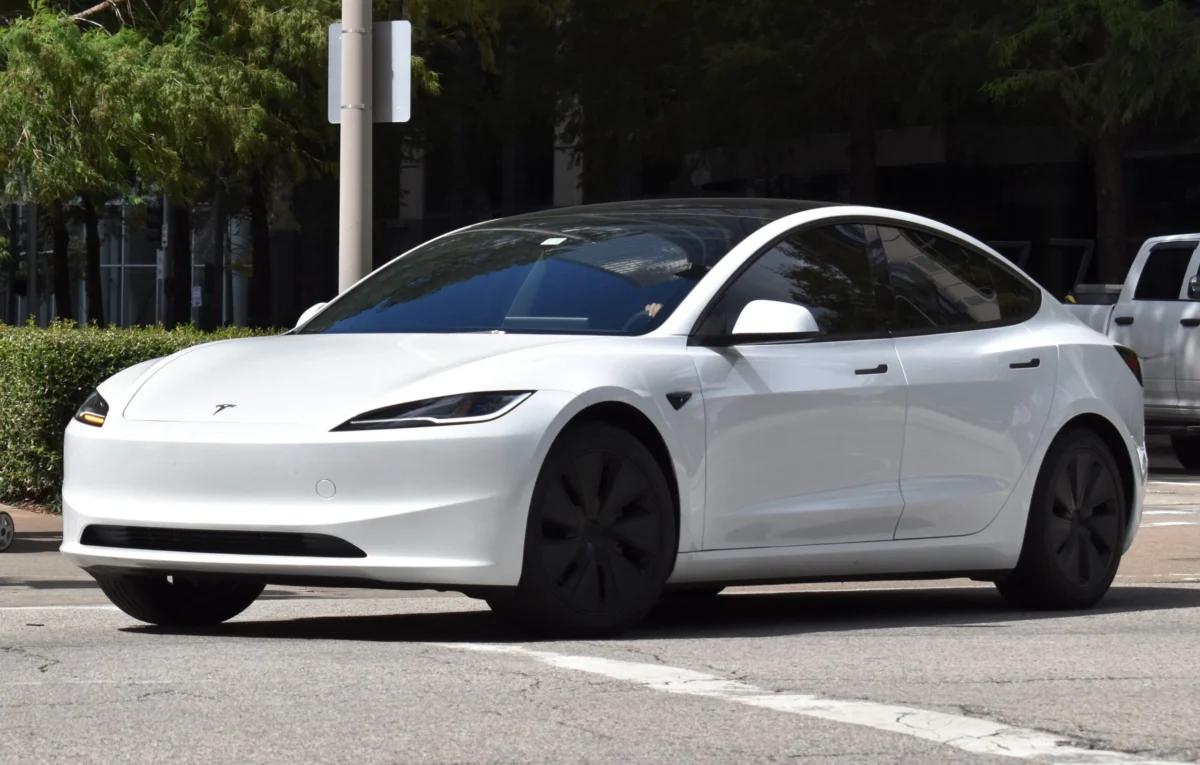
The landscape of automotive liability and the safety of semi-autonomous driving technology have come under renewed scrutiny following a fatal incident in Harris County, Texas, that claimed the life of a 76-year-old grandmother. Martha Avila was standing in the front room of her suburban residence last week when a Tesla Model 3, traveling at a reported speed of over 70 miles per hour, veered off the road and hurtled through the brick exterior of her home. The impact was catastrophic, resulting in Avila’s death and causing injuries to her son-in-law, Justin Barbour, who was also inside the property at the time of the collision.
The driver of the vehicle, 44-year-old Michael Butler, was not found to be under the influence of alcohol or controlled substances at the scene. According to reports from the Harris County Sheriff’s Office, Butler exhibited "no signs of intoxication" following the crash. However, the focus of the investigation shifted rapidly when Butler informed law enforcement that Tesla’s advanced driver assistance features were engaged at the time of the incident. This revelation has triggered a high-stakes legal battle and prompted multiple federal agencies to launch formal investigations into the role of Tesla’s "Full Self-Driving" (FSD) software in the tragedy.
Legal Allegations and the Theory of Defective Design
On Tuesday, lawyers representing Avila’s daughter and son-in-law filed a wrongful death and personal injury lawsuit in Harris County District Court. The suit names both Michael Butler and Tesla, Inc. as defendants. The central argument of the litigation posits that Tesla’s FSD (Supervised) technology was "defective in design and unreasonably dangerous."
The plaintiffs contend that the system, which is marketed as being capable of navigating city streets, stopping for traffic signals, and managing lane changes, fails to provide adequate safeguards to prevent the very types of high-speed erratic behavior witnessed in this incident. Ryan Zehl, the attorney representing the Avila family, stated that the family is "understandably devastated" and remains committed to determining the exact mechanics of the failure to prevent future tragedies.
The lawsuit underscores a growing legal debate regarding "automation bias"—a psychological phenomenon where drivers become overly reliant on automated systems, leading to a dangerous lapse in situational awareness. While Tesla explicitly states that FSD requires "active driver supervision" and that the driver must remain ready to intervene at any moment, critics argue that the marketing and the capabilities of the system lull users into a false sense of security.
The Technical Battle: Data Logs vs. Driver Testimony
Tesla has historically defended its technology by citing vehicle log data, which often points toward driver error rather than system failure. In response to the Texas crash, Tesla’s Vice President of AI Software, Ashok Elluswamy, took to the social media platform X to provide the company’s preliminary findings. Elluswamy asserted that Tesla’s data indicated Butler "manually overrode self-driving by pressing the accelerator all the way to 100 percent." He further claimed that the accelerator remained depressed even after the initial impact.
Tesla CEO Elon Musk echoed these sentiments, dismissing suggestions that the company’s technology played a role in the crash as "making no sense." This defense strategy—placing the onus entirely on the human operator—has been Tesla’s primary shield in previous litigation. By arguing that a manual override cancels out the autonomous system’s control, Tesla seeks to categorize these incidents as traditional driver-error accidents rather than product liability cases.
However, the legal threshold for liability is shifting. Plaintiffs’ attorneys argue that if a system is designed in a way that allows a driver to easily override safety protocols in a moment of confusion, or if the system’s interface contributes to that confusion, the manufacturer may still bear responsibility.
A History of Legal Precedent: The Florida Verdict
The Texas lawsuit arrives in the wake of a landmark legal decision in Florida that fundamentally altered the liability landscape for Tesla. Last year, a jury examined a 2019 crash involving a Tesla Model S using "Autopilot"—the predecessor and current baseline for FSD. In that case, the vehicle failed to detect the end of a T-shaped intersection, leading to a crash that killed 22-year-old Naibel Benavides Leon.
While the Florida jury found the driver mostly responsible for the crash, they reached a precedent-breaking conclusion: Tesla was found to be one-third responsible for the fatality. The jury determined that Tesla’s marketing and the operational nature of Autopilot contributed to the driver’s failure to intervene. The court awarded $200 million in punitive damages and $43 million in compensatory damages, a verdict that a judge upheld earlier this year.
This case was particularly notable for the transparency issues it highlighted. Tesla initially claimed it could not recover critical data from the crashed vehicle. It was only after the family’s legal team hired a specialized hacker that the data was retrieved, revealing that the car’s sensors had indeed failed to recognize the road’s end while the system was active. This history of data disputes adds a layer of complexity to the Texas case, as investigators will likely demand independent verification of the logs cited by Elluswamy and Musk.
Federal Oversight: NHTSA and NTSB Investigations
The gravity of the Texas incident has prompted immediate action from the nation’s top transportation safety regulators. The National Highway Traffic Safety Administration (NHTSA), which has the power to mandate vehicle recalls, confirmed this week that it has opened a formal investigation into the Harris County crash.
Simultaneously, the National Transportation Safety Board (NTSB) announced a joint probe with the Harris County Sheriff’s Office. Unlike the NHTSA, the NTSB does not have regulatory power but issues safety recommendations that carry significant weight in the industry and in the halls of Congress. Peter Knudson, a spokesperson for the NTSB, noted that the agency typically investigates accidents that have the potential to provide broader safety lessons for the public and the automotive industry.
These investigations are occurring against the backdrop of a massive, ongoing probe by NHTSA’s Office of Defects. That investigation was triggered by more than 40 reported incidents where Tesla’s FSD failed to adhere to traffic laws, including instances of running red lights and failing to stop at stop signs. The agency is specifically evaluating whether the software provides "prior warning or adequate time for the driver to respond to unexpected behavior."
In 2023, NHTSA pressure already led Tesla to issue an "over-the-air" software recall for Autopilot. The agency’s two-year investigation suggested that the system’s methods for ensuring driver engagement were insufficient, leading to "foreseeable misuse."
Chronology of the Texas Incident and Legal Aftermath
- The Incident: Last week, Michael Butler’s Tesla Model 3 crashes into Martha Avila’s home at 70+ mph.
- Immediate Response: Harris County Sheriff’s Office arrives; Butler is cleared of intoxication but claims FSD was active.
- The Lawsuit: Tuesday, Avila’s family files a suit in Harris County District Court alleging design defects.
- Tesla’s Rebuttal: Within 48 hours, Tesla executives claim data shows a 100% manual accelerator override.
- Federal Intervention: Wednesday, NTSB and NHTSA officially announce independent investigations into the crash.
The Psychology of Semi-Autonomous Driving
The Texas crash highlights the "human-in-the-loop" problem that plagues Level 2 and Level 3 autonomous systems. Under the Society of Automotive Engineers (SAE) definitions, Tesla’s FSD is considered Level 2, meaning the human must remain the primary driver. However, as the software becomes more capable, the human driver’s role shifts from "active operator" to "passive monitor."
Studies in human factors engineering suggest that humans are notoriously poor at monitoring automated systems for long periods. When a system performs correctly 99% of the time, the human brain tends to disengage. If the 1% failure occurs at high speed in a residential neighborhood, the time required for a human to "re-orient" to the driving task and take corrective action—such as braking—can be longer than the physics of the situation allow.
The Avila family’s lawsuit will likely lean heavily on this argument: that Tesla has created a product that exceeds human cognitive limits for supervision. If the court finds that the "manual override" cited by Tesla was a result of panic or confusion induced by the system’s own behavior, the company could face a liability judgment similar to the one in Florida.
Broader Implications for the Autonomous Industry
The outcome of the Texas lawsuit and the federal investigations could have far-reaching consequences for the entire autonomous vehicle (AV) sector. Companies like Waymo and Cruise, which operate fully driverless taxis (Level 4), are often grouped with Tesla in the public eye, despite using vastly different sensor suites (including Lidar and Radar) compared to Tesla’s "vision-only" camera approach.
A finding against Tesla in this case would likely lead to:
- Stricter Driver Monitoring Requirements: Regulators may mandate more intrusive infrared cameras to ensure eyes remain on the road.
- Standardized Data Transparency: Laws could be introduced requiring "black box" data from AVs to be immediately accessible to law enforcement and federal investigators without manufacturer gatekeeping.
- Redefining "Supervised" Marketing: The FTC could step in to regulate how "Full Self-Driving" is branded to prevent consumer misconception about the car’s actual capabilities.
As the legal proceedings move forward in Harris County, the automotive world remains focused on the balance between innovation and public safety. For the family of Martha Avila, the quest for answers is personal; for the rest of the world, it is a pivotal moment in determining who is truly in the driver’s seat of the future.
