

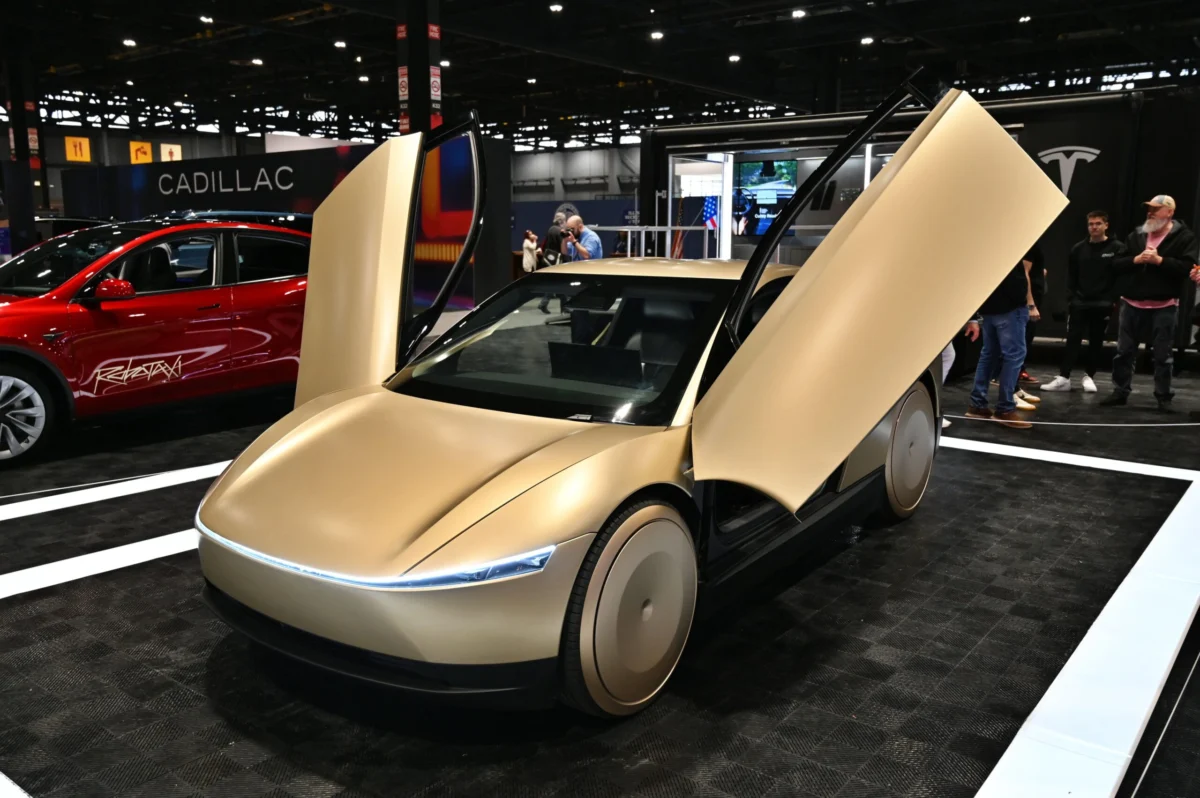
The landscape of American transportation reached a potential inflection point this Thursday as Tesla hosted a high-profile event at its global headquarters in Austin, Texas, to officially debut the Cybercab. A vehicle characterized by its matte gold finish, sloped aerodynamic profile, and the total absence of a steering wheel or pedals, the Cybercab represents the physical manifestation of CEO Elon Musk’s long-standing promise to transition Tesla from a traditional automotive manufacturer into a dominant force in artificial intelligence and autonomous robotics. The event serves as a formal introduction of the purpose-built robotaxi to Tesla’s burgeoning ride-hail platform, which has been operating under pilot conditions in select markets for over a year.
While the Cybercab was first glimpsed as a prototype during a 2024 event at the Warner Bros. studio lot in California, the Austin unveiling signals the start of a more aggressive operational phase. Data recently filed with Texas regulatory bodies reveals that Tesla has added 51 Cybercabs to its fleet of registered autonomous test vehicles in the state, joining a more robust contingent of 263 Model Y units. This expansion follows a pilot program that launched in Austin in the summer of 2025 and has since expanded to several metropolitan areas across Texas and Florida, with additional permits currently secured for future launches in Arizona and Nevada.
The Strategic Shift to Autonomy
For over a decade, Tesla’s valuation has been tethered to its ability to mass-produce electric vehicles (EVs). However, the introduction of the Cybercab underscores a fundamental shift in the company’s core business thesis. Musk has increasingly messaged to investors that the company’s future value lies not in the hardware of the cars themselves, but in the software that drives them. The goal is to create a "network of autonomy" where Tesla-owned Cybercabs and customer-owned vehicles operate in a seamless ride-sharing ecosystem.
Ashok Elluswamy, Tesla’s head of AI software, recently signaled the magnitude of this shift, stating on social media that the arrival of these vehicles would fundamentally alter the nature of urban streets. When questioned by the public regarding the density of the deployment, Musk confirmed that the intent is to "flood" markets like Austin with autonomous options. Despite this hyperbole, the company faces a complex path toward commercial viability, involving not just the perfection of AI, but the navigation of a fractured regulatory environment and the establishment of a massive logistical infrastructure.
A Chronology of Autonomous Development
The path to the Cybercab has been marked by ambitious timelines and significant technological pivots.
- 2016–2019: Tesla began promising that all vehicles produced would eventually be capable of full autonomy via over-the-air software updates.
- 2020–2023: The company rolled out "Full Self-Driving" (FSD) in beta to thousands of customers, though the system remained at Level 2 autonomy, requiring constant human supervision.
- October 2024: Tesla revealed the first Cybercab prototype in Los Angeles, showcasing a two-seater design without traditional controls.
- June 2025: Architectural permits filed in Texas revealed plans for a dedicated "robotaxi hub" at Giga Texas, featuring specialized infrastructure such as automated cleaning systems.
- June 2026: Tesla officially began testing the steering-wheel-free Cybercab on public roads in Austin, utilizing safety monitors in the passenger seats to oversee the AI’s performance in real-world traffic.
- Late 2026: The current debut marks the transition from experimental testing to a more formalized ride-hail service, with Musk maintaining that direct-to-consumer sales of the Cybercab could begin before the end of the year.
Technical Philosophy: The Camera-Only Approach
Central to the Cybercab’s design—and its controversy—is Tesla’s reliance on "vision-only" technology. Unlike its primary competitors, such as Alphabet-owned Waymo or GM’s Cruise, Tesla eschews the use of Lidar (Light Detection and Ranging) and radar. Instead, the Cybercab relies entirely on a suite of external cameras processed by Tesla’s proprietary AI inference computer.
This approach is driven by the desire to reduce manufacturing costs and simplify the hardware stack. Musk has argued that since humans drive using biological vision, a machine should be able to do the same with digital vision. However, this philosophy has drawn sharp criticism from industry peers. Waymo recently issued a public rebuttal to this logic, asserting that while cameras are powerful, they are insufficient for the redundancy required for safe Level 5 autonomy, particularly in adverse weather or complex lighting conditions. Waymo’s vehicles utilize a multi-modal sensor suite to ensure a "360-degree" safety net that does not rely on a single data source.
Operational Logistics and the "Utilization" Challenge
Beyond the software, the success of the Cybercab depends on what industry experts call "fleet utilization." J.D. Alexander, founder of AVFleetTech, notes that the economics of a robotaxi service are dictated by how many minutes per hour a vehicle is actually carrying a paying passenger. For a fleet to be profitable, the "down-time" for charging, cleaning, and maintenance must be minimized.
Tesla’s approach to these logistics differs significantly from its competitors. Companies like Waymo have opted for strategic partnerships to handle the "nitty-gritty" of fleet management. In various markets, Waymo partners with Avis for maintenance and storage, while Uber has aligned with Hertz for its autonomous ambitions. In contrast, Tesla appears to be pursuing a vertically integrated model.
Evidence of this "do-it-yourself" strategy surfaced in a 2025 Texas state architectural permit, which detailed a specialized hub designed to service robotaxis. This facility is expected to use a "cleaning robot" to sanitize vehicle interiors between rides, a necessity for a service that lacks a human driver to monitor the cabin’s condition. This automation is critical to Tesla’s goal of operating a low-overhead service that can undercut the pricing of traditional ride-hail giants like Uber and Lyft.
Regulatory Roadblocks and Safety Investigations
The rollout of the Cybercab is occurring under the watchful eye of federal and state regulators. In California, the San Francisco Bay Area—a traditional hub for autonomous testing—remains legally off-limits for Tesla’s driverless operations. The state’s Department of Motor Vehicles and Public Utilities Commission require rigorous data reporting and specific permits for driverless deployment, which Tesla has yet to secure for its steering-wheel-free models.
On a federal level, the National Highway Traffic Safety Administration (NHTSA) continues to investigate Tesla’s Full Self-Driving (Supervised) software. Following a series of crashes in 2024 involving the system, the NHTSA opened a probe into how the software handles low-visibility environments. Tesla’s manuals currently stipulate that FSD is a "supervised" system, meaning the human driver bears all legal responsibility. With the Cybercab, which has no steering wheel for a human to grab, the legal and safety liability shifts entirely to the software and the manufacturer, a transition that regulators are approaching with extreme caution.
Market Analysis and Future Implications
The financial implications of the Cybercab debut are significant for Tesla’s stock and its standing in the tech industry. Seth Goldstein, a senior equity analyst at Morningstar, suggests that while the physical production of the Cybercab is a milestone, the ultimate valuation of the project depends on the "safety-critical" nature of the software. "Ultimately, it only matters if the software can allow a car to navigate safely," Goldstein noted, highlighting that the hardware is secondary to the AI’s reliability.
If Tesla succeeds, the Cybercab could disrupt the $100 billion global ride-hailing market by removing the cost of the human driver, which typically accounts for the majority of a ride’s fare. Furthermore, Musk’s insistence on selling these vehicles to individuals by late 2026 suggests a future where private citizens could potentially "lease out" their autonomous Teslas to the fleet while they are at work or asleep, creating a passive income stream for owners and a decentralized fleet for Tesla.
However, the "flood" of Austin streets with gold, autonomous cars remains a test case. The industry is watching to see if Tesla’s vision-only AI can handle the "edge cases" of urban driving—such as unpredictable pedestrian behavior, complex construction zones, and sudden weather changes—without the expensive sensor arrays used by its rivals. As the Thursday event concludes and the 51 newly registered Cybercabs begin their work in the Texas heat, the reality of autonomous transport moves one step closer to a definitive proof of concept, or a cautionary tale of over-ambition.
