

One month after the initial eruption of heavy fighting between Sudan’s two primary military factions, the nation remains gripped by a devastating conflict that shows no signs of resolution despite international pressure. What began as a power struggle in the heart of the capital, Khartoum, has rapidly transformed into a nationwide humanitarian catastrophe, drawing in regional interests and threatening the very foundations of the Sudanese state. Despite high-level peace talks brokered by the United States and Saudi Arabia in Jeddah, the violence has not only persisted but intensified, spreading from the urban corridors of the capital to the historically volatile Darfur region and beyond.
The conflict, which pitted the Sudanese Armed Forces (SAF), led by General Abdel Fattah al-Burhan, against the paramilitary Rapid Support Forces (RSF), led by General Mohamed Hamdan Dagalo, known as Hemedti, has entered a period of grinding attrition. As of early May 2023, the International Rescue Committee (IRC) and various United Nations agencies have reported a staggering toll on the civilian population. Official figures suggest more than 600 individuals have been killed and over 5,000 injured, though medical professionals on the ground warn that the actual numbers are likely significantly higher due to the inability of emergency services to reach many areas under active bombardment.
A Month of Escalation: The Chronology of Conflict
The roots of the current violence are found in the fragile and ultimately failed transition to democracy following the 2019 ousting of longtime dictator Omar al-Bashir. While the SAF and RSF initially collaborated to remove Bashir and later to orchestrate a military coup in October 2021 against the civilian government of Abdalla Hamdok, the alliance was one of convenience rather than shared vision.
The timeline of the current escalation began in early April 2023, as tensions flared over the proposed integration of the RSF into the regular army—a key component of a framework agreement intended to return the country to civilian rule. The SAF insisted on a rapid two-year integration period, while the RSF demanded a ten-year timeline, seeking to preserve its autonomous command structure and vast economic interests.
On April 15, 2023, the tension broke into open warfare. Heavy gunfire and explosions were reported across Khartoum as both sides vied for control of the presidential palace, the state broadcaster, and the international airport. Within days, the conflict moved from the streets of the capital to the surrounding cities of Omdurman and Bahri, and soon after, reports of ethnic-based violence emerged from West Darfur, reminiscent of the genocidal conflict that plagued the region in the early 2000s.
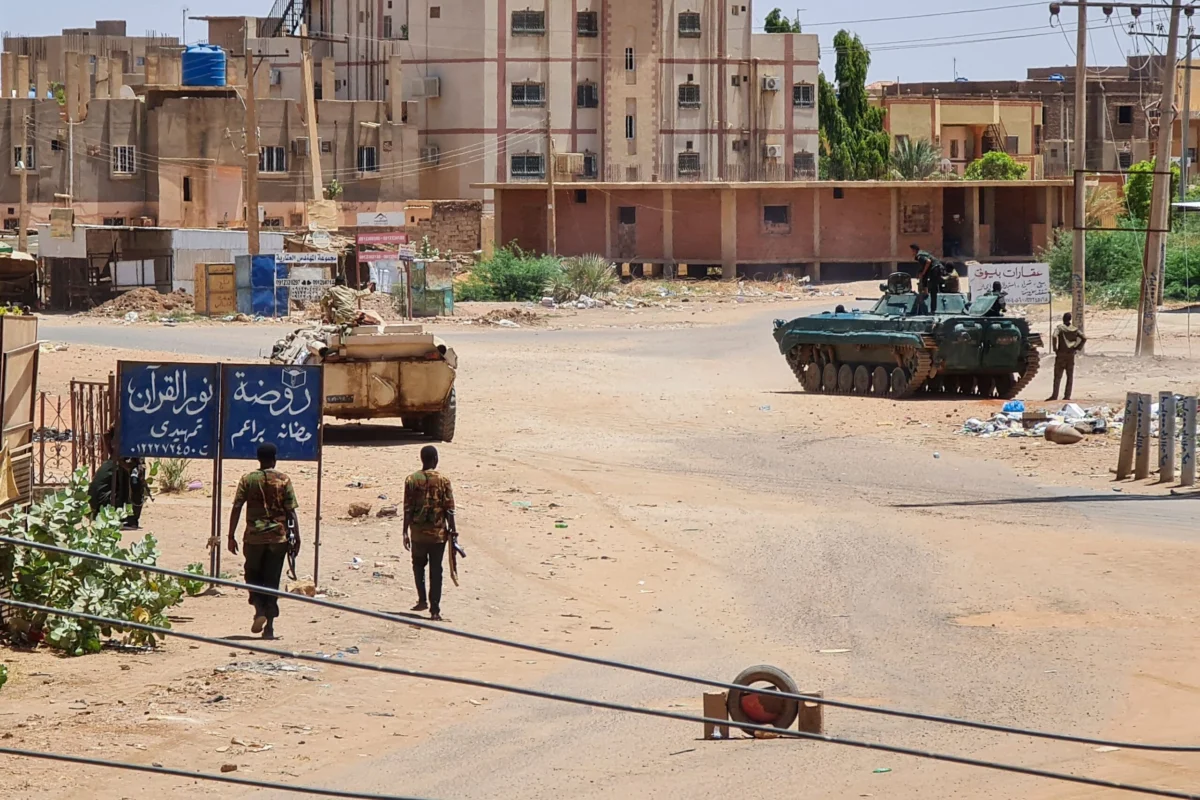
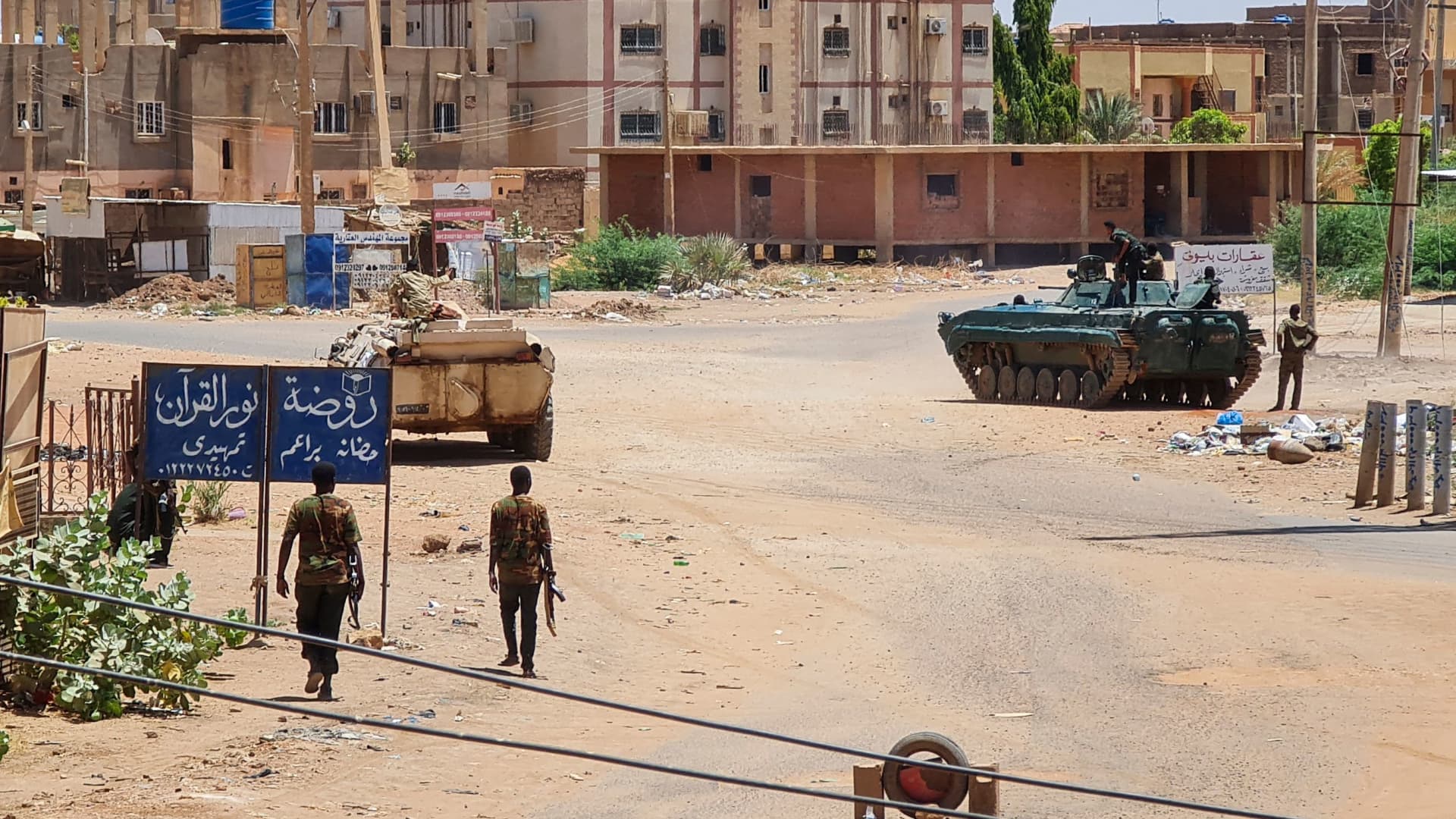
By early May, the situation had deteriorated into a full-scale humanitarian crisis. While the international community focused on the Jeddah talks, the reality on the ground was characterized by a series of violated ceasefires. On May 6, 2023, Sudanese Army soldiers were observed maneuvering armored vehicles through the streets of southern Khartoum, signaling a continued commitment to a military rather than a diplomatic solution.
The Humanitarian Crisis and Massive Displacement
The human cost of the month-long war is profound. According to the United Nations High Commissioner for Refugees (UNHCR), nearly one million people have been displaced within the first 30 days of fighting. This includes over 700,000 internally displaced persons (IDPs) and approximately 150,000 who have fled across borders into neighboring Egypt, Chad, South Sudan, and Ethiopia.
In Metema, Ethiopia, thousands of refugees have been documented waiting in long lines for registration with the International Organization for Migration (IOM). These refugees often arrive with little more than the clothes on their backs, having survived perilous journeys through active combat zones. The neighboring countries, many of which are already grappling with their own internal economic and security challenges, are now facing the strain of a massive influx of desperate people.
Within Sudan, the infrastructure of daily life has largely collapsed. The IRC has warned that the humanitarian situation is on a trajectory toward total breakdown. Approximately 70% of hospitals in conflict-affected areas are no longer functional, either due to being shelled, occupied by military forces, or running out of essential medical supplies and electricity. The price of basic commodities, including bread, water, and fuel, has tripled in many areas, while the banking system remains largely paralyzed, leaving even those with savings unable to purchase food.
Failed Diplomacy and the Jeddah Process
The international response has been centered on the "Jeddah talks," a joint initiative by Saudi Arabia and the United States. However, these negotiations have been criticized for their narrow focus and the absence of civilian representation. While the warring factions signed a "Declaration of Commitment to Protect the Civilians of Sudan" in mid-May, the agreement lacked a formal ceasefire mechanism and failed to stop the use of heavy artillery in densely populated neighborhoods.
The United Kingdom’s Minister for International Development and Africa, Andrew Mitchell, recently emphasized the need for a "united message of horror" from the international community to break the "cycle of impunity" in Sudan. Yet, many Sudanese activists and political analysts argue that the Jeddah process inadvertently legitimizes the two warring generals by treating them as the sole stakeholders in Sudan’s future.
Yassmin Abdel-Magied, a prominent Sudanese-Australian activist and writer, noted that the international community’s historical tendency to engage primarily with military leaders has marginalized the very civilian movements that led the 2019 revolution. She argues that without a substantial civilian voice and the threat of targeted international sanctions against the generals’ financial networks, the talks are unlikely to produce a sustainable peace.
Geopolitical Interests and External Influences
The conflict in Sudan is not happening in a vacuum. Both General al-Burhan and General Dagalo have cultivated deep ties with regional and global powers, complicating the prospects for a neutral intervention.
The SAF has traditionally maintained strong ties with Egypt, which views the Sudanese military as a bulwark of stability and a partner in managing the Nile water disputes. Conversely, the RSF has developed significant financial and military relationships with the United Arab Emirates (UAE) and has been linked to the Wagner Group, a Russian private military company, particularly regarding the lucrative gold mining industry in Darfur.
Saudi Arabia, while acting as a mediator, also has a vested interest in ensuring that the conflict does not spill over the Red Sea or lead to a permanent collapse of a state that sits on its doorstep. The University of Cambridge’s Associate Professor Sharath Srinivasan has pointed out that these external relationships provide the warring factions with the resources to sustain a long-term conflict, effectively "throttling" the incentives for peace unless the international community can successfully pressure these external patrons to withdraw their support.
The Role of Resistance Committees and Civil Society
In the absence of a functioning state, the burden of survival has fallen on Sudanese civil society. The "Resistance Committees"—informal, neighborhood-based networks that were instrumental in the pro-democracy protests against Bashir—have pivoted to humanitarian aid. These groups have organized "emergency rooms" to coordinate medical evacuations, distribute food, and repair damaged water and power lines.
Activists argue that these committees represent the true aspirations of the Sudanese people and should be integrated into any formal peace process. Abdel-Magied suggests that a delegation of these grassroots leaders could provide the "civilian interest" currently missing from the Jeddah talks. "The framework is already there," she noted, highlighting that these groups are already performing the functions of a government in many parts of Khartoum.
Implications for the Future: The Specter of State Failure
The longer the conflict persists, the higher the risk that Sudan will follow the path of other failed states in the region. Analysts warn that a total collapse of the Sudanese state would have catastrophic implications for the Horn of Africa and the Sahel. Sudan’s strategic location, its control over portions of the Nile, and its role as a transit point for migration make its stability vital for regional and international security.
The current trajectory suggests a protracted war of attrition. Without a fundamental shift in the approach of the international community—moving away from merely managing the conflict between two generals toward empowering civilian governance and enforcing accountability—Sudan faces the prospect of decades of dysfunction.
As Kurt Tjossem of the IRC stated, the needs are "immense, immediate, and will be for a long time." The international community now faces a critical window to act with "intentional, diligent, and thought-through action" to prevent the worst-case scenario: the complete disintegration of one of Africa’s largest and most pivotal nations. For the millions of Sudanese caught in the crossfire, the hope remains that the world will not only offer aid but will demand a return to the civilian-led democratic path that they so bravely fought for only four years ago.
