

Dr. Catherine Marchewitz, Managing Director at Governance & Values, and David Mondl, Head of Active Ownership at Inrate, argue that the financial industry’s approach to stewardship is at a critical juncture, urging a shift from measuring activity to understanding genuine effectiveness. As investors are equipped with unprecedented levels of data, sophisticated engagement tools, and heightened regulatory expectations, the fundamental question arises: are these advancements translating into tangible positive change, or are institutions merely increasing their output without a corresponding rise in impact?
The current landscape of stewardship is characterized by an explosion of resources and methodologies. Engagement programs have been formalized, proxy voting is increasingly integrated into overarching ownership strategies, and sustainability data analytics have reached new levels of complexity. Regulatory frameworks and stewardship codes across various jurisdictions, such as the EU’s Shareholder Rights Directive II (SRD II), have further amplified expectations for transparency and accountability from investors. However, Marchewitz and Mondl contend that this surge in activity, while indicative of investor commitment, does not inherently guarantee improved outcomes. More engagement meetings do not automatically translate to greater influence, nor do a higher volume of votes necessarily yield superior corporate performance or behavior. Similarly, a growing number of reported milestones may not accurately reflect an investor’s specific contribution to those achievements.
"Activity matters," the authors acknowledge, "It tells us whether investors are using their stewardship capabilities and provides an important degree of transparency." Yet, they emphasize that the true measure of success lies beyond mere participation. The critical next step, they posit, is to scrutinize the impact of an investor’s intentions, moving beyond the observable actions to understand what transpires between the investor’s engagement and the actual corporate outcome. This evolution, they argue, represents the next frontier in stewardship: the transition from quantifying stewardship activities to discerning their effectiveness.
The Evolving Stewardship Provider Ecosystem
This imperative for effectiveness is unfolding against a backdrop of significant transformation within the stewardship service provider market. Over the past decade, the demand for specialized external stewardship services – encompassing engagement, voting, research, data provision, reporting, and infrastructure management – has surged. Investors have increasingly leaned on these external experts to navigate the complexities of active ownership.
Concurrently, the distinct lines between these service offerings have begun to blur. Data is becoming inextricably linked with engagement strategies, proxy voting is being woven into broader ownership blueprints, and the monitoring of engagement progress is growing more sophisticated. Technological advancements are now connecting research, portfolio information, voting decisions, and direct dialogue in ways that were previously unimaginable.
Recent shifts within the provider landscape, including the withdrawal or strategic repositioning of some key players, signal a broader reconfiguration of this market. These developments should not be misconstrued as a decline in the demand for stewardship. Instead, they compel a deeper examination of where specialized stewardship capabilities truly create value and how these capabilities are best delivered.
For asset owners, these market dynamics present a strategic imperative. When an external provider alters its business model, exits a particular service, or restructures its offerings, the immediate reaction of simply seeking an alternative provider may not always be the most prudent. These moments offer a valuable opportunity to pause and reassess the fundamental design of an investor’s own stewardship model: is it still optimally structured to achieve its intended objectives? This is not merely a question of external partnerships but a fundamental inquiry into the investor’s overarching operating model for active ownership.

Stewardship, by its very nature, is a long-term endeavor. In contrast, providers, technologies, and business models are subject to change. A resilient stewardship model, therefore, must prioritize the preservation of strategic ownership principles and institutional knowledge while adeptly leveraging external capabilities where they demonstrably add value. A foundational principle remains: outsourcing the execution of stewardship activities does not equate to outsourcing responsibility. The investor retains ultimate accountability for the objectives, priorities, and ultimate outcomes of its stewardship efforts, underscoring the paramount importance of understanding effectiveness.
Scope: A Focus on Listed Equities
This analysis primarily concentrates on stewardship within the realm of listed equities. This asset class provides a fertile ground for examining stewardship effectiveness due to the established mechanisms for dialogue, escalation, and the exercise of shareholder rights. It offers a clear starting point for investors to define their objectives, assess progress, and draw reasonable connections between their stewardship activities and tangible corporate outcomes.
However, the challenge of assessing stewardship effectiveness extends beyond listed equities. Fixed income and alternative asset classes present distinct avenues for investor influence, necessitating tailored approaches to evaluating their respective stewardship outcomes. This broader question will be revisited later in the discussion.
The Stewardship Influence Toolkit
Investors today possess a comprehensive and increasingly sophisticated toolkit for exercising stewardship. The primary challenge is not necessarily the adoption of more tools, but rather the judicious selection of the most appropriate tools or combinations thereof for a given objective.
1. Cultivating Knowledge and Building the Case: Effective stewardship commences with rigorous research to identify risks, opportunities, corporate vulnerabilities, and potential solutions. This evidence-based approach is crucial for understanding the root of a problem and constructing a compelling argument for change. Consequently, good stewardship begins long before the initial engagement meeting; it is rooted in a deep understanding of the issue, the target company, and its specific decision-making context. As Marchewitz and Mondl articulate, "Good stewardship starts with knowing what you are trying to change and why."
2. Shaping the Broader Environment: Not all challenges can be resolved through direct engagement with a single company. Public policy initiatives and system-level engagement are vital for addressing issues driven by structural factors such as regulation, market standards, or industry practices. This approach is particularly relevant for systemic issues where outcomes are contingent upon the collective behavior of multiple market participants.
3. Influencing Corporate Decision-Making: This is typically where the majority of investor stewardship resources are allocated. The available mechanisms include:

- Direct Engagement: One-on-one dialogues with company management and boards.
- Collaborative Engagement: Joining forces with other investors to amplify influence.
- Proxy Voting: Exercising voting rights at shareholder meetings to support or oppose management proposals.
- Shareholder Resolutions: Proposing specific actions or policies for shareholder approval.
Crucially, these mechanisms are not mutually exclusive. The most effective strategy often involves a synergistic combination of several tools, tailored to the specific objective and prevailing circumstances.
4. Leveraging Financial Influence: Stewardship extends beyond mere dialogue. Capital allocation decisions can serve to reinforce stewardship objectives by integrating corporate progress into investment decisions. This can manifest as overweighting companies demonstrating strong sustainability performance or divesting from those with persistent ESG deficits.
The authors posit that stewardship should not be viewed as a rigid, sequential escalation ladder. Instead, the more pertinent question is: "Which mechanism, or combination of mechanisms, gives us the best chance of achieving the objective?" This could involve a private conversation, a collaborative initiative, voting against management, or adjusting capital allocation. Sometimes, a combination of these approaches is most effective. The key is not to deploy the most potent tool, but the most appropriate one.
From Influence to Effectiveness: Measuring Real Impact
This leads to the core of the discussion: how can we ascertain whether stewardship is truly effective? Marchewitz and Mondl propose viewing stewardship as a continuous, iterative loop.
The logic is straightforward:
- Define Objectives: Clearly articulate what the investor aims to achieve.
- Identify Influence Opportunities: Determine where a meaningful contribution to change is realistically possible and prioritize accordingly.
- Select Intervention: Choose the engagement strategy that best suits the situation.
- Assess Influence Pathway: Evaluate the credible route to influencing relevant decision-makers.
- Observe Outcomes: Analyze what has actually changed within the company.
- Incorporate Learning: Feed the insights gained back into future decision-making processes.
Each step is critical to the overall effectiveness of the stewardship process.
- Objective: A well-defined objective provides the foundational clarity for all subsequent actions. It must be specific enough to guide concrete steps and realistic enough to allow for the assessment of progress.
- Prioritization: Investors must realistically assess where they can make a significant contribution. Not every material issue, company, or risk can receive equal attention. Prioritization must balance the significance of the issue with the investor’s capacity to influence it.
- Intervention: The selection of the appropriate intervention—be it direct engagement, collaborative efforts, voting, shareholder resolutions, policy advocacy, capital allocation adjustments, or a combination thereof—is paramount.
- Influence: A critical, yet often underdeveloped, aspect of stewardship evaluation is determining whether the investor genuinely influenced the relevant decision-makers. Influence does not always equate to immediate capitulation to every investor request. It can also mean elevating the quality of discussions, contributing to a decision, clarifying investor expectations, or building momentum for future change.
- Outcome: This is where stewardship reporting often places the heaviest emphasis. Milestones, commitments, policy changes, or target setting can all serve as indicators of progress. However, outcomes require careful interpretation, as corporate change can stem from a multitude of sources, including regulatory shifts, market developments, management decisions, the actions of other investors, or broader stakeholder pressure. Establishing direct causality can be challenging. This does not diminish the possibility of assessing influence; rather, it necessitates a focus on an investor’s contribution to change, rather than assuming sole causality for every corporate alteration.
- Learning: Perhaps the most frequently overlooked element, learning is crucial. Did the engagement strategy prove particularly effective? Was the investor’s leverage overestimated? Did collaboration make a decisive difference? Did the issue prove less material than initially anticipated? A stewardship outcome should not simply conclude a case; it should yield actionable insights that enhance future decision-making. This transforms stewardship into a continuous learning process, rather than a series of disconnected activities.
The authors highlight that corporate change is rarely a simple cause-and-effect scenario. It often results from a confluence of factors, including the coordinated actions of multiple investors, evolving regulations, market dynamics, management decisions, and broader societal pressures. Therefore, claiming direct causality can be difficult. However, this does not preclude the assessment of influence. The critical distinction lies in shifting the question from "Did we cause this change?" to "What was our contribution to this change?" An engagement meeting is an activity. A company commitment may be a milestone. A shift in corporate behavior can be an outcome. Understanding the investor’s contribution to that outcome represents a further, more sophisticated level of assessment. As stewardship practices become more intricate, these distinctions will become increasingly vital.

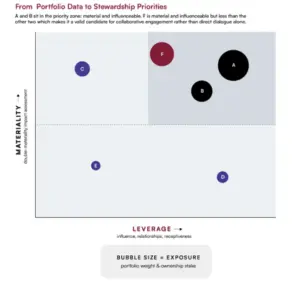
From Portfolio Data to Stewardship Priorities
If effectiveness is the ultimate goal, then prioritization becomes indispensable. Investors now have access to an unprecedented volume of portfolio data, encompassing exposure levels, ownership stakes, environmental, social, and governance (ESG) risks, controversies, double materiality assessments, corporate performance metrics, and much more. The challenge has shifted from simply acquiring information to discerning how to best utilize it. A company might present a significant sustainability risk, yet offer limited avenues for investor leverage. Conversely, another company might harbor a less obvious risk but possess a highly material issue, substantial investor ownership, and a management team receptive to change.
This is where the synergistic integration of diverse intelligence sources proves invaluable. Marchewitz and Mondl propose a framework: Exposure x Materiality x Leverage = Prioritization. These three dimensions are intentionally broad, serving as guiding principles rather than a rigid mathematical formula or a mechanical scoring model. The core tenet is that effective stewardship necessitates prioritization based not only on the magnitude of risks but also on the potential for meaningful investor influence and a credible pathway to achieving change.
This framework underscores the significant value that sustainability data and analytics can provide. Enhanced data quality can assist investors in identifying relevant exposures, comprehending material issues, benchmarking companies, and pinpointing potential areas for intervention. However, data should serve as an informed basis for stewardship strategy, not as a substitute for it. Prioritization, therefore, is not merely about identifying the "worst" performing companies; it is about discerning opportunities where the confluence of issue importance and investor influence creates a tangible prospect for stewardship impact.
However, prioritization is only the initial step. Once a company or issue is designated as a stewardship priority, investors must determine the most appropriate form of intervention. The relevant question extends beyond the materiality of an issue to encompass how the investor can realistically influence the outcome. Factors such as the nature of the issue, the investor’s leverage, the company’s receptiveness, and the available stewardship mechanisms all play a crucial role. Consequently, stewardship cannot be reduced to a fully automated decision-making process. While data can illuminate priorities and inform the choice of intervention, effective stewardship still demands informed human judgment. The same issue might warrant direct engagement with one company, collaborative efforts or proxy voting with another, and a broader systemic response in a third. In essence, good stewardship is not simply about possessing superior data, but about leveraging that intelligence to make more astute decisions.
What Data and Technology Can and Cannot Do
The rapid evolution of technology is profoundly reshaping the field of stewardship. Advanced analytics and artificial intelligence (AI) are empowering investors to identify emerging controversies, assess materiality, benchmark companies, monitor engagement progress, and manage vast quantities of information. Technology is also facilitating the integration of previously disparate activities, including research, voting, engagement, and reporting.
However, there are inherent limitations to what technology can achieve. While AI can process data and identify patterns with remarkable efficiency, it cannot replicate human judgment, ethical reasoning, or the nuanced understanding of complex stakeholder relationships. These remain fundamentally human domains. Therefore, the opportunity lies not in the wholesale automation of stewardship, but in the intelligent integration of intelligence, decision-making, action, and learning. This means transforming raw data into actionable stewardship intelligence. The true value of technology resides not solely in its capacity to generate more information, but in its ability to assist investors in making more informed decisions about where to focus their efforts, how to act, and what lessons to extract from the outcomes.
A European Stewardship Landscape in Transition
The ongoing discussion about stewardship effectiveness is particularly timely given the evolving regulatory and market landscape in Europe. Directives such as SRD II, alongside various national stewardship codes, have established more robust expectations regarding shareholder engagement, proxy voting, and transparency. However, approaches to stewardship remain heterogeneous across different European markets, resulting in a landscape that is increasingly sophisticated yet also fragmented. The current challenge is not merely about the proliferation of stewardship frameworks, but about whether existing frameworks can equip investors to act more coherently, foster greater comparability, and ultimately enhance their stewardship effectiveness. This necessitates a focus that transcends mere reporting requirements and delves into the qualitative aspects of the stewardship process itself – how investors set objectives, prioritize, intervene, evaluate outcomes, and learn from their experiences.

A Simple Stewardship Health Check
For investors seeking to gauge their stewardship effectiveness, a series of straightforward questions can serve as a valuable starting point. These questions do not necessitate a complete overhaul of existing stewardship models but offer a framework for evaluating whether the current approach is functioning as intended.
- Are our stewardship objectives clearly defined and measurable?
- Do we effectively prioritize issues based on both materiality and our ability to influence them?
- Do we consistently select the most appropriate intervention for each situation?
- Do we systematically assess our influence and contribution to corporate change?
- Do we actively learn from our stewardship activities to improve future engagement?
- Is our stewardship model resilient to changes in providers, technologies, and market conditions?
- Do we maintain institutional knowledge and strategic oversight, even when outsourcing execution?
Conclusion: The Next Frontier in Active Ownership
The journey from activity-based metrics to a focus on effectiveness is not an indictment of engagement, voting, or reporting; these remain essential components of active ownership. Rather, it is a recognition that activity serves as a means to an end, not the end itself. The stewardship market has progressed beyond questioning whether investors are active owners; the next critical challenge is to ascertain: "Are our stewardship activities genuinely helping us achieve our objectives, and are we improving our effectiveness over time?"
This necessitates a more robust and integrated connection between the various stages of the stewardship process. For investors, this means shifting their focus from the sheer volume of stewardship activities to the deliberate and strategic design of those activities. For service providers, it entails demonstrating value that extends beyond quantitative measures of activity. And for the stewardship ecosystem as a whole, it requires the development of more sophisticated methodologies for understanding influence, contribution, and ultimate outcomes. The ultimate objective is not merely to conduct more stewardship, but to render stewardship demonstrably more effective. This marks a pivotal evolution in active ownership, a transition from a preoccupation with activity to a strategic imperative for effectiveness.
