

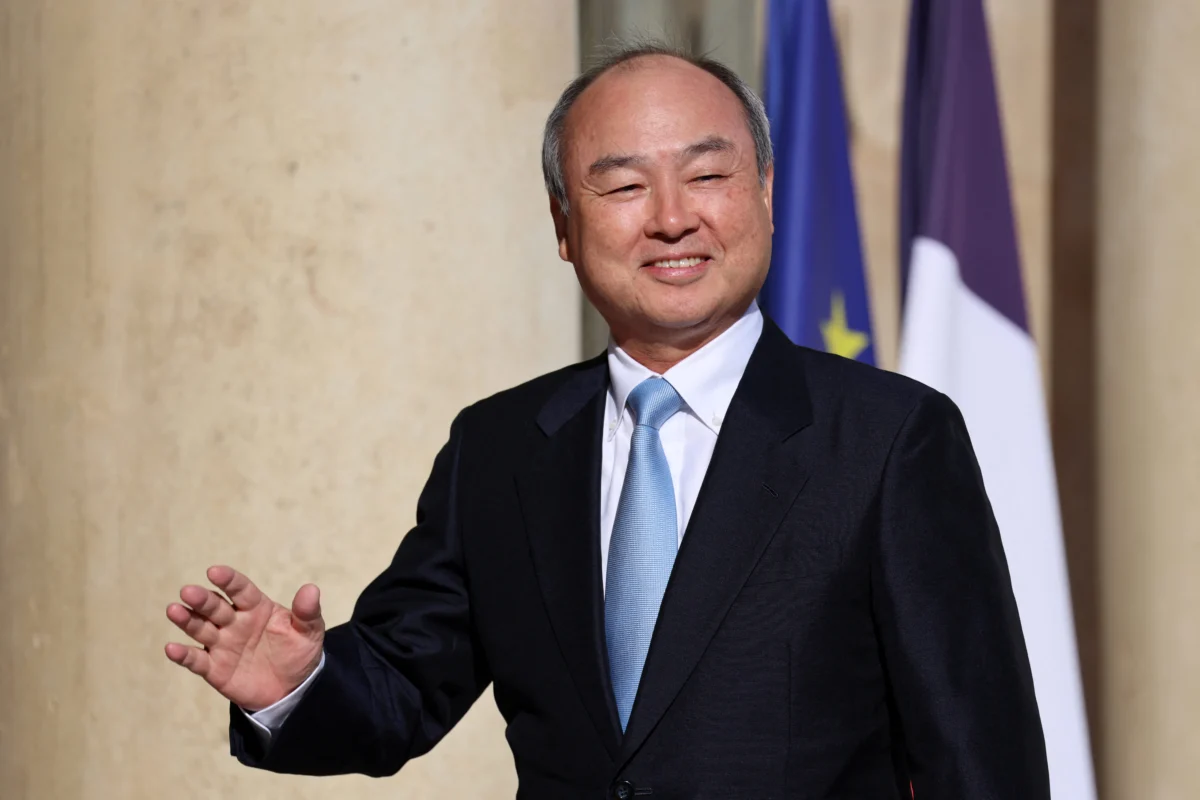
In a definitive statement that underscores the scale of the current technological shift, SoftBank Group Corp. CEO Masayoshi Son has characterized the artificial intelligence revolution as an event fifty times more significant than the dot-com boom of the late 1990s and early 2000s. Speaking with CNBC in Paris on Monday, Son outlined a vision of human progress where AI does not merely iterate upon existing digital frameworks but fundamentally redefines the capabilities of mankind. This assessment came on the heels of SoftBank’s announcement of a staggering 75 billion euro ($87 billion) investment plan to develop AI infrastructure in France, a move intended to position the nation as a central hub for European computing power.
The scale of this investment is unprecedented for the Japanese conglomerate in Europe, targeting the development of 5 gigawatts (GW) of AI-specific data center capacity. Son’s rhetoric suggests that the current market enthusiasm for AI is not a fleeting bubble, but the genesis of a century-long growth trajectory. By comparing the potential impact of AI to the historical shifts in motorization and electronics following the 1929 Wall Street crash, Son provided a macro-economic justification for SoftBank’s aggressive capital deployment into hardware and infrastructure.
A Paradigm Shift in Technological Evolution
Masayoshi Son’s comparison between the dot-com era and the current AI landscape highlights a shift from information connectivity to cognitive automation. During the interview, Son noted that while the dot-com crash of 2000 was a painful period for investors, it served as a necessary correction that preceded decades of sustained growth for internet-based businesses. However, he argues that the AI revolution is of a different magnitude entirely. "I think this is like more than 10x, probably 50x bigger than dot-com," Son told CNBC, emphasizing that the realization of AI’s potential is only in its infancy.
This "50x" metric refers to the total addressable market and the depth of integration AI will have across every sector of the global economy. Unlike the internet, which primarily transformed how information is transmitted and consumed, AI has the potential to automate intelligence itself. For Son, this represents the "biggest revolution of technology and realization that mankind ever experienced." The investment strategy reflects this belief, moving away from pure software plays toward the physical infrastructure—the "bricks and mortar" of the digital age—required to run complex large language models (LLMs) and generative AI applications.
Massive Infrastructure Commitment in France
The centerpiece of SoftBank’s current European strategy is the 75 billion euro commitment to France. This initiative aims to build 3.1 GW of AI data center capacity in the northern Hauts-de-France region by 2031. Specifically, the project will target locations in Dunkirk, Bosquel, and Bouchain. This regional focus is strategic; the north of France offers proximity to major European markets and access to a robust power grid.
To execute this vision, SoftBank has entered into a strategic partnership with the French industrial giant Schneider Electric. The collaboration intends to establish a large-scale industrial production hub in Dunkirk. This hub will not only support the construction of the data centers but also focus on the specialized cooling and power management systems required for high-density AI computing. During a press briefing with French President Emmanuel Macron, Son emphasized that France has the potential to become the "center of Europe" for AI technology.
The 5 GW total target for France is a monumental figure in the context of global energy consumption. For comparison, 1 GW of power is roughly equivalent to the output of a large nuclear reactor or enough to power approximately 750,000 homes. SoftBank’s plan to install 5 GW suggests a future where France hosts a significant portion of the continent’s "digital brainpower," attracting developers and enterprises that require massive computational resources.
Historical Perspective and the 1929 Analogy
Addressing concerns regarding a potential market bubble, Son invoked the history of the 1929 Wall Street crash. He observed that while the stocks of electronics and motorization companies collapsed during the Great Depression, those technologies went on to dominate the global economy for the next 100 years. "There’s always a correction," Son admitted, but he viewed such downturns as "the best investment opportunity."
This perspective is central to the SoftBank philosophy, which often prioritizes long-term technological dominance over short-term volatility. By framing the current AI surge within a century-long cycle, Son is signaling to investors that SoftBank is prepared to weather any immediate market "bursts" in exchange for a dominant position in the foundational infrastructure of the future. This historical lens also explains why SoftBank is pivoting so heavily toward hardware and energy, sectors that provide the essential utility for the AI software layer.

Portfolio Strategy: Arm and the OpenAI Alliance
Despite the scale of the new French investment, Son addressed questions regarding SoftBank’s concentration of risk, particularly its exposure to OpenAI. Last year, SoftBank partnered with the Sam Altman-led startup on the "Stargate" project, an ambitious joint venture aimed at building massive AI infrastructure in the United States. Son clarified that OpenAI currently represents just over 20% of SoftBank’s net asset value (NAV), a figure he considers manageable.
The true cornerstone of SoftBank’s portfolio remains the British semiconductor design firm Arm. Arm currently accounts for over 50% of SoftBank’s NAV. As AI applications require increasingly efficient and powerful chips, Arm’s architecture has become indispensable to the ecosystem. Son’s strategy appears to be a "full-stack" approach: owning the chip architecture (Arm), investing in the leading AI model developer (OpenAI), and now building the massive data centers (the France and U.S. projects) where these chips and models will operate.
Furthermore, Son expressed high confidence in OpenAI’s trajectory, noting that the company "will be very successful" as it moves toward a potential initial public offering (IPO). The synergy between OpenAI’s software needs and SoftBank’s infrastructure capabilities creates a feedback loop that Son intends to capitalize on globally.
Financing the Future: A Model of Scalability
One of the most critical aspects of the 75 billion euro plan is how it will be funded. Given SoftBank’s history of high-leverage investments, market analysts have closely watched the group’s capital allocation. Son revealed that the company will rely largely on "project financing" rather than depleting its own capital reserves. This model involves securing loans and investments based on the projected cash flows of the specific infrastructure projects themselves.
Son referenced a 10-gigawatt project in Ohio as a blueprint. In that instance, SoftBank is securing long-term "take-off" agreements—contracts where customers commit to buying the data center capacity before it is even built. "Our own money that we need is very, very condensed," Son explained. "I’m confident that we’re going to get big purchase orders from our customers that we already have relationships with." This approach minimizes the direct risk to SoftBank’s balance sheet while allowing the company to facilitate massive infrastructure builds that would otherwise be impossible.
Geopolitical and Economic Implications for Europe
The investment serves as a significant win for President Emmanuel Macron’s "Choose France" initiative, which seeks to attract foreign direct investment through pro-business reforms and strategic incentives. For Europe, the SoftBank deal is a matter of digital sovereignty. Currently, much of the world’s AI infrastructure is concentrated in the United States and China. By hosting 5 GW of capacity on French soil, Europe can ensure that its businesses and researchers have local access to high-performance computing without total reliance on American hyperscalers like Amazon or Microsoft.
The economic impact on the Hauts-de-France region is expected to be substantial. Beyond the initial construction jobs, the partnership with Schneider Electric points toward a long-term manufacturing presence. This could revitalize industrial zones in Dunkirk and surrounding areas, transforming them into "AI Valleys" that mirror the tech clusters of Silicon Valley or Shenzhen.
Market Reaction and Industry Forecast
Following the announcement and Son’s bullish remarks, SoftBank’s shares in Tokyo closed 14% higher, reflecting investor confidence in the company’s clear pivot toward AI infrastructure. Analysts suggest that the market is responding favorably to the shift from the "scattergun" investment approach of the earlier Vision Funds toward a more focused, infrastructure-heavy strategy.
The broader industry forecast remains centered on the "compute" crunch. As AI models grow in complexity, the demand for electricity and data center space is outstripping supply. By securing land, power agreements, and partnerships with companies like Schneider Electric, SoftBank is effectively "cornering the market" on the physical requirements of the AI age.
In conclusion, Masayoshi Son’s pronouncements in Paris mark a new chapter for SoftBank and the global AI industry. By declaring the AI revolution 50 times larger than the dot-com boom, Son has set a high bar for growth expectations. With 75 billion euros committed to the French landscape and a strategic focus on the intersection of semiconductors, models, and infrastructure, SoftBank is positioning itself not just as a financier of the AI era, but as its primary architect. The success of this vision will depend on the continued demand for AI services and the ability to navigate the immense energy and logistical challenges of building the world’s largest digital workshops.
