

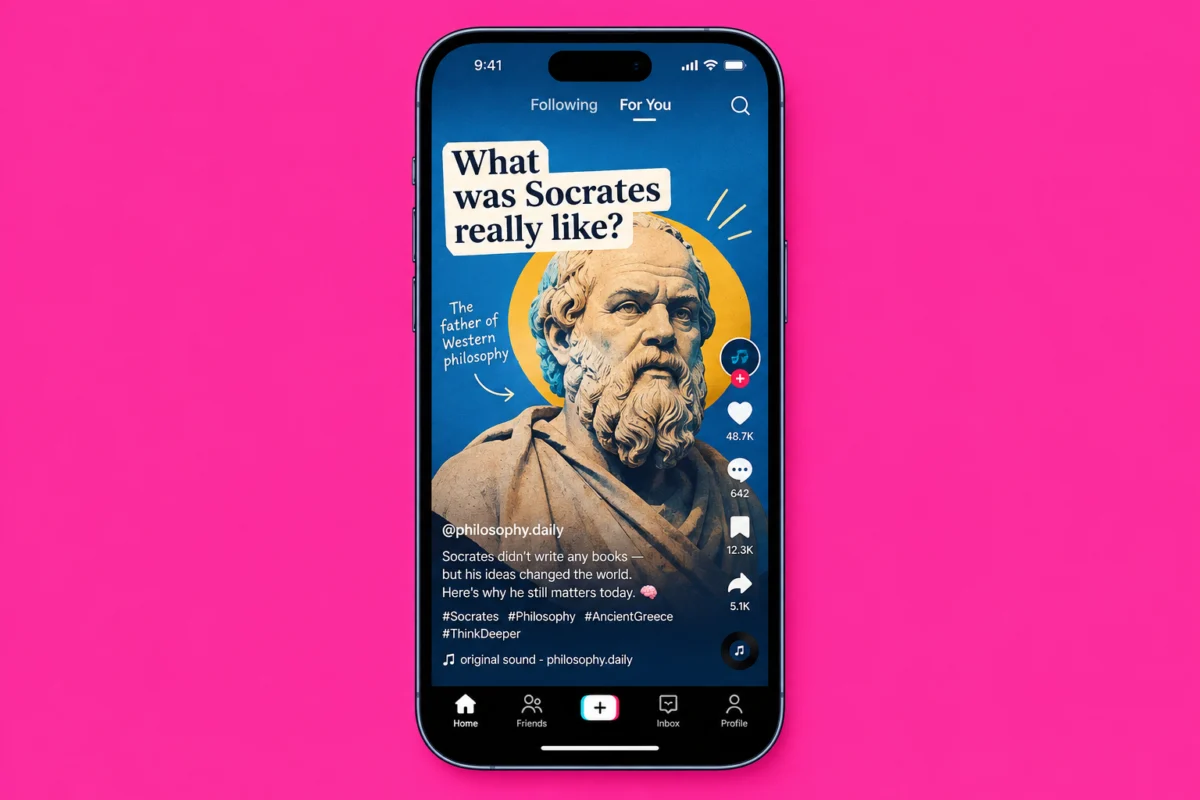
The modern educational landscape is currently grappling with a paradox of accessibility and engagement, as traditional pedagogical methods collide with the dopamine-driven design of the attention economy. For years, educators and sociologists have lamented the perceived erosion of the collective attention span, often citing the phenomenon of "doomscrolling"—the act of endlessly consuming negative or trivial content on social media—as a primary culprit for the decline in deep reading and academic focus. However, a new Palo Alto-based startup named ScrollEd is proposing a radical shift in perspective: rather than fighting the medium of the vertical feed, education should inhabit it.
Competing in the prestigious TechCrunch Disrupt Startup Battlefield 200, ScrollEd is introducing a platform designed to bridge the gap between rigorous academic content and the consumption habits of Gen Z and Gen Alpha. The startup’s core thesis is that if students are increasingly unwilling to engage with static, long-form textbooks, the textbooks themselves must evolve into a format that mirrors the interfaces of TikTok and Instagram Reels. By leveraging artificial intelligence to transform dry PDFs and complex manuscripts into interactive, short-form media, ScrollEd seeks to reclaim the "scroll" for the purpose of intellectual growth.
The Mechanics of Educational Micro-Learning
ScrollEd has developed a sophisticated application that allows users to upload virtually any text-based file, ranging from standard academic textbooks to corporate training manuals and technical white papers. Once uploaded, the platform’s AI engine parses the content, distilling it into a series of "units" that are presented in a vertical, swipeable feed. This feed is not merely a digital version of a book; it is a multi-modal experience featuring AI-generated video summaries, narrated audio clips, and concise text overlays.
The user interface employs a two-dimensional navigation system designed to balance breadth with depth. A vertical "swipe up" gesture moves the user to a new topic or chapter, maintaining the momentum of a traditional social media feed. Conversely, a horizontal "swipe sideways" allows the learner to delve deeper into the specific nuances of the current topic, accessing more detailed explanations or supplementary media. This architecture addresses one of the primary criticisms of short-form content: the lack of nuance. By placing a quiz at the end of these deeper dives, the platform ensures that the engagement is not passive but requires active cognitive participation.
Utsav Gupta, co-founder of ScrollEd, emphasizes that the platform is a response to a shift in consumer behavior that may be irreversible. Speaking to the necessity of the platform, Gupta noted that the younger demographic, particularly those entering university at age 18, have become conditioned to vertical, short-form delivery. He argues that rather than attempting to force these "digital natives" back into traditional formats, educators must meet them where they are. The challenge, according to Gupta, is to be deliberate about the platform’s design, choosing to prioritize learning outcomes over the "engagement maximization" strategies typically used by social media giants to keep users on their apps indefinitely.
Origins and the Founders’ Vision
The genesis of ScrollEd is rooted in the personal experiences of its founders, Utsav Gupta and Rebecca Neff. The husband-and-wife duo, who are both current students at elite institutions, found themselves victims of the very "doomscrolling" habits they are now trying to disrupt. Gupta, who studies AI and human purpose at Stanford University, and Neff, a computer science student at the University of Pennsylvania, recognized a shared sense of dissatisfaction and mental fatigue after spending late nights scrolling through mindless social media feeds.
This epiphany led to a "bootstrapped" development process throughout 2024. Their goal was to create a tool that provided the same ease of use as a social network but left the user feeling enriched rather than drained. Gupta’s academic focus on the intersection of artificial intelligence and human purpose provides a philosophical foundation for the company, ensuring that the AI tools used to generate content are aligned with educational efficacy rather than just visual flair.
The startup is positioning itself as a "social network that’s better for you," a tagline that highlights its ambition to compete for the screen time currently dominated by entertainment-centric platforms. By transforming curiosity into a seamless digital journey, ScrollEd aims to make the pursuit of knowledge as addictive as the pursuit of viral trends.
Market Context and the Shift in Literacy
The rise of ScrollEd comes at a critical juncture for the global education sector. According to data from the Pew Research Center, roughly 95% of teens have access to a smartphone, and nearly 35% say they are on at least one social media platform "almost constantly." Simultaneously, national reading scores in various regions have seen a decline, leading to a heated debate among experts regarding the "death of the book."
However, industry analysts suggest that the problem may not be a lack of interest in information, but a mismatch in delivery. The global EdTech market, valued at approximately $340 billion in 2023, is increasingly shifting toward "micro-learning"—a method of delivering content in small, specific bursts. Research indicates that micro-learning can improve knowledge retention by up to 20% by preventing cognitive overload. ScrollEd’s model aligns perfectly with these findings, utilizing the "spacing effect" and "interleaving" through its quiz-based reinforcement and varied content types.
Furthermore, the integration of AI in education is no longer a luxury but a necessity for scaling personalized learning. By automating the conversion of static text into dynamic media, ScrollEd allows for the rapid digitization of curricula that would otherwise take months of manual production. This speed is essential for corporate training environments and fast-moving academic fields like technology and medicine.
Business Model and Institutional Integration
ScrollEd is launching with a freemium business model, a standard in the software-as-a-service (SaaS) industry. This approach includes a free consumer feed where individuals can explore public educational content, alongside a "ScrollEd Pro" subscription for advanced features and private document conversion.
The most significant growth lever for the company, however, lies in its institutional licensing. Educational institutions, such as universities and high schools, as well as corporate HR departments, can pay for the platform to deliver their specific proprietary materials. In return, these organizations receive detailed analytics and "heat maps" of engagement. These reports can show which sections of a lesson are being skipped, where students are struggling with quizzes, and how much time is being spent on specific topics. This data-driven approach allows educators to adapt their teaching strategies in real-time, moving away from the "one-size-fits-all" model of traditional textbooks.
The startup’s roadmap for the coming months is ambitious. Following its official consumer launch at TechCrunch Disrupt, ScrollEd plans to expand its lesson library through partnerships with content creators and publishers. A critical component of this expansion is the development of a "source-checking workflow" to ensure that the AI-generated summaries remain factually accurate and free from the "hallucinations" that sometimes plague large language models.
TechCrunch Disrupt and the Path Forward
The selection of ScrollEd for the Startup Battlefield 200 at TechCrunch Disrupt in San Francisco (October 13-15) places the company in the spotlight of the global venture capital community. TechCrunch Disrupt has historically been a launching pad for some of the most influential companies in tech, including the likes of Dropbox, Fitbit, and Cloudflare.
As the company prepares for its debut, the broader implications of its technology are being scrutinized by both tech enthusiasts and traditionalists. Critics may argue that "TikTok-ifying" education further diminishes the capacity for long-form concentration. However, supporters argue that in a world where the attention of the youth is already captured by vertical video, providing high-quality, educational alternatives is a pragmatic and necessary intervention.
ScrollEd’s infrastructure is being built with a long-term vision of adaptive learning. Eventually, the startup hopes to utilize machine learning to assess individual learners’ strengths and weaknesses, automatically adjusting the difficulty and style of the feed to suit each user. If successful, ScrollEd could transform from a simple content converter into a comprehensive AI tutor that lives within the interface of the modern smartphone.
In the words of Utsav Gupta, the goal is not just to provide a new way to study, but to "disrupt" the very nature of short-form media. By turning the "doomscroll" into an "edu-scroll," ScrollEd represents a new wave of startups focused on "humane technology"—tools designed to align with human psychology while fostering growth rather than exploitation. As the doors open at the Moscone Center in San Francisco this October, the tech world will be watching to see if the vertical feed can truly become a tool for the next generation of scholars.
