

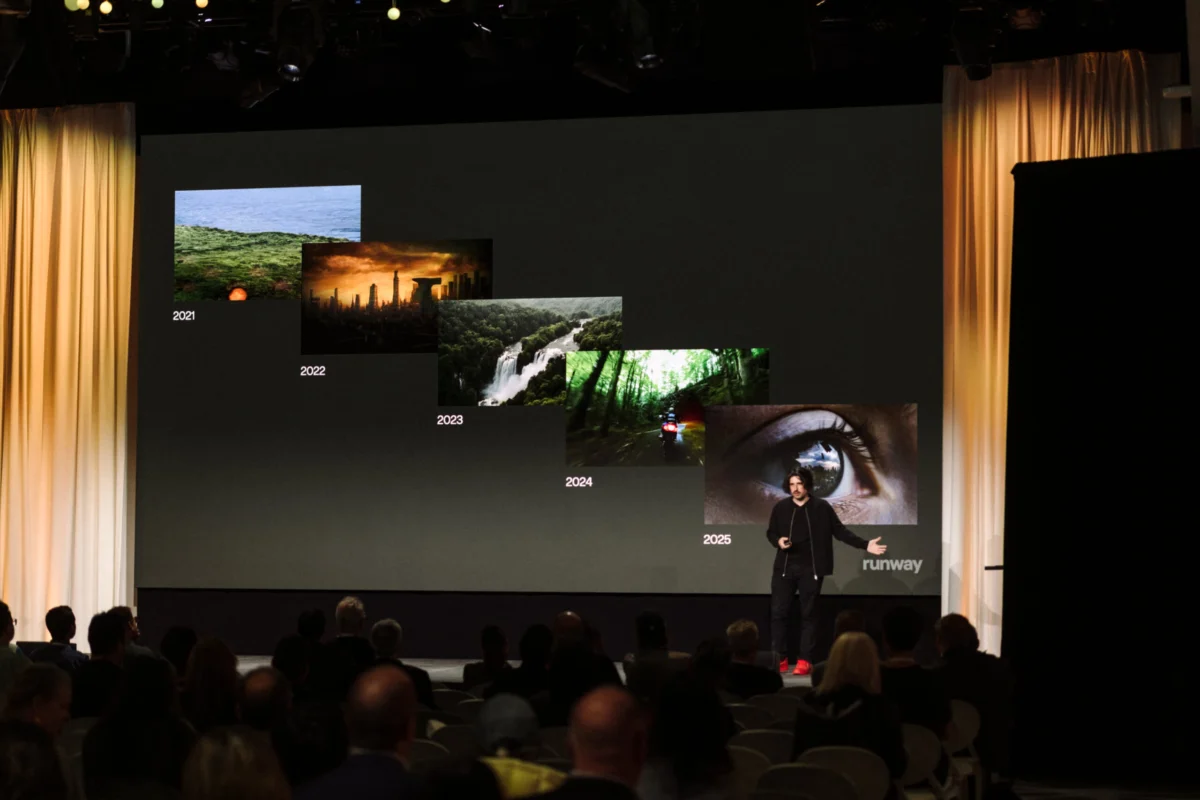
Runway, a prominent American artificial intelligence startup specializing in generative video and "world models," has officially designated London as the site for its new European headquarters, signaling a major expansion of its international operations. The New York-based company revealed exclusively to CNBC that it intends to invest upwards of $200 million into the United Kingdom’s AI ecosystem by the end of 2028. This move follows a broader trend of high-profile Silicon Valley firms, including OpenAI and Anthropic, establishing a permanent presence in the British capital to capitalize on the region’s specialized talent pool and its concentration of creative and commercial industries.
The expansion comes at a time of significant momentum for Runway, which recently concluded a Series E funding round totaling $315 million. This investment round featured participation from major industry players such as Nvidia, AMD Ventures, and General Atlantic, propelling the company’s valuation to approximately $5.3 billion. By anchoring its European operations in London, Runway aims to deepen its engagement with a growing roster of enterprise clients while tapping into the research capabilities of the United Kingdom’s academic and technological sectors.
Strategic Justification for the London Expansion
The decision to choose London over other European tech hubs like Paris or Berlin was driven by several strategic factors, most notably the proximity to key clients in the media and advertising sectors. Anastasis Germanidis, co-founder and Co-CEO of Runway, emphasized that the city’s existing infrastructure and human capital made it the logical choice for the company’s first major international hub.
"London puts us close to many of our largest European customers already doing serious work with Runway, including the BBC, Fremantle, and WPP," Germanidis stated. He further noted that the company already maintains a research team in the city, and the new headquarters will serve to consolidate and expand these efforts. The "talent pool" in London, bolstered by world-class universities and a legacy of innovation in computer science and the arts, was cited as an "exceptional" resource for the company’s future growth.
For Runway, London serves as a gateway to the broader European market. While the initial focus is on the UK, Germanidis indicated that the company expects to expand its footprint across the continent in the near future, using the London office as a springboard for further internationalization.
The Evolution of AI: Moving Beyond Large Language Models
A central component of Runway’s mission is the development of "world models," a subset of artificial intelligence that differs fundamentally from the Large Language Models (LLMs) popularized by platforms like ChatGPT. While LLMs are primarily designed to predict and generate text based on linguistic patterns, world models are engineered to understand and simulate the physical world.
World models ingest a diverse array of inputs, including video, audio, images, and real-world sensory data, to build an internal representation of how the environment functions. This allows the AI to understand concepts such as gravity, depth, lighting, and the movement of objects in three-dimensional space. By mastering these physical properties, Runway’s technology enables high-fidelity video generation and editing tools that are increasingly utilized by Hollywood studios, marketing agencies, and independent creators.
The applications of world models extend beyond the creative arts. Experts suggest that the research conducted at Runway’s new London hub could have far-reaching implications for fields such as robotics and autonomous systems. If an AI can accurately model the physical world, it can be used to train robots in virtual environments before they are deployed in reality, significantly accelerating the development of hardware that can navigate complex human environments.
Financial Trajectory and the Competitive Landscape
Runway’s $200 million investment commitment is a testament to its robust financial position. The company has emerged as a leader in the generative video space, a sector that has become increasingly competitive over the last 18 months. The $5.3 billion valuation reflects investor confidence in Runway’s proprietary technology, particularly its "Gen-3 Alpha" model, which has set new benchmarks for temporal consistency and visual fidelity in AI-generated cinema.
The presence of Nvidia and AMD Ventures as investors is particularly noteworthy. As the primary manufacturers of the high-performance Graphics Processing Units (GPUs) required to train and run massive AI models, their backing provides Runway with both the capital and the technical synergy needed to maintain its edge.
However, Runway is not alone in its pursuit of the London market. In April, Anthropic, the San Francisco-based creator of the Claude LLM, announced it was leasing office space in London capable of housing 800 employees. This followed an announcement by OpenAI, the developer of Sora (a direct competitor to Runway’s video tools), regarding the establishment of its first international office in the UK. Google is also finalizing a major move into a new UK headquarters at King’s Cross this summer. This influx of capital and corporate presence suggests that London is successfully positioning itself as the "AI capital of Europe."
Government Support and Economic Impact
The UK government has been proactive in courting international AI firms, viewing the sector as a critical pillar of future economic growth. Kanishka Narayan, the UK’s AI Minister, welcomed Runway’s announcement, framing it as a validation of the country’s industrial strategy.
"Runway’s new London hub will bring pioneering research into world models to the UK, helping power breakthroughs across industries from film and gaming to science and robotics," Narayan said. He added that the government’s goal is to ensure that the "world’s most ambitious AI firms" view the UK as the premier destination for their long-term development.
The $200 million investment is expected to create high-skilled jobs in research, engineering, and creative production. Furthermore, the presence of Runway is likely to foster a secondary ecosystem of startups and service providers that utilize Runway’s API and tools to build new applications. This "multiplier effect" is a key component of the UK’s broader ambition to become a global "AI superpower," as outlined in various government policy papers over the last three years.
Chronology of Runway’s Growth and UK Presence
To understand the significance of this expansion, it is helpful to look at the timeline of Runway’s rapid ascent in the technology sector:
- 2018: Runway is founded in New York by Cristóbal Valenzuela, Alejandro Matamala Ortiz, and Anastasis Germanidis. The founders met at New York University’s Interactive Telecommunications Program.
- 2021-2022: The company gains early traction with the release of Gen-1 and Gen-2 models, which introduced "video-to-video" and "text-to-video" capabilities to the public.
- 2023: Runway raises $141 million in an extension of its Series C round, with participation from Google and Salesforce Ventures. Later that year, the company plays a visible role in the creative discussions surrounding the use of AI in filmmaking during the Hollywood strikes.
- Early 2024: Runway announces the Series E round, valuing the company at $5.3 billion.
- April 2024: Major competitors OpenAI and Anthropic announce London expansions.
- Current: Runway officially commits to a $200 million investment in the UK and designates London as its European headquarters.
Implications for the Creative and Tech Sectors
The concentration of AI power in London has profound implications for the UK’s creative economy, which contributes more than £120 billion annually to the national GDP. Companies like WPP, the world’s largest advertising group, have already integrated Runway’s tools into their production pipelines to streamline content creation and reduce costs.
For the BBC and Fremantle, the use of generative AI presents both opportunities and challenges. While AI can significantly reduce the time required for visual effects (VFX) and post-production, it also raises complex questions regarding copyright, the authenticity of media, and the future of labor in the creative arts. Runway’s physical presence in London will likely facilitate a more direct dialogue between the tech developers and the cultural institutions navigating these transitions.
From a technical perspective, the expansion reinforces the importance of "multimodal" AI. The industry is moving away from single-purpose tools toward systems that can perceive and interact with the world in a human-like manner. Runway’s focus on world models places it at the forefront of this shift, potentially bridging the gap between digital content generation and physical world interaction.
Conclusion and Future Outlook
Runway’s $200 million commitment to London represents a significant vote of confidence in the United Kingdom’s post-Brexit economic landscape and its technological future. By establishing its European headquarters in the city, Runway is positioning itself at the intersection of Silicon Valley innovation and European creative heritage.
As the company scales its operations through 2028, the focus will likely shift toward the practical implementation of world models across diverse sectors. While the immediate benefits will be felt in the film and media industries, the long-term impact of Runway’s research may be seen in everything from the way we design cities to how we train the next generation of autonomous robots. For now, the move solidifies London’s status as a central battlefield in the global race for AI supremacy, ensuring that the next chapter of the "world model" revolution will be written, in part, from the banks of the Thames.
