

The Evolving Landscape of Hydrogen Research
For several years, hydrogen has been promoted as a "silver bullet" for decarbonizing difficult-to-abate sectors. However, as the technology matures and real-world data becomes available, the "Hydrogen Ladder"—a concept that prioritizes hydrogen for applications where no other alternatives exist—has become a central framework for critics and analysts alike. RMI’s recent reports reflect a growing realism regarding where hydrogen can realistically compete.
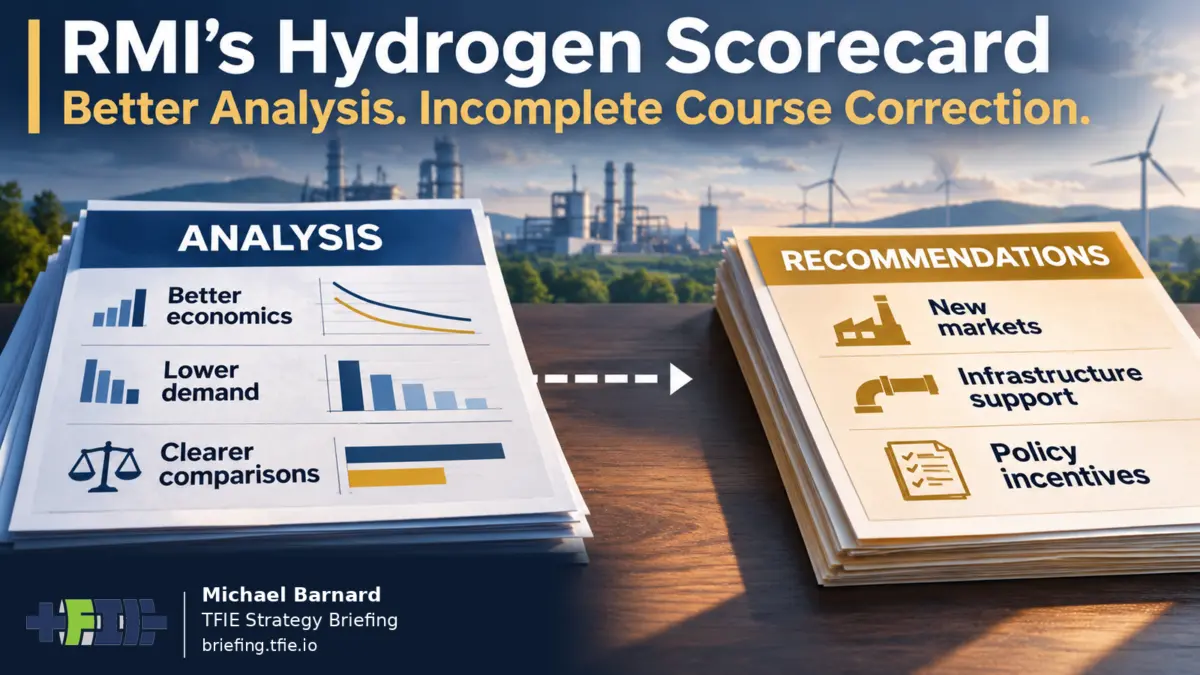
In its 2024 and 2025 assessments, RMI has corrected several previous assumptions, noting that the demand for hydrogen in 2030 will likely be significantly lower than earlier, more optimistic projections. Despite these analytical corrections, the organization continues to advocate for public subsidies and infrastructure development in sectors where its own data suggests that direct electrification is more cost-effective. This includes heavy-duty trucking and certain industrial heating applications, where battery-electric vehicles (BEVs) and heat pumps often outperform hydrogen fuel cells and combustion.
Case Study: Heavy-Duty Trucking in India and the United States
One of the most prominent examples of this analytical-strategic gap is found in RMI’s February 2026 report on hydrogen trucking in India. The report’s baseline economic comparisons indicate that fuel-cell electric vehicles (FCEVs) are unlikely to reach total cost of ownership (TCO) parity with battery-electric trucks through 2040, even in long-haul use cases.
Despite this finding, the report’s policy section recommends a suite of interventions, including:

- Direct subsidies for hydrogen vehicles.
- Public funding for refueling station networks.
- Production incentives for green hydrogen.
- Tax relief for hydrogen infrastructure developers.
A similar pattern is observed in RMI’s 2025 U.S. hydrogen report. The analysis concludes that battery trucks possess greater market readiness and lower TCO in the near term. This is corroborated by independent data from the North American Council for Freight Efficiency (NACFE), which projects that batteries will become the lowest-cost option across nearly all modeled duty cycles by 2035 without the need for incentives. Nevertheless, RMI continues to call for the development of hydrogen distribution and refueling infrastructure along major freight corridors, a move that critics argue could lead to stranded assets if battery technology continues its current trajectory.
Europe’s Strategic Recalibration and the Cost of Public Support
In Europe, the discrepancy between analytical diagnosis and policy ambition is even more pronounced. In March 2025, RMI released a "recalibration" of Europe’s hydrogen strategy. The report significantly reduced the expected mandate-driven demand for renewable hydrogen in 2030 to between 2.2 and 2.8 million tons. This is a stark contrast to the European Union’s original ambition of 20 million tons of supply and imports.
However, the financial implications of the proposed strategy remain massive. RMI’s analysis identifies a need for €13.9 billion in public support under existing mandates, plus an additional €31.7 billion for an "accelerated" scenario. Totaling €45.6 billion, this level of public expenditure is being scrutinized by economists who suggest that the same decarbonization goals could be achieved more cheaply through direct electrification or the importation of green materials, such as green steel or ammonia, rather than manufacturing hydrogen domestically.
A November 2026 assessment by the Fossil Free Infrastructure Project (TFIE) further illustrates the cost disparity. According to TFIE modeling:
- Domestic Green Ammonia (Europe): Approximately €1,222 per ton.
- Imported Green Ammonia: Between €745 and €755 per ton.
These figures suggest that strategies starting with rigid hydrogen production targets, rather than end-use requirements, may result in inefficient infrastructure planning and unnecessary costs for taxpayers and industry.

Industrial Applications: Steel, Ammonia, and the China Market
RMI has shown an ability to make nuanced distinctions in specific industrial sectors. Its 2026 research on steel production accurately separates the use of hydrogen as a reducing agent (where it is essential) from its use as a source of process heat (where electricity is more efficient). For an illustrative plant, RMI noted that electric heat requires 850 GWh annually, whereas using hydrogen to provide the same heat would require 1,300 GWh of electricity to produce the gas.
In the ammonia sector, the launch of the Green Ammonia Buyers Alliance represents a coherent strategy. Because ammonia is an existing industrial feedstock currently made from fossil-derived hydrogen, replacing it with green ammonia addresses a known demand without the need to "invent" a new energy market.
However, in China, RMI’s 2026 report on green ammonia and methanol acknowledges that green production costs remain double or triple those of conventional methods. Despite this, the report discusses expanding the use of ammonia as an energy carrier for electricity generation. Critics point out that RMI has yet to demonstrate that ammonia combustion can compete with renewable generation coupled with long-duration storage and grid flexibility measures.
The Strategy Problem: Diagnosis vs. Action
The current state of RMI’s hydrogen program can be analyzed through the lens of Richard Rumelt’s framework for strategy, which consists of a diagnosis, a guiding policy, and coherent actions.
- Diagnosis: RMI’s diagnosis has improved significantly. It now recognizes the economic headwinds facing hydrogen in transport and the reduced demand forecasts in Europe.
- Guiding Policy: The guiding policy remains overly committed to market expansion for hydrogen, seemingly regardless of whether it is the most efficient solution.
- Coherent Actions: Because the guiding policy is at odds with the diagnosis, the resulting actions—calling for subsidies for uncompetitive applications—lack economic coherence.
The risk of this approach is the misallocation of limited public and private capital. If governments prioritize hydrogen infrastructure for sectors where batteries are more efficient, they risk slowing the overall pace of decarbonization and creating a reliance on expensive, subsidized energy pathways.

Implications for Global Decarbonization
The influence of RMI cannot be understated; its research informs the decisions of sovereign wealth funds, national energy ministries, and multinational corporations. As the global energy transition moves from theoretical modeling to large-scale deployment, the evidentiary bar for hydrogen must be raised.
Industry experts suggest that hydrogen policy should be governed by three main criteria:
- Technological Comparison: Direct electrification should be the default option unless hydrogen is proven to be more efficient or the only viable alternative.
- Investment Thresholds: Public money should only be committed when there is a clear path to commercial viability without indefinite subsidies.
- Exit Criteria: Policy frameworks should include "off-ramps" where support is withdrawn if a competing technology (like solid-state batteries or advanced heat pumps) achieves a clear market lead.
Conclusion
RMI possesses the technical expertise to align its strategic recommendations with its improved analytical findings. By incorporating more rigorous alternative-technology comparisons and focusing on hydrogen’s role as an essential chemical input rather than a universal fuel, the organization could provide a more reliable roadmap for the energy transition.
The transition to a net-zero economy requires making hard choices about which technologies to scale. While hydrogen will undoubtedly play a critical role in heavy industry and long-term storage, attempting to force it into markets where it is economically and energetically inferior may prove to be a costly detour. For RMI and the broader policy community, the challenge is to support hydrogen where it is necessary, while allowing superior technologies to win where they are already succeeding.
