

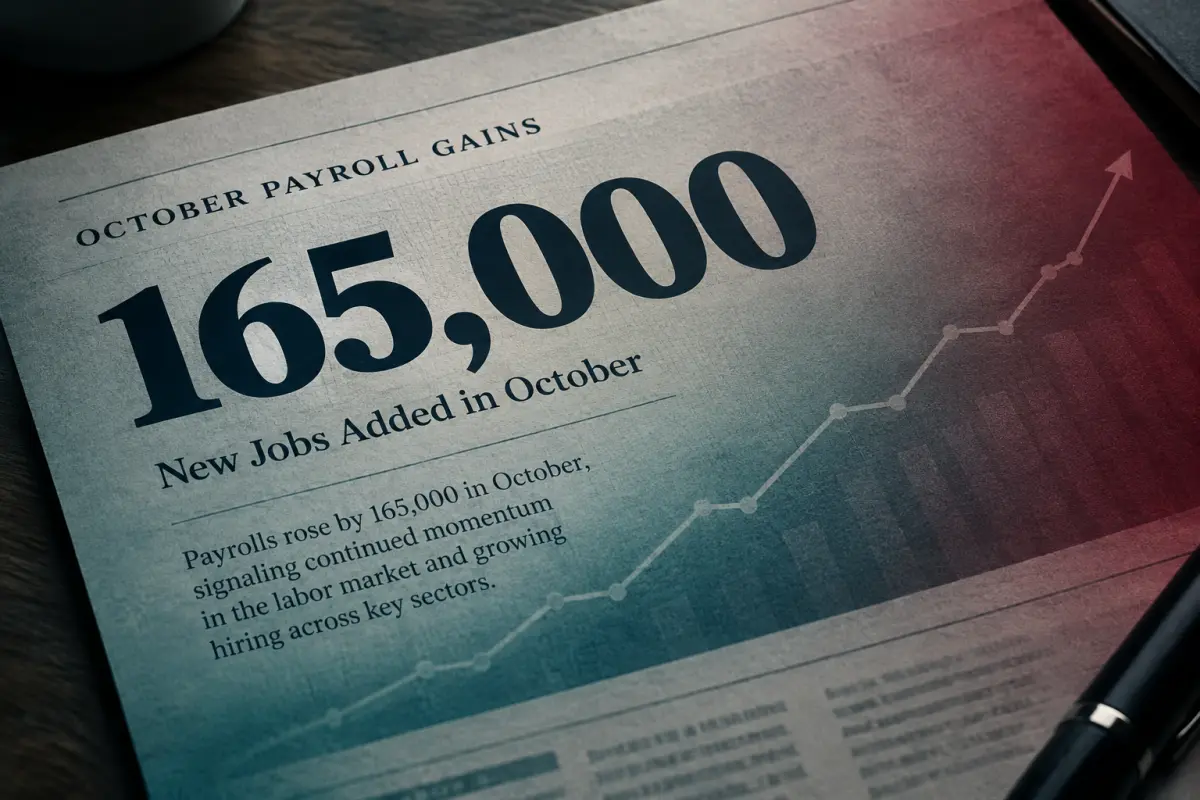
The United States labor market demonstrated unexpected strength in October, with non-farm payrolls expanding by 165,000 positions, a figure that has significantly shifted the narrative regarding the Federal Reserve’s upcoming monetary policy decisions. According to the latest data released by the U.S. Bureau of Labor Statistics (BLS), this surge in hiring far exceeds the cooling trends observed earlier in the year and stands in stark contrast to the average monthly gain of just 48,000 jobs recorded over the previous 12 months. This robust performance, characterized by broad-based gains across several key sectors, has placed a December interest rate hike firmly back on the table, as central bank officials weigh the persistence of economic momentum against the ongoing battle to stabilize inflation.
The October jobs report did more than just provide a snapshot of a single month; it also included substantial upward revisions to previous data, suggesting that the labor market was stronger throughout the late summer than initially estimated. The BLS revised August’s employment figures upward by 53,000 jobs, while September’s totals were increased by 31,000. These adjustments indicate a cumulative "catch-up" effect, where the economy entered the fourth quarter with more underlying steam than many analysts had projected. For the Federal Open Market Committee (FOMC), these figures represent a double-edged sword: while they signal a healthy economy capable of weathering higher borrowing costs, they also suggest that consumer demand—driven by steady income growth—could continue to apply upward pressure on prices.
A Broad-Based Recovery in Private Sector Hiring
The composition of October’s job gains reveals a labor market that is diversifying its growth engines. While much of the post-pandemic recovery was initially driven by the leisure and hospitality sectors, the current expansion is being led by high-value professional services and essential infrastructure roles. The professional and business services sector saw the most significant increase, adding 70,000 jobs during the month. This sector is often viewed as a bellwether for corporate confidence, as it encompasses legal, accounting, and consulting services that businesses typically invest in when they anticipate expansion.
Healthcare followed closely, contributing 42,000 new positions to the economy. The healthcare sector remains a consistent driver of employment due to the aging U.S. demographic and the ongoing structural demand for medical services. Furthermore, transportation and warehousing added 25,000 jobs, reflecting a stabilization in global supply chains and a continued consumer preference for e-commerce and rapid delivery services.
Perhaps the most surprising development in the October report was the performance of the manufacturing sector. Despite high interest rates typically dampening industrial output, manufacturing added 19,000 jobs. This figure surpassed most economist expectations and served as evidence that the hiring rebound has extended beyond the service-oriented industries into the "hard" goods economy. Sam Williamson, senior economist at First American, noted that this pickup suggests employers are successfully converting open positions into active payrolls, indicating a tightening of the slack that had previously characterized the post-pandemic labor shuffle.
The Construction Paradox: Commercial Growth vs. Residential Decline
While the overall employment picture was positive, the construction industry presented a more complex narrative. The sector as a whole lost 3,000 jobs in October, but a granular look at the data reveals a sharp divergence between residential and non-residential activity. Residential building construction saw a decrease of 1,200 jobs, while residential specialty trade contractors—the electricians, plumbers, and carpenters who work on home projects—shed 15,200 positions.
This decline in residential construction employment is a direct byproduct of the "lock-in" effect and high mortgage rates, which have slowed new housing starts and cooled the home renovation market. Conversely, the non-residential sector showed remarkable resilience. Non-residential building construction added 2,900 jobs, and non-residential specialty trade contractors grew by 7,900. This growth is largely attributed to large-scale infrastructure projects, fueled by federal spending and a surge in the construction of data centers and domestic manufacturing facilities.
The real estate sector itself managed to buck the downward trend seen in residential construction, adding 5,600 jobs in October. Of these, 4,300 were specific to real estate services, suggesting that even in a high-rate environment, the industry is maintaining a baseline level of activity as buyers and sellers navigate the current market constraints.
Unemployment Nuances and the Rise of Underemployment
On the surface, the headline unemployment rate remained steady and historically low at 4.1%, with approximately 7.1 million people classified as unemployed. However, economists are looking closer at the "quality" of this employment. Mike Fratantoni, senior vice president and chief economist at the Mortgage Bankers Association (MBA), highlighted a concerning trend in the U-6 unemployment rate. The U-6 measure, which includes discouraged workers and those working part-time for economic reasons (underemployed), rose to 7.9% in October, up from 7.6% the previous month.
Fratantoni pointed out that while the headline number looks strong, many individuals are taking part-time roles because they cannot secure full-time positions. Furthermore, the duration of unemployment spells is increasing. Both the median and average lengths of time that individuals remain without work are trending upward, suggesting that while hiring is happening, those who find themselves displaced are facing a more difficult path back into the workforce. This friction in the labor market could eventually lead to a cooling of consumer spending if the trend of underemployment persists.
Monetary Policy and the Path to the December FOMC Meeting
The Federal Reserve’s "dual mandate" requires it to balance maximum employment with price stability. With the labor market showing such resilience, the "maximum employment" side of the equation appears satisfied, allowing the Fed to focus almost exclusively on curbing inflation. Following a "hot" inflation print earlier in the season, the strong October jobs report has cleared the final hurdle for a December rate hike.
Market analysts and Fed observers had previously debated whether the central bank would pause its tightening cycle to observe the effects of previous hikes. However, the combination of upward job revisions and the 165,000-job gain in October has largely silenced the "doves" on the committee. Jake Krimmel, senior economist at Realtor.com, suggested that the report provides "Fed hawks" with the necessary data to justify another increase in the benchmark rate.
The implications for the housing market are particularly significant. A December rate hike would likely mean that mortgage-rate relief, which many prospective homebuyers have been hoping for, will be delayed further into the next year. Mortgage rates typically track the yield on the 10-year Treasury note, which reacts to Fed policy and economic growth expectations. A strong labor market keeps yields high, which in turn keeps mortgage rates elevated.
Chronology of Economic Shifts Leading to the Current Climate
The current economic situation is the culmination of a year-long struggle to find an equilibrium between growth and stability. In the early months of the year, the U.S. economy saw a series of fluctuating job reports that led many to believe a recession was imminent. However, by the summer, it became clear that the labor market was more durable than anticipated.
- August/September: Initial reports showed a cooling labor market, leading to speculation that the Fed might begin cutting rates by the end of the year. However, subsequent revisions (adding 84,000 jobs between the two months) changed the perspective from "cooling" to "stabilizing."
- Early October: Inflation data (CPI) came in higher than expected, signaling that the "last mile" of the inflation fight would be the hardest.
- Late October: The BLS release of the October payroll data confirmed that the economy was not only adding jobs but doing so at a rate nearly four times the previous 12-month average.
This chronology suggests that the U.S. economy is currently in a "no-landing" scenario, where growth remains robust despite significant monetary tightening. While this is positive for current workers and income levels, it creates a challenging environment for long-term debt, such as mortgages and corporate loans.
Broader Implications and the Road Ahead
As the Federal Reserve prepares for its December meeting, the focus will shift from the quantity of jobs to the trajectory of wages. If the tight labor market leads to accelerated wage growth, the Fed may feel compelled to maintain higher rates for an even longer duration to prevent a wage-price spiral.
For the housing market, the outlook remains a "slow-burn recovery." On one hand, the strong labor market provides households with the income necessary to eventually enter the market. On the other hand, the resulting high interest rates keep the cost of borrowing prohibitive for many. Sam Williamson of First American noted that a healthier labor market could eventually put more "churn" into a housing market that has been stuck in low-inventory gridlock, as more people gain the financial confidence to move, even if rates are not ideal.
Beyond December, the path remains data-dependent. Economists will be watching the next round of inflation data and the November jobs report to determine if the October surge was an outlier or the start of a new trend. For now, the message from the labor market is clear: the U.S. economy is not yet ready to slow down, and the Federal Reserve will likely respond accordingly.
