

The release of the Google Pixel 11 Pro XL marks a significant milestone in the evolution of Google’s hardware ecosystem, representing a decade of refinement since the original Pixel debuted in 2016. While the device arrives with industry-leading specifications, including a sophisticated Tensor G5 chipset and an advanced LTPO display, early adopters and technical analysts have noted that the device requires specific manual adjustments to unlock its full potential. Despite the "Made by Google" philosophy of seamless integration, the Pixel 11 Pro XL ships with several high-performance features disabled or throttled by default, primarily to maximize out-of-the-box battery longevity for the average consumer. For power users and photography enthusiasts, however, these default settings represent a bottleneck that must be addressed to justify the flagship’s premium price point.
The Evolution of the Pixel Hardware Strategy
Google’s trajectory in the smartphone market has shifted from the enthusiast-focused Nexus program to the premium, AI-centric Pixel brand. With the Pixel 11 series, Google has doubled down on its "AI-first" vision, integrating Gemini Intelligence more deeply into the operating system than ever before. This integration is not merely software-based; it is supported by a hardware architecture designed to handle on-device machine learning tasks. However, the complexity of this integration means that certain user-facing features are tucked away in sub-menus.
Historically, Google has faced criticism for hardware inconsistencies, ranging from display tint issues in early models to thermal management challenges in the Tensor-transition years. The Pixel 11 Pro XL appears to have solved the majority of these legacy hardware concerns, but the software configuration remains a point of contention. Industry analysts suggest that by shipping phones with conservative settings, Google aims to minimize "return-to-store" rates from users who might otherwise be confused by rapid battery drain or complex interface elements.
1. Advanced Imaging: Configuring the Camera Look Styles
The primary draw of the Pixel series has consistently been its computational photography. With the Pixel 11 Pro XL, Google introduced "Camera Looks," a feature designed to address a long-standing criticism of the Pixel’s aesthetic: the tendency toward aggressive HDR and over-processing. While the Pixel’s ability to pull detail out of shadows is legendary, it can occasionally result in images that lack natural contrast or appear "flat."
The Camera Look setting allows users to define the processing pipeline before the shutter is even pressed. By navigating to the camera app’s settings, users can adjust contrast, shadow depth, tint, sharpness, and warmth. This is a departure from the "point-and-shoot" simplicity of previous generations, offering a middle ground between standard JPEG processing and the complexity of RAW editing. Data from photography focus groups suggests that users increasingly prefer a "film-like" or "authentic" aesthetic over the clinical precision of early AI photography. Setting this style immediately is critical, as the chosen parameters are baked into the image processing, ensuring consistency across a user’s entire photo library.
2. Enhancing the Interface: Lock Screen Widget Customization
The "At a Glance" feature has been a staple of the Pixel experience for years, but in the Pixel 11 Pro XL, it has evolved into a more robust widget-based system. Surprisingly, many of the most useful integrations—such as real-time flight tracking, food delivery countdowns, and fitness metrics—are disabled by default.
These widgets utilize the "Always-on Display" (AOD) capabilities of the LTPO panel to provide information without requiring the user to wake the device or authenticate via biometrics. From a productivity standpoint, this reduces "phone pickup" frequency, which studies have linked to increased focus and reduced digital fatigue. To optimize this, users must manually navigate through the "Wallpaper & Style" menu to enable "Widgets on lock screen." Once active, a simple left swipe on the lock screen reveals a customized dashboard. This feature represents Google’s attempt to compete with Apple’s "Live Activities," providing a persistent stream of data that updates dynamically based on the user’s calendar and location.
3. Display Optimization: Unlocking the Full LTPO Resolution
The Pixel 11 Pro XL features one of the most advanced displays in the industry, yet it is throttled to a lower resolution out of the box. The device utilizes a low-temperature polycrystalline oxide (LTPO) panel, which allows for a variable refresh rate ranging from 1Hz to 120Hz. However, the default software setting is "High resolution" (1080 x 2404), whereas the hardware is capable of "Max resolution" (1344 x 2992).
The decision to ship at 1080p is a strategic move to preserve battery life, as driving more pixels requires more GPU cycles. For the average user scrolling through social media, the difference may be negligible. However, for users who consume high-definition video content or read extensive text, the jump to 1344p provides a noticeable increase in pixel density and sharpness. Technical benchmarks show that while "Max resolution" does impact battery life, the efficiency of the Tensor G5 chip mitigates this drain to a point where most users will still achieve a full day of use. To change this, users must go to Settings > Display > Screen Resolution and manually toggle the higher setting.

4. Power Management: Utilizing Extreme Charging Mode
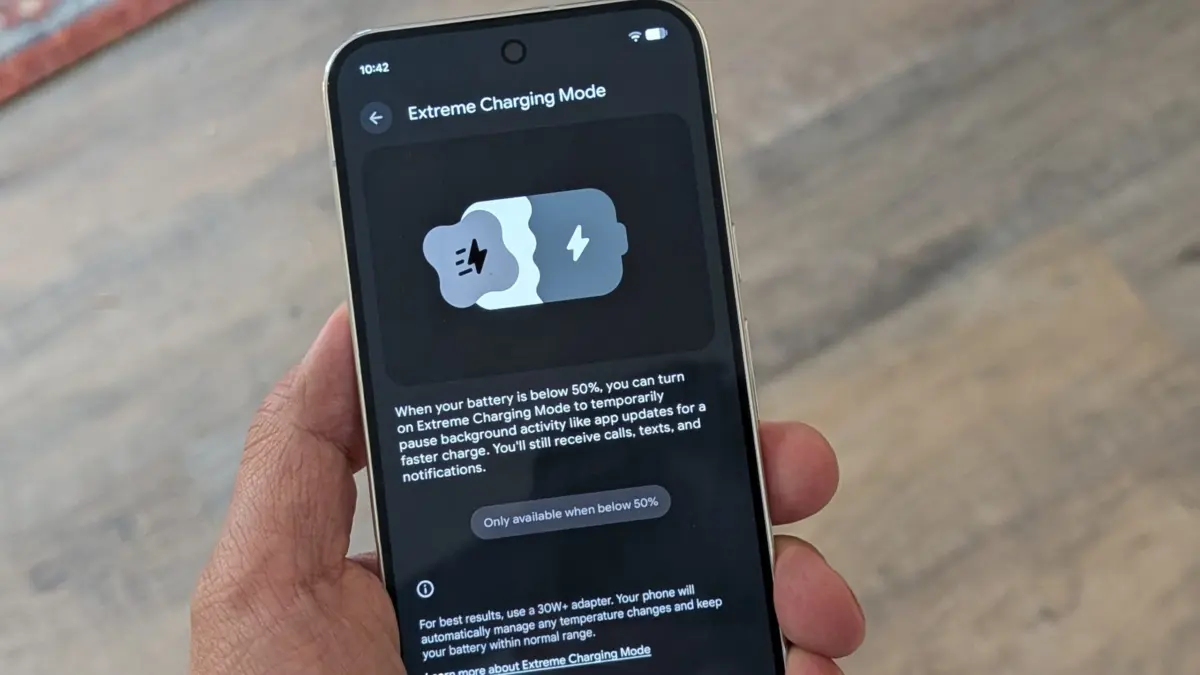
Charging speeds have long been a metric where Google lagged behind its international competitors, such as Xiaomi and OnePlus. The Pixel 11 series addresses this with "Extreme Charging Mode." This mode is an aggressive power management state that prioritizes the battery’s intake of electricity over all other system functions. When enabled, the device pauses background syncs and throttles non-essential applications to minimize internal heat generation during the charging cycle.
Official data from Google indicates that this mode allows the Pixel 11 Pro XL to reach a 75% charge in just 30 minutes, provided the user is using a compatible 45W or higher USB-C PD charger. There are, however, specific operational parameters: the mode is only available when the battery level is below 50%. This is because lithium-ion batteries can safely accept a higher current when they are depleted, whereas the charging rate must "trickle" as the battery nears capacity to prevent chemical degradation. Users must enable this in the "Battery & Charging" menu, after which it becomes a toggleable shortcut in the Quick Settings tray.
5. Hardware Personalization: The HiLight Notification System
In a surprising hardware pivot, Google replaced the thermometer sensor found on previous Pro models with a multi-functional LED array known as "HiLight." This feature is integrated into the rear camera bump and serves as a visual communication tool. While some initial reviews labeled it a gimmick, its utility in professional and social settings is becoming clear.
The HiLight system allows for color-coded notifications. By assigning specific colors to individual contacts, a user can determine the importance of an incoming call or message simply by looking at the back of the phone. This is particularly useful when the device is placed face-down on a table during meetings—a practice often used to signal attentiveness to others. Furthermore, the HiLight serves as a status indicator for Gemini, pulsing when the AI is processing a request. This provides a non-intrusive way to monitor background tasks. Customizing these colors in the contact settings is a small but impactful step in making the device feel more personal and less like a generic tool.
6. Information Management: Notification History and AI Summaries
Modern smartphone users are often overwhelmed by a "notification blizzard," leading to the accidental dismissal of important alerts. The Pixel 11 Pro XL introduces a two-pronged solution to this problem: Notification History and AI Summaries.
Notification History, which is disabled by default, maintains a 24-hour log of every alert that has hit the device. This serves as a fail-safe for users who reflexively swipe away notifications. More impressively, the AI Notification Summaries feature leverages on-device Gemini Intelligence to condense long threads of messages—such as those from group chats or Slack—into concise bullet points. This allows the user to grasp the context of a conversation without reading every individual message.
Because these summaries are processed on-device, Google emphasizes that user privacy is maintained, as the data does not need to be sent to the cloud for analysis. Enabling these features in the "Notifications" menu significantly changes the user’s relationship with their device, moving from a reactive state of answering pings to a proactive state of managing information.
Market Impact and Future Implications
The necessity of these manual adjustments highlights a growing trend in the smartphone industry: the "Pro" moniker increasingly refers to a device’s potential rather than its default state. As mobile technology becomes more sophisticated, the gap between "safe" factory settings and "optimal" user settings continues to widen.
For Google, the Pixel 11 Pro XL represents a successful marriage of hardware and AI, but it also places more responsibility on the consumer to understand their device. Analysts suggest that future iterations of Android may use AI to automatically suggest these optimizations based on a user’s behavior—for instance, prompting a switch to "Max resolution" if the user frequently opens e-book applications.
In the broader context of the 2025-2026 smartphone market, the Pixel 11 Pro XL’s emphasis on customized photography and AI-driven utility positions it as a strong competitor to the iPhone 17 and Samsung Galaxy S26 series. By taking the time to configure these six essential settings, users ensure that they are not just owning a flagship device, but are actually experiencing the flagship performance they paid for. As the holiday season approaches and Black Friday deals make the device more accessible, understanding these technical nuances will be the key difference between a standard user experience and a truly "Pro" one.
